Poland strengthens its role in the Baltic-Black-Aegean corridor
Investment prospects within the Trans-European Transport Network (TEN-T) were at the center of discussions between Deputy Minister of Infrastructure Piotr Malepszak and Mario Mauro, the European Coordinator for the Baltic–Black–Aegean Sea Transport Corridor.
logistics worldwide politics transport and forwarding news22 october 2025 | 16:09 | Source: Gazeta Morska | Prepared by: Kamil Kusier | Print
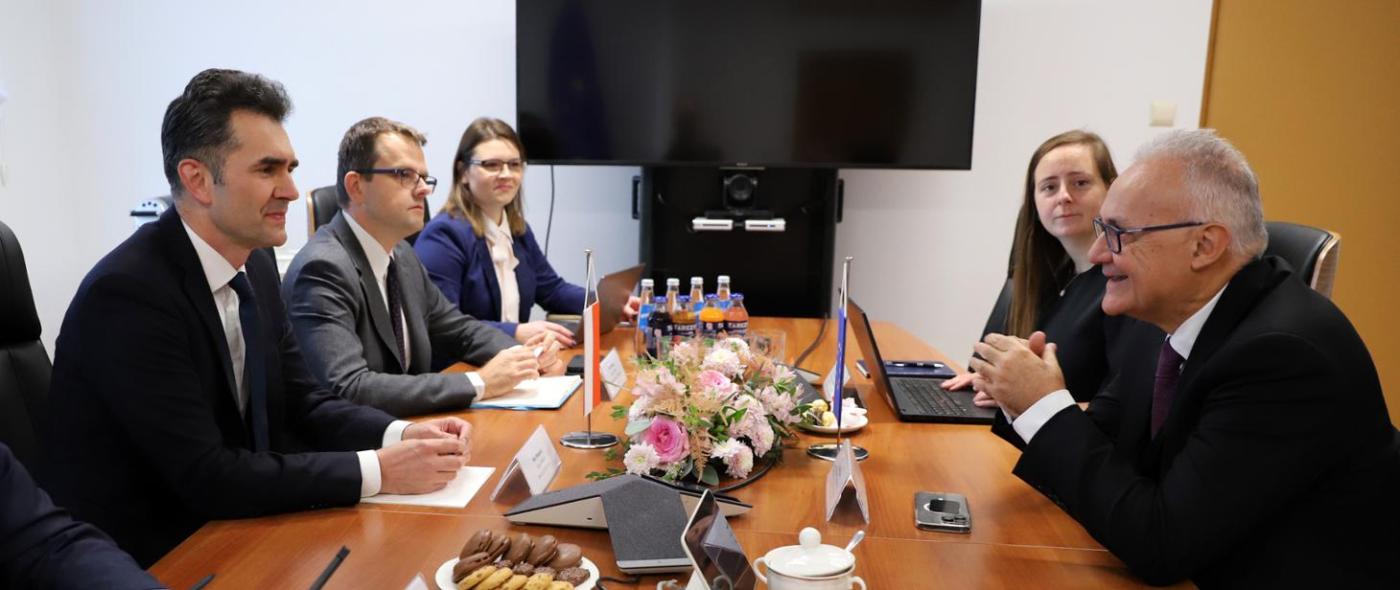
fot. Ministerstwo Infrastruktury
The corridor, formally established under the EU Regulation 2024/1679, came into force on 18 July 2024 as part of the renewed TEN-T framework. It connects northern, eastern, and southern Europe — from the Baltic Sea to the Black and Aegean Seas — strengthening links between ports, rail, and multimodal infrastructure across the continent.
The TEN-T policy aims to create a multimodal transport network integrating rail, road, inland waterways, and short-sea shipping, linking major urban nodes, seaports, inland ports, airports, and terminals within the EU and beyond.
— We see this corridor not only as an element that strengthens economic ties and prosperity within the EU. In the face of Russia’s aggression against Ukraine, we need a high level of interoperability on the eastern flank of the EU and NATO, along with dual-use investments in transport infrastructure. Poland is steadily modernizing its transport system, moving toward the new TEN-T parameters on schedule — said Deputy Minister Piotr Malepszak.
Malepszak underlined that the corridor’s development is fully aligned with Poland’s transport priorities — the growth of seaports, revitalization of the railway network, and the Central Communication Port (CPK) project, which will serve as a major hub for both Poland and Europe, enhancing connectivity across the TEN-T network.
The Baltic–Black–Aegean Sea Corridor is becoming not only a key economic axis, but also a strategic component of Europe’s transport security — a new infrastructure backbone of the continent’s eastern flank.
Buy us a coffee, and we’ll invest in great maritime journalism! Support Gazeta Morska and help us sail forward – click here!
Kamil Kusier
redaktor naczelny
comments
Add the first comment
see also
Swedish ports record lowest ship calls in 18 years. Implications for the maritime sector
First month of Jantar Unity operations. Polsca ferry paves the way for Batory program units
Hapag-Lloyd to acquire ZIM for $4.2bn: strategic consolidation in the container shipping market
Baltic Sea water levels at a record low: a meteorological-oceanographic anomaly with major implications
Poland as Europe’s food hub. Minister Stefan Krajewski on export, security, and global competition
Gdańsk - Karlshamn ferry route strengthens Baltic shipping network
Ukraine maintains a safe maritime corridor amid ongoing war
Connecting Poland with Sweden for 50 years: Polferries on the Baltic, past, present, and future of shipping
Port of Gdynia surpasses 1 million TEU for the first time in history
ORP Czernicki strengthens logistical capabilities of NATO’s SNMCMG1 at sea
ADVERTISEMENT
ADVERTISEMENT