Connecting Poland with Sweden for 50 years: Polferries on the Baltic, past, present, and future of shipping
Polska Żegluga Bałtycka, better known as Polferries, celebrates its 50th anniversary in 2026. Founded in 1976, the company has played a crucial role in the development of ferry transport in the Baltic region, particularly linking Poland with Sweden. Over the past five decades, Polferries has become a key player not only in passenger transport but also in cargo logistics. This milestone anniversary is not only a time for reflection but also for announcing new investments aimed at further expanding the company and improving service quality in the maritime industry.
business maritime economy logistics pomerania west pomerania ports transport and forwarding tricity news31 january 2026 | 23:47 | Source: Gazeta Morska | Prepared by: Kamil Kusier | Print
fot. Polska Żegluga Bałtycka
The beginnings of Polferries: the 70s
Polska Żegluga Bałtycka was established on January 31, 1976, as the third national shipping company in Poland, following the establishment of Polskie Linie Oceaniczne (PLO) and Polska Żegluga Morska (PŻM). Initially, the company’s headquarters were located in Kołobrzeg, a decision that sparked debates at the time. Despite the lack of significant maritime traditions in Kołobrzeg compared to other Polish ports like Gdańsk or Gdynia, the location offered great tourism potential, and the personal connections of the then-Prime Minister Piotr Jaroszewicz to the city played a role in this decision.
The company’s first ferry, m/s Ruciane, began service in 1976, followed by the acquisition of several passenger-car ferries from PLO, including the vessels Gryf, Skandynawia, Wawel, and Wilanów in 1977. This marked the beginning of an era of rapid expansion for Polish ferry transport.
Investment and growth
During the 1980s, Polferries significantly expanded its fleet and service offerings. By 1981, the company operated six passenger ferries and 17 cargo vessels. In the mid-1980s, the company employed more than 3,500 people and had become one of the largest employers in the region. A landmark investment was the construction of the ferry terminal in Świnoujście, which was completed in 2000.
Over the years, Polferries underwent restructuring processes to adapt to the changing political and economic environment. The company's fleet was modernized, and new routes were introduced to meet the growing demand for both passenger and cargo services. The company’s focus on efficient operations and customer satisfaction helped it survive and thrive despite several challenges, including economic transitions and financial crises.
50 years of Polferries - achievements and future plans
Over the past five decades, Polferries has transported 18 million passengers, 5 million cars, and 3 million trucks, becoming a vital link for trade and tourism between Poland and Scandinavian countries. These numbers speak to the company’s success and enduring impact on the development of mobility and economic cooperation in the Baltic region.
To celebrate its 50th anniversary, Polferries has planned several events throughout 2026, with the main celebrations taking place on January 31, aboard the Nova Star ferry. The company is also introducing new initiatives and attractions for passengers, with continued investments in fleet development and service improvements.
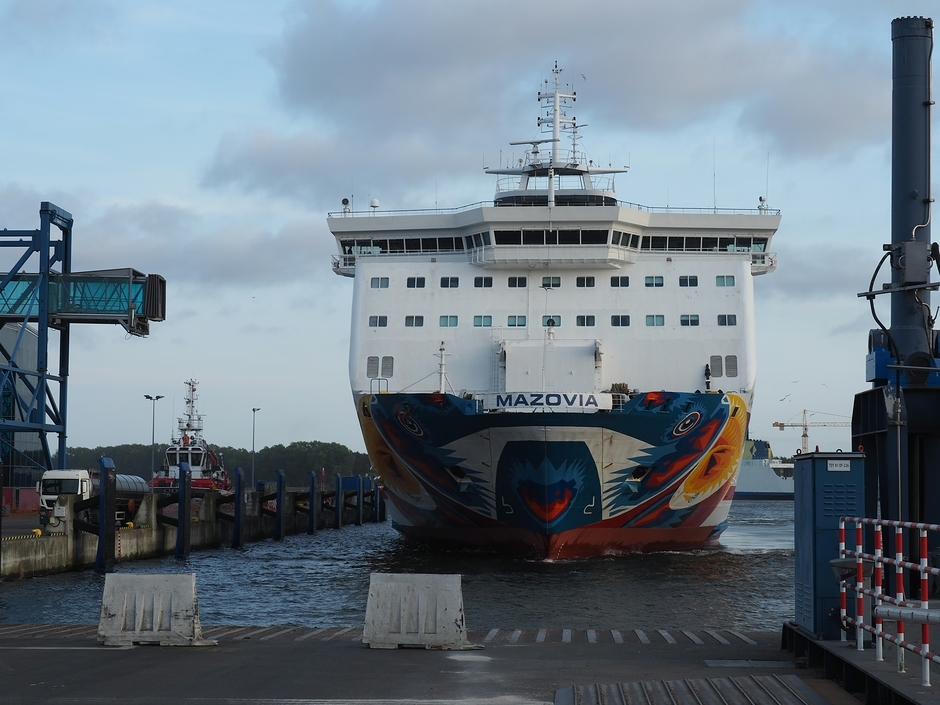
In 2015, Polferries introduced the m/f Mazovia, which became known for the artistic bow painting created by Mariusz Waras. The ferry was later joined by the m/f Cracovia, which underwent extensive modernization, including the addition of a stunning mural depicting a whale. This modernized vessel has been deployed for Mediterranean services as part of a charter arrangement.
Fleet and services of Polferries
Today, Polferries operates a modern fleet of ferries serving both passenger and cargo routes. The current fleet includes:
- m/f Varsovia - 216.2 meters long, 28.2 meters wide, carrying 976 passengers, 200 cars, and 150 trucks. Built in 2024 at Cantiere Navale Visentini in Italy.
- m/f Nova Star - 161 meters long, 25.6 meters wide, with a capacity of 827 passengers and 1,575 meters of cargo space for trucks and 1,215 meters for cars. Built in 2011 at ST Marine in Singapore.
- m/f Mazovia - 168 meters long, 27.7 meters wide, offering space for 1,000 passengers and 2,620 meters of cargo space (140 trucks or 600 cars). Built in 1996 in Indonesia, extensively modernized in 2012 and 2014.
- m/f Wawel - 163.96 meters long, 27.63 meters wide, with a capacity for 1,000 passengers, 310 cars, and 50 trucks. Built in 1980 at Kockums Varv AB in Malmö, Sweden.
- m/f Cracovia - 180 meters long, 24.3 meters wide, with space for 650 passengers, 64 cars, and 98 trucks. Built in 2002 at IZAR Construcciones Navales in Spain, and modernized in 2017 at Szczecin Shipyard in Poland.
Polferries currently operates key routes such as:
- Gdańsk - Nynäshamn (m/f Nova Star, m/f Wawel)
- Świnoujście - Ystad (m/f Varsovia, m/f Mazovia)
A new chapter for Polferries
As part of its 50th anniversary celebrations, Polferries is entering a new chapter in its history. The company has announced a strategic collaboration with Polska Żegluga Morska (Unity Line) and Hass Holding, creating a new Polish shipping entity called Polsca. The first ferry under this new brand, m/f Jantar Unity, was launched on January 17, 2026, and is already operating on the Świnoujście - Trelleborg route.
The company’s 50th anniversary is a moment to reflect on the progress made over the last five decades, but it is also a springboard for the future, with further plans for expansion and modernized services to strengthen Poland’s position in the international maritime sector.
Buy us a coffee, and we’ll invest in great maritime journalism! Support Gazeta Morska and help us sail forward – click here!
Kamil Kusier
redaktor naczelny
comments
Add the first comment
see also
Port of Gdynia surpasses 1 million TEU for the first time in history
Poland’s nuclear project secures landmark financing as PEJ signs first loan agreement with US EXIM
Shipbuilding industry is awesome. Stability. When shifting mass takes control away
Ellerman City Liners launches BALTEX service, positioning Port of Gdynia at the heart of the Baltic network
Port of Gdańsk posts strong 2025 performance as liquid fuels dominate and container volumes hit record high
UK sets offshore wind auction record. Offshore beats gas and nuclear on price
Agata Staniewska-Bolesta appointed Country Manager of Ørsted Poland
NHV launches helicopter base in Gdańsk to support Baltic offshore wind sector
POLSCA S.A. officially launched as Polish ferry operators consolidate on the Baltic Sea
Robert Lewandowski becomes Sunreef Yachts ambassador, orders 80-foot power catamaran built in Poland
ADVERTISEMENT
ADVERTISEMENT