A record year for the Port of Gdańsk. 2024 closed with a record financial result
Strong Ports Mean a Strong Maritime Economy. This is evident in the case of the Port of Gdańsk. Poland's largest seaport continues to grow, achieving impressive results. In 2024, it handled 3,559 commercial sea vessels and transshipped 77.4 million tons of cargo. The port also generated a record net profit estimated at approximately 264 million PLN.
ports tricity news22 january 2025 | 14:00 | Source: Port Gdańsk / Gazeta Morska | Print
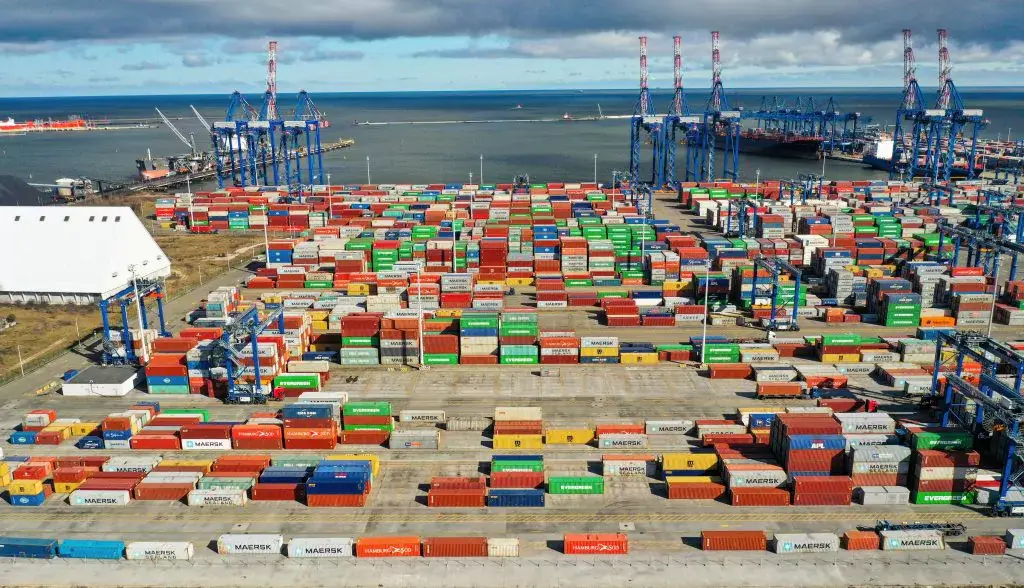
fot. Port Gdańsk
Strong ports build a strong maritime economy
The Port of Gdańsk, Poland’s largest seaport, continues to demonstrate robust growth and outstanding results. In 2024, the port serviced 3,559 commercial sea vessels, handling 77.4 million tons of cargo. It also recorded a net profit estimated at approximately 264 million PLN, marking a historic high.
Significant growth across cargo categories
2024 was a year of remarkable increases in liquid fuels (up by over 1.8 million tons, nearly 5%) and general cargo (up by approximately 430,000 tons, nearly 2%). Container throughput saw an impressive 10% rise, while ore shipments increased by 28,000 tons (11%). Roll-on/roll-off (Ro-Ro) cargo also grew by 3.6%. Additionally, passenger traffic, including cruise ships and ferries, rose by 4.5%.
When coal—a category that saw extraordinary volumes in 2022 and 2023—is excluded, total cargo throughput amounted to 69.5 million tons, reflecting an improvement of nearly 2 million tons (2.8%) compared to the previous year.
A changing cargo landscape
Since Russia's invasion of Ukraine in February 2022, shifts in cargo structures have been evident across Polish ports. The energy market crisis has driven increases in bulk dry and liquid cargoes, which now dominate port operations.
In 2024, liquid fuels remained the leading cargo group at the Port of Gdańsk, accounting for nearly 40 million tons—51% of total throughput. General cargo, including containers, ranked second at 30.2% (23.4 million tons), with container operators like the Baltic Hub Container Terminal handling 21 million tons (2.25 million TEU). Coal throughput reached 7.8 million tons (10.2%), followed by aggregates and sulfur at 3.5 million tons (4.5%) and grain at 2.9 million tons (3.7%).
The port also handled larger commercial vessels in 2024, with an average GT (gross tonnage) of 25,025—1.6% higher than in 2023. Additionally, 60 cruise ships (18 more than in 2023) and 293 ferries (6 fewer) called at the port during the year.
Sustainable growth and strategic development
“We have achieved a stable and balanced financial and investment position, which significantly supports the business strategies of our partners and the results of the Port of Gdańsk,” said Dorota Pyć, CEO of the Port of Gdańsk. “Our ongoing investments and efforts to commercialize unused areas, along with continuous improvements in management procedures, ensure our competitiveness and strong financial performance, even in challenging times.”
The port has also initiated work on its Development Strategy 2060, aiming to position itself as a sustainable hub within the blue and green economy.
Financial stability and future investments
Preliminary data indicates that the Port of Gdańsk closed 2024 with a financial result of approximately 264 million PLN—51.7 million PLN (24%) higher than in 2023. This growth was driven by a nearly 6% year-on-year increase in revenue and a 3% reduction in costs, including sales expenses.
“The financial condition of the Port of Gdańsk Authority S.A. remains very strong, with liquidity maintained at a stable and rational level,” noted Alan Aleksandrowicz, Vice President for Finance and Security. “Net sales profitability is estimated at nearly 49%, an improvement over last year. Our financial position is continuously analyzed to support long-term investments in port infrastructure, ensuring sustainable growth and operational efficiency.”
Daniel Nawrocki
redaktor
gallery
comments
Add the first comment
see also
Swedish ports record lowest ship calls in 18 years. Implications for the maritime sector
Evening SAR operation in the Baltic. Two kitesurfers stranded offshore
Gdańsk port’s Basen Górniczy to gain modern port infrastructure
Medical evacuation from sailing ship in Gdynia port. 17-year-old safely transported
Baltic Sea water levels at a record low: a meteorological-oceanographic anomaly with major implications
Gateway to the Baltic: Elbląg Moves Forward with Modular, Multimodal Port Expansion
Gdynia at 100: A Strategic port city celebrates its maritime identity
A city designed from the sea. one hundred years of Gdynia as a project ahead of its time
The Maritime Office in Słupsk returns: ministerial plenipotentiary to oversee reestablishment
Gdańsk - Karlshamn ferry route strengthens Baltic shipping network
ADVERTISEMENT
ADVERTISEMENT