Keel laid for Poland’s FSRU Terminal: a floating pillar of energy security takes shape
The keel laying of Poland’s future Floating Storage and Regasification Unit (FSRU) at HD Hyundai Heavy Industries’ shipyard in Ulsan, South Korea, marks a decisive milestone in one of Central Europe’s most strategically important energy infrastructure projects. With this step, the construction of the floating regasification vessel formally enters its core structural phase, transforming long-term energy policy objectives into tangible maritime assets.
business power engineering maritime economy investments worldwide pomerania ports shipbuilding industry tricity news02 january 2026 | 15:10 | Source: Gazeta Morska | Prepared by: Kamil Kusier | Print
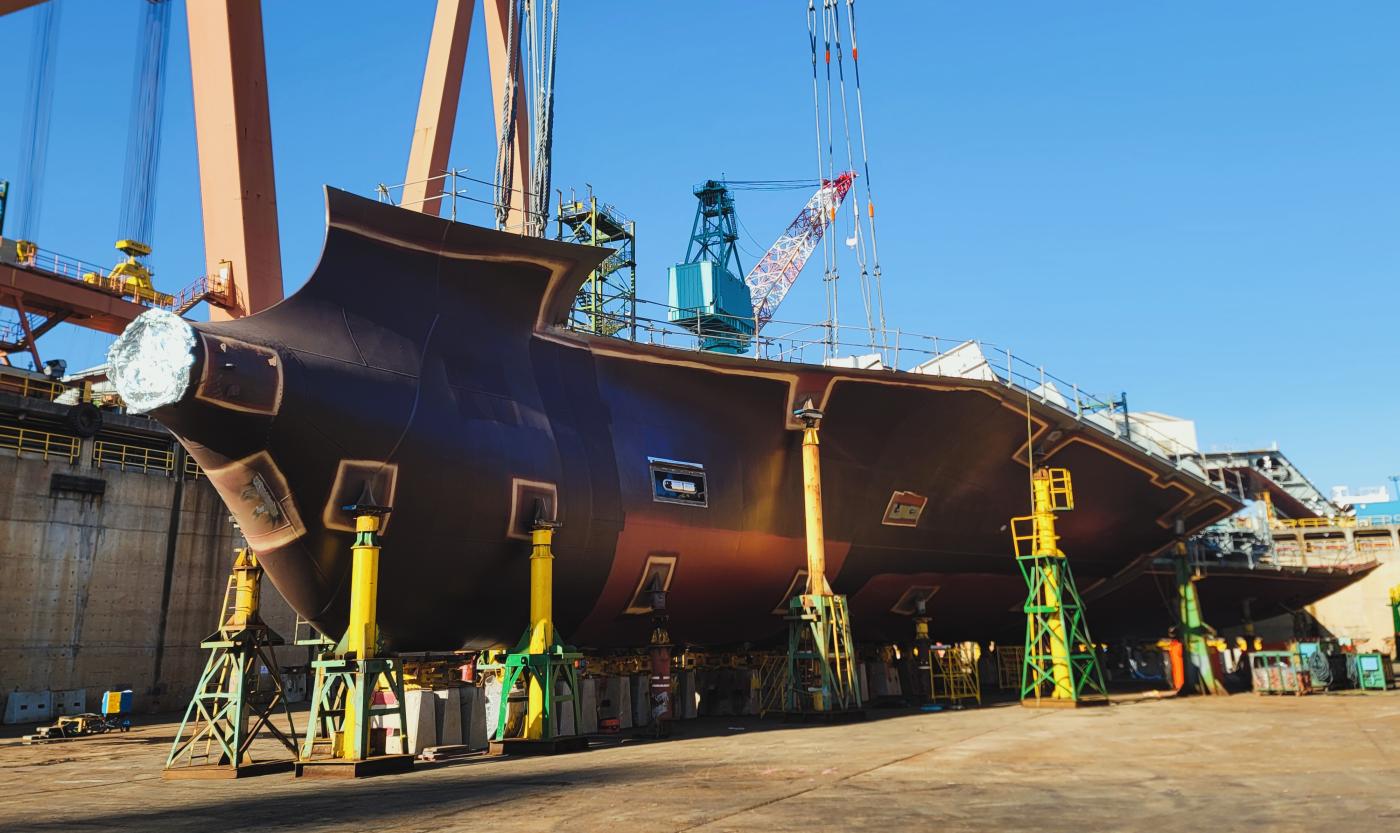
fot. Gaz-System
Weighing more than 50 tonnes, the keel is the vessel’s primary structural backbone, extending from bow to stern and forming the foundation upon which the hull and all major systems are assembled. In an FSRU, the keel plays a dual role: beyond providing structural integrity, it also functions as a stabilising ballast element, lowering the centre of gravity and ensuring safe operations during LNG storage, regasification and mooring.
According to GAZ-SYSTEM CEO Sławomir Hinc, the keel-laying ceremony represents a breakthrough moment in the delivery of a project that is fundamental to Poland’s energy security strategy. Once operational, the FSRU terminal in the Gulf of Gdańsk will significantly enhance supply diversification and position Poland as a regional gas hub serving Central and Eastern Europe.
The floating terminal will have the capacity to receive, store and regasify more than 6 billion cubic metres of natural gas annually. LNG cargoes delivered from any global source will be regasified offshore and injected directly into Poland’s national transmission system, increasing resilience against supply disruptions and geopolitical volatility.
The vessel will be chartered by GAZ-SYSTEM from White Eagle Energy Ltd., a subsidiary of Japan’s Mitsui O.S.K. Lines, under a 15-year agreement with options for extension and purchase. Construction is being carried out by HD Hyundai Heavy Industries, one of the world’s leading shipbuilders. The next major milestone in the shipbuilding programme will be the vessel’s launching, scheduled for late April 2026.
Onshore works in Poland are progressing in parallel. Preparations are underway for microtunnelling operations on the Gdańsk coastline, dredging and land reclamation works continue, and the Gdańsk–Gustorzyn gas pipeline is nearing completion, with commissioning planned for the fourth quarter of 2026. Full operational start-up of the FSRU terminal is expected in 2028.
The project is also supported by European funding mechanisms. In June 2025, GAZ-SYSTEM secured a PLN 2.2 billion loan from Bank Gospodarstwa Krajowego, financed under Poland’s National Recovery and Resilience Plan, to support the onshore pipeline infrastructure. The investment aims to strengthen national energy security, improve economic resilience and support post-pandemic recovery.
More than a maritime construction project, the FSRU in the Gulf of Gdańsk represents a long-term strategic asset — a floating gateway linking global LNG markets with Poland and the wider region, and a cornerstone of Europe’s evolving energy landscape.
see also
Buy us a coffee, and we’ll invest in great maritime journalism! Support Gazeta Morska and help us sail forward – click here!
Kamil Kusier
redaktor naczelny
comments
Add the first comment
see also
StartupHack 3.0 at GPNT: Space and maritime technologies at the core of innovation
Polish technology powers zero-emission public transport. AREX secures largest municipal contract
Defence.Hub strengthens capabilities in technologies supporting maritime infrastructure security
Hanseatic Global Terminals takes full ownership of Florida International Terminal
Aleksandra Kosiorek: The sea has always been a space of openness for us, and that will not change
Gdańsk to launch Baltic Sea monitoring center
Türkiye advances indigenous GNSS ambitions: what FGN-100-D3 means for the maritime sector
Lithium at the core. TKMS and E3 Lithium align on Canada’s submarine ambitions
Błażej Konkol appointed vice president for infrastructure at the Port of Gdańsk Authority
WB Group expands into Romania, strengthening presence in the Black Sea region
ADVERTISEMENT
ADVERTISEMENT