









StormRider 850 tests Gdynia naval base defences in Polish Navy drone boat exercise
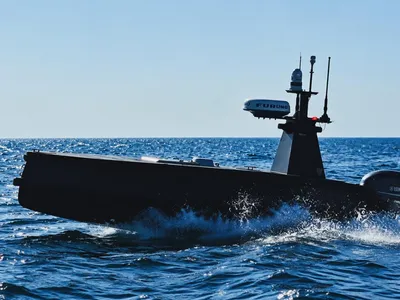
In one episode of exercise Dzielny Okoń-26, run by the Polish Navy as part of the wider Czarny Obrońca-26 exercise series, the defenders of the Gdynia naval base repelled a simulated attack by an uncrewed surface vessel tasked with breaking through the port's defences and disrupting the base. The attack was simulated by StormRider 850, an 8.5-metre, 3.5-tonne craft built by Polish defence group WB Group. The Polish Navy used a domestic design in the same size and range class as the uncrewed boats the Royal Navy ordered this year to rehearse defence against a threat that has reshaped the Black Sea and now sits high on the Allied planning agenda in the Baltic.

In brief
Grupa WB's StormRider 850 uncrewed surface vessel simulated an attack on Naval Port Gdynia during the Polish Navy exercise Dzielny Okoń-26, part of the Czarny Obrońca-26 exercise federation. The Polish Navy presented the episode's scenario on 19 September, and the port's defenders simultaneously ran a full air defence procedure. StormRider 850 is 8.5 metres long, weighs 3.5 tonnes and has a range of around 500 kilometres. Kongsberg signed an agreement with Grupa WB in September on joint development of uncrewed surface vessels.
The Gdynia scenario
The Polish Navy described the episode on its social media channels on 19 September. The defenders of the Gdynia naval base had to repel an attack by a small, fast and hard-to-detect surface craft whose task was to approach the port, force its defences and disrupt the base. In parallel with the surface threat, the forces taking part activated the full air defence procedure for the port.
Dzielny Okoń-26 is part of a broader programme of Polish Navy activity during Czarny Obrońca-26. Alongside countering drones attacking ports and naval groups, the manoeuvres covered live firing and mine countermeasures. The threat picture was therefore complete, with the attacker coming from the surface, the air and below the water, and the defender forced to split resources across all three.
Using a real uncrewed boat to simulate the threat has practical value. Radar, electro-optical and gun crews trained against an object with the actual radar signature, speed and movement profile of a craft of this class, rather than against a towed target or a computer simulation.
The domain that changed the Black Sea
Uncrewed surface vessels, or USVs in NATO terminology, were for years used mainly for reconnaissance, hydrography and mine countermeasures. The war in Ukraine changed that within months. Magura V5 drones developed by Ukraine's military intelligence service HUR, and Sea Baby craft operated by the Security Service of Ukraine, became the main tools with which Kyiv undermined the dominance of Russia's Black Sea Fleet.
The best-known series of strikes came in early 2024. In February, Magura drones sank the missile corvette Ivanovets on Lake Donuzlav and, days later, the large landing ship Tsezar Kunikov off Alupka. On 5 March they sank the Project 22160 patrol ship Sergey Kotov near the Kerch Strait. Sergey Kotov was one of the newest ships in the Black Sea Fleet, valued by Ukraine at 65 million dollars, and had already been attacked in August 2023 and damaged in September 2023.
A HUR representative told Deutsche Welle in August 2024 that Magura drones had hit 18 Russian naval vessels during the war, and the Ukrainian military estimated at the time that it had destroyed or disabled around 30 percent of the Black Sea Fleet. According to available data, Magura V5 reaches about 80 km/h and carries a payload of up to 320 kilograms. Set against a warship worth tens of millions of dollars, the cost equation is devastating for the defender.
Why a port is the hardest place to defend
The Black Sea showed that a drone boat is most dangerous where a warship is least mobile: alongside, in the roads and at anchor. A ship tied up at the quay cannot manoeuvre, and its own defensive systems are often switched off or only partly manned. For the attacker it is a fixed target at a known position, reachable from the water through the harbour entrance.
The drone itself is hard to detect for several reasons at once. It has a low profile and a small radar signature, moves at high speed, and on a rough sea its radar return easily disappears into sea clutter. At night or in poor visibility, visual observation is of little use, and the time from detection to impact is measured in minutes.
Port defence therefore has to be layered, combining early radar and electro-optical detection, physical barriers at basin entrances, weapons able to engage small and agile targets quickly, and procedures that separate a threat from normal civilian traffic in neighbouring commercial ports. In Gdynia that last element matters, because the naval base sits next to one of the largest commercial ports on the Baltic.
The Baltic, cables and Task Force X
In the Baltic, interest in uncrewed surface vessels stems first from a series of incidents involving undersea infrastructure between September 2022 and December 2024. In response, NATO formally launched Baltic Sentry at a summit in Helsinki in January 2025, built largely around Standing NATO Maritime Group 1.
In parallel, Allied Command Transformation launched Task Force X Baltic to speed up the introduction of uncrewed maritime systems into NATO forces. In June 2025 the Alliance fielded more than 70 air, surface and subsurface systems in the Baltic for reconnaissance patrols, choke-point monitoring and surveillance of undersea infrastructure, with the uncrewed fleet operating at one third of the cost of comparable coverage by crewed frigates.
In February 2026 eight countries, including Poland, signed a letter of intent to move Task Force X Baltic into a second phase, shifting from experimental fleets to nationally owned capabilities that NATO can task for persistent coverage of the Baltic. StormRider has already been part of that process. In July 2026 it took part in a Task Force X demonstration alongside the Polish frigate ORP Kościuszko, with its sensor data shown live at the NATO summit in Ankara.
StormRider 850 and 550
StormRider 850 debuted at the MSPO defence exhibition in Kielce in 2025 as an uncrewed reconnaissance and strike craft for maritime and coastal operations. It is 8.5 metres long, weighs 3.5 tonnes, is powered by a Volvo Penta diesel with a waterjet and has a range of about 500 kilometres. The hull draws on Poland's yacht-building industry, and WB Group is developing the platform together with Polish Navy specialists.
The sensor fit includes a navigation radar, sonar, echo sounder and electro-optical turret. The craft can carry Warmate loitering munitions in TL-R and TL-C variants, or the ZMU-05N remote weapon station with a heavy machine gun. WB Group lists the protection of roads, ports, anchorages and critical maritime infrastructure, counter-sabotage operations and force protection among its main tasks. This year StormRider 850 received the Defender 2026 award at MSPO.
At the same exhibition WB Group showed the smaller StormRider 550, a simpler and cheaper 5.5-metre craft. It reaches about 30 knots and can operate autonomously on patrol for more than 24 hours. It comes in a high-profile variant for long patrols and a low-profile variant with a smaller radar signature and higher speed for combat or training use, and can also be used for bathymetric survey and underwater object search. Both variants share the StormRider 850 control interface, and WB Group spokesman Remigiusz Wilk has said the 550 may be the first to enter Polish Navy service, for training.
In the same league as the Royal Navy's new drone boats
The most useful benchmark for StormRider 850 is the British Kraken K3 Scout. In March 2026 the Royal Navy ordered 20 of these craft for 12.3 million pounds for the Coastal Forces Squadron and 47 Commando Royal Marines, after a competition involving twelve bidders, among them BAE Systems, Kongsberg and L3Harris. Series production is under way at the Blohm+Voss yard in Hamburg under the Rheinmetall Kraken joint venture.
The two designs are closely matched. K3 Scout is 8.4 metres long with a maximum displacement of 2.5 tonnes, carries 600 kilograms of payload and has a range of about 650 nautical miles at 25 knots. StormRider 850 is 8.5 metres long, weighs 3.5 tonnes and has a range of about 500 kilometres. Both have been shown within NATO's Task Force X, the programme in which the Alliance tests uncrewed systems before integrating them into its standing naval forces.
More broadly, the segment is defined by designs that have moved from prototype to use. Turkey's ULAQ, built by Ares Shipyard and Meteksan for the Turkish and Qatari navies, is 11 metres long, has a range of about 400 kilometres and carries Roketsan missiles. StormRider 850 sits within the same bands of size, range and reconnaissance and strike roles.
What sets the Polish design apart is the completeness of a single supplier's ecosystem. WB Group provides not only the hull and propulsion but also its own Warmate loitering munitions that can be launched from the deck, a remote weapon station with its own optics and integration with the TOPAZ command system. The loitering munition extends strike reach well beyond the range of the boat's own guns.
The choice of partner points the same way. Kongsberg, one of Europe's largest maritime systems suppliers and one of the bidders in the British competition, signed an agreement with WB Group in September to jointly develop uncrewed surface vessels, naming StormRider 850 as one of the core projects. The difference from the British rival today lies in the stage of adoption. K3 Scout already has a Royal Navy contract, while StormRider 850 has completed sea trials and moved into its next test phase, which now includes exercises with the Polish Navy.
Partners in Norway and Canada
Two foreign agreements signed at MSPO in September underpin the development of the StormRider family. The agreement with Kongsberg covers joint development of uncrewed maritime platforms with multi-sensor imaging and electronic reconnaissance and the integration of weapon modules. WB Group President Piotr Wojciechowski said the partners intend to design and build both larger and smaller craft together for European markets.
The second agreement, with Canadian boatbuilder Rosborough Boats, which has supplied the Royal Canadian Navy, covers an assessment of Canadian hulls for the further development of the StormRider system and possible deliveries to European and North American markets. Both follow the same logic. Autonomy, data links, command software and operator training transfer between platforms far more easily than hull design and propulsion, so the system developer looks for partners with shipbuilding and sensor experience.
A drone boat on both sides of the exercise
The Gdynia episode showed StormRider in a role that had mostly been discussed in theory. A craft designed to protect ports and infrastructure simulated an attack on one, and its behaviour became training material for the defenders. That use has real market value, because navies preparing to defend against drone boats need a realistic way to simulate the threat, and not all of them have access to Black Sea experience.
Both roles come from the same domain. A craft that can approach a base unseen can also patrol its approaches unseen, and the sensors that help it avoid detection also help it detect others. For the Polish Navy, rehearsing defence and building its own uncrewed capability are in practice one process viewed from two sides.
Following its February letter of intent on Task Force X Baltic, Poland is expected to contribute its own uncrewed systems to persistent surveillance of the Baltic. Dzielny Okoń-26 showed that a domestic platform of this class is already operating in the Gulf of Gdańsk, working with Polish warships and allowing Polish crews to rehearse defence against a threat known until now mainly from the Black Sea.
Source: Gazeta Morska · Compiled by: Kamil Kusier
Related articles
 Equipment and technology A Gdynia company supplies the brain of Poland's counter-drone shield. The state wants to protect it from takeover
 Navy and defence Convoys return to the Baltic. An exercise showed how hard it is to shield merchant ships from an uncrewed attacker
 Navy and defence REPMUS 26 off Tróia. Four weeks of uncrewed systems testing with 36 navies taking part
 Safety and rescue Three hundred metres and 42 seconds. A Russian Mi-8 crossed into Polish airspace near Braniewo
 Ports and logistics 74 unauthorised drone flights over the Port of Gdańsk. Fines of up to 24,000 zloty, confiscation and prison
 Equipment and technology Naval drones changed the war at sea. Magura, Sea Hunter, Sounder and Poland's StormRider in the race
Comments (0)
The discussion is moderated by the editors: a comment appears after review. Your e-mail address is not published.
Nobody has commented on this article yet.