









A Gdynia company supplies the brain of Poland's counter-drone shield. The state wants to protect it from takeover
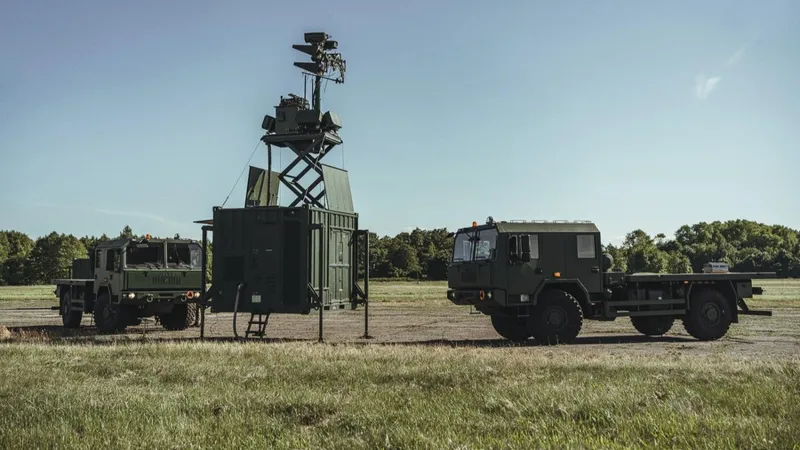
The SAN programme, intended to build the largest counter-drone system in Europe, rests on two elements supplied by a company from Gdynia. Advanced Protection Systems provides its detection layer, based on the firm's own radars, and the SAN View command and control system, which fuses data from every sensor into a single picture.
In brief
Gdynia-based Advanced Protection Systems is supplying FIELDctrl radars and the SAN View command and control system to the SAN programme. The Armament Agency signed the contract for 18 SAN batteries in January with the PGZ and Kongsberg Defence & Aerospace consortium, worth about PLN 15 billion net, covering surveillance of 186 kilometres of border. The Ministry of National Defence has drafted a regulation placing APS under protection of the act on the control of certain investments. Advanced Protection Systems has announced investments of around PLN 100 million, including a new production hall.
In parallel, Poland's Ministry of National Defence has drafted a regulation that would place APS under the protection of the act on control of certain investments. It is the mechanism used to shield companies of strategic importance for national security from uncontrolled takeover.
Together, the two facts describe something rarely discussed in Poland's debate about the defence industry. The key supplier in a programme worth billions of euros is neither a state-owned company nor a foreign group, but a privately held technology firm from Pomerania.
Eighteen batteries and 186 kilometres of border
The contract for battery modules of air defence systems capable of countering uncrewed aircraft was signed in January this year by the Armaments Agency with a consortium of the Polish Armaments Group and Norway's Kongsberg Defence & Aerospace. Financing comes from the EU's SAFE instrument.
The value is given in two ways: around 15 billion zloty net in the signing announcements, and 3.6 billion euros in APS materials. The programme covers 18 SAN batteries, and a 186-kilometre stretch of border is to be placed under intelligent surveillance. The first three fire platoons of the first battery are to reach the armed forces by the end of 2026.
SAN forms part of the East Shield programme and is described as securing the border not only of Poland but of the European Union. It is a layered structure: detection, identification and neutralisation of uncrewed aircraft, using both kinetic and non-kinetic effectors.
What the Gdynia company actually delivers
The first component is detection. APS supplies fully digital 3D radars using FMCW technology, from the FIELDctrl Ultra and FIELDctrl Follow families, designed to detect and classify LSS targets, meaning low, slow and small. That is the hardest category in air defence, because a micro drone has a minimal radar signature, moves slowly and can hover, and a conventional radar easily mistakes it for a bird or discards it as clutter.
The second component is the decision layer. SAN View, built on the company's CyView platform and adapted to border protection requirements, aggregates data from radars, thermal cameras and acoustic sensors into a common operational picture. Algorithms classify objects and separate birds from drones to reduce operator workload, while the system manages the use of effectors.
That second element matters more than it may appear. Counter-drone defence rarely lacks sensors or effectors. What it lacks is the layer that ties them together, cuts false alarms and lets an operator decide within seconds.
Transbit, the third Polish element at the core of the system
A radar that has detected a target and the system that has to decide what to do about it must talk to each other within a fraction of a second, often tens of kilometres apart and under deliberate jamming. In the SAN programme that layer belongs to Transbit, a Warsaw company with exclusively Polish capital, listed by the Prime Minister's office among the programme's Polish suppliers as responsible for communications equipment.
The company has close to forty years on the defence market and a team of around 160 people, specialising in military ICT systems and radio communications equipment. Its R-450A family of digital radio relay links has been the Polish Armed Forces' basic means of radio relay communications for more than twenty years; the military operates over 1,100 of them, including at 50 fixed communications nodes. Transbit also produces R-450C software defined broadband radios that form self-organising IP networks for mobile users, fitted among others to Rosomak vehicles and Krab howitzers, and together with Military Communications Works No. 1 in Zegrze builds the RWŁC-10T mobile digital communications nodes. It is also developing the R-460 radio relay link, designed with the Wisła air defence programme in mind.
In a system of 18 batteries, 18 command platoons and 52 fire platoons spread along 186 kilometres of border, communications are a condition of operation rather than an add-on. The air picture from FIELDctrl radars flows into SAN View, and from there the decision to use an effector returns to the fire platoon. Each of those links must be jam-resistant, encrypted and able to work without fixed infrastructure, because the battery is meant to be mobile. That is precisely the kind of network Transbit has been building for the military for years.
Detection, decision and communications, the three elements without which the system does not function, therefore come from domestic companies, while the platform and effectors come from the PGZ and Kongsberg consortium.
A dual-use system
APS materials contain a line that moves the programme beyond the purely military. SAN View is to serve as the information backbone for Border Guard officers, enabling real-time decisions.
That means the air picture along the border is to reach not only the military but also the service responsible for the border day to day, including in conditions below the threshold of war. The model matches what is happening on the eastern flank, where drone incidents mix with migration pressure, smuggling and hybrid activity.
For Pomerania there is a further conclusion. The same architecture, sensors plus a decision layer, is what protecting ports, fuel terminals, energy infrastructure and naval bases requires. Technology built today for the eastern border transfers directly to the coast.
A company that grew outside the state structure
Advanced Protection Systems began as a radar technology development project in 2015, founded by Maciej Klemm and Radosław Piesiewicz. It is headquartered in Gdynia, with a second office in Warsaw, employs close to 200 specialists including scientists, software engineers and hardware engineers, and develops its entire technology in-house, from radars to software.
Its SKYctrl system, based on FIELDctrl 3D MIMO radars, is used by the Polish and Ukrainian armed forces and by operators of critical infrastructure, including the Naftoport oil terminal in Gdańsk. The defence ministry earlier bought more than a dozen SKYctrl systems for around 150 million zloty. The company is also developing high power microwave modules designed to damage drone electronics with an electromagnetic pulse.
In 2023 the private equity fund Enterprise Investors took a significant minority stake. That matters to the wider picture, because private capital entered the company before it became a key subcontractor in a government programme.
A hundred million zloty and a new production hall
The contract is bringing investment with it. APS has announced spending of around 100 million zloty under the Kashubia Green Industrial District project, including a new production hall and several dozen additional specialists. The aim is to raise production capacity and expand engineering teams for orders arising from SAN.
It is a rare case in which a large defence contract translates directly into industrial investment in Pomerania rather than only into deliveries from abroad.
Why the state wants to protect a private company
In August this year the defence ministry entered into the government's legislative plans a draft regulation that would place Advanced Protection Systems and the Częstochowa steelworks under the protection of the act of 24 July 2015 on control of certain investments. The justification cites the protected activity of those companies, including the manufacture of weapons and technologies for military use.
The mechanism is simple. Acquiring a significant shareholding or taking control of a listed company requires notification and the consent of the supervising authority, and a transaction completed without it is void. It is a tool aimed at takeovers by capital from outside NATO and the EU, and at situations in which critical technology could leave the country along with the company.
It is worth noting that the available information concerns a draft regulation. Before relying on it, its adoption and publication should be confirmed.
A state platform with a private brain
The arrangement is unusual, and that is exactly why it deserves attention. The platform and battery modules come from a consortium of the state-owned Polish Armaments Group and Norway's Kongsberg, while the heart of the system, detection of difficult targets and the command layer, comes from a private Gdynia company employing two hundred people.
For the local content debate that is a strong argument. Poland's share in the programme is not limited to assembly or maintenance but covers software and sensors, the elements where most of the value is created and which are hardest to replace.
That is also precisely why ownership protection becomes necessary. A company supplying the brain of a system guarding 186 kilometres of border becomes part of the state's security architecture, regardless of who its shareholders are.
Source: Gazeta Morska · Compiled by: Kamil Kusier
Related articles
 Safety and rescue Polish SAR’s new rescue vessel Mistral launched at Kewatec in Finland
 Safety and rescue Icelandic Coast Guard and police delegation visits Polish Border Guard’s Maritime Division
 Safety and rescue Polish Navy helicopter evacuates man from Baltic platform 100 km off Władysławowo
 Navy and defence SNMG2 joins Allied warships in PASSEX as Italy's Mare Aperto 2026 gets under way
 Safety and rescue From lightships to solar power: 160 years of the Grundkallen light station
 Education 254 people, manikins and life rafts: Maritime University of Szczecin joins national CPR record attempt
Comments (0)
The discussion is moderated by the editors: a comment appears after review. Your e-mail address is not published.
Nobody has commented on this article yet.