









SNMG2 joins Allied warships in PASSEX as Italy's Mare Aperto 2026 gets under way
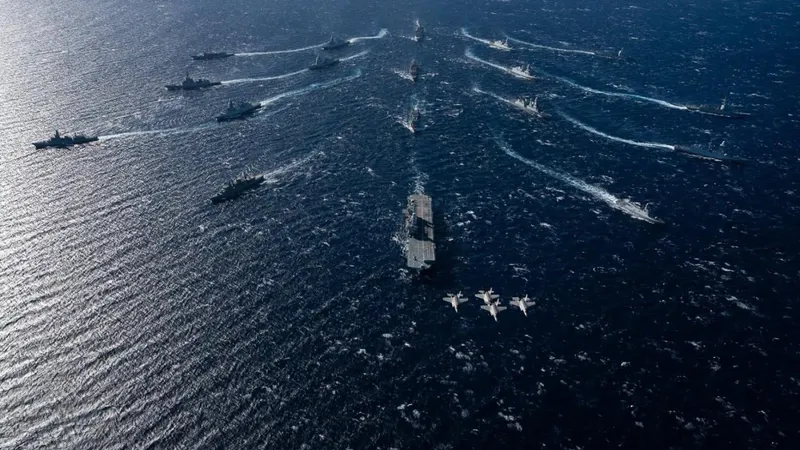
Ships of Standing NATO Maritime Group Two (SNMG2) joined warships from Allied and partner nations for a passing exercise (PASSEX) at the start of the autumn edition of Italy's Exercise Mare Aperto 2026. NATO Allied Maritime Command (MARCOM) released images of ships sailing side by side, stressing that every such manoeuvre builds trust and the skills needed to operate in a multinational force. The exercise runs until 24 October in the waters around Sardinia, with the carrier Cavour group at its core.
In brief
Ships of NATO's SNMG2 group took part in PASSEX manoeuvres that opened the autumn edition of the Italian exercise Mare Aperto 2026. Mare Aperto 2026 runs until 24 October in waters around Sardinia, with the Cavour carrier group at its core. Captain Georgios Kypriotis of the Hellenic Navy has commanded SNMG2 since 29 June 2026. The SNMG2 flagship is the Greek frigate HS Kountouriotis (F462).
A Greek commodore at the helm of a force that never leaves the sea
SNMG2 is one of four NATO standing naval forces under MARCOM in Northwood. Active since 1992 as the successor to the former Mediterranean force STANAVFORMED, it usually comprises four to six destroyers and frigates and provides the Alliance with an immediate response capability. Member states contribute ships and take command on a rotational basis.
Since 29 June 2026 the group has been commanded by Commodore Georgios Kypriotis of the Hellenic Navy, who took over from Italian Rear Admiral Cristian Nardone. According to MARCOM, the flagship is the Greek frigate HS Kountouriotis (F462), with the German replenishment ship FGS Berlin (A1411) and the Italian multipurpose offshore patrol vessel ITS Raimondo Montecuccoli (P432) also in the group.
PASSEX: a test of teamwork in a few hours
A PASSEX is a short joint drill between warships that meet at sea. Ships of different flags manoeuvre in close formation, change formation on command and check communications and signalling procedures. It looks spectacular from the outside, but for crews it is a practical test of whether commanders understand the same orders, whether communications systems work together and whether ships from different navies can sail safely alongside each other at speed.
That is why a PASSEX routinely opens major exercises and accompanies almost every NATO port visit abroad. It takes little time and confirms the basics of cooperation before a force moves on to more demanding scenarios.
Mare Aperto: the Italian fleet at sea twice a year
Mare Aperto is the Italian Navy's most important and complex training event. The fleet command runs it twice a year, in spring and autumn, with surface ships, submarines, aircraft, amphibious forces and uncrewed systems, including Allied units. The spring edition ran from 3 to 27 May.
The autumn phase began on 6 October. On 13 October the carrier Cavour sailed from Taranto with other units. An amphibious phase is under way off the Capo Teulada range in Sardinia, and from 21 to 24 October a tactical phase, TACEX, will take place along the island's east and south-east coast. The Italian Navy is also opening ships to the public: on 17 and 18 October the amphibious ships San Giusto and San Giorgio can be visited in Cagliari and the replenishment ship Etna in Gaeta.
Polish ships in NATO standing forces
NATO standing forces are the best school of cooperation for member navies, and the Polish Navy has a strong presence in them. Polish ships serve regularly above all in the mine countermeasures groups in the Baltic and North Sea, and ORP Kontradmirał Xawery Czernicki has repeatedly served as their flagship. The Miecznik-class frigates now entering service will give the Polish Navy the opportunity to contribute more to the surface combatant groups as well, such as SNMG1 and SNMG2.
Source: Gazeta Morska · Compiled by: Kamil Kusier
Related articles
 Safety and rescue Polish SAR’s new rescue vessel Mistral launched at Kewatec in Finland
 Safety and rescue Icelandic Coast Guard and police delegation visits Polish Border Guard’s Maritime Division
 Safety and rescue Polish Navy helicopter evacuates man from Baltic platform 100 km off Władysławowo
 Safety and rescue From lightships to solar power: 160 years of the Grundkallen light station
 Education 254 people, manikins and life rafts: Maritime University of Szczecin joins national CPR record attempt
 Education Energa's Kropelka Energii blood drive marks 100th edition with over 4,100 litres donated since 2012
Comments (0)
The discussion is moderated by the editors: a comment appears after review. Your e-mail address is not published.
Nobody has commented on this article yet.