









From lightships to solar power: 160 years of the Grundkallen light station
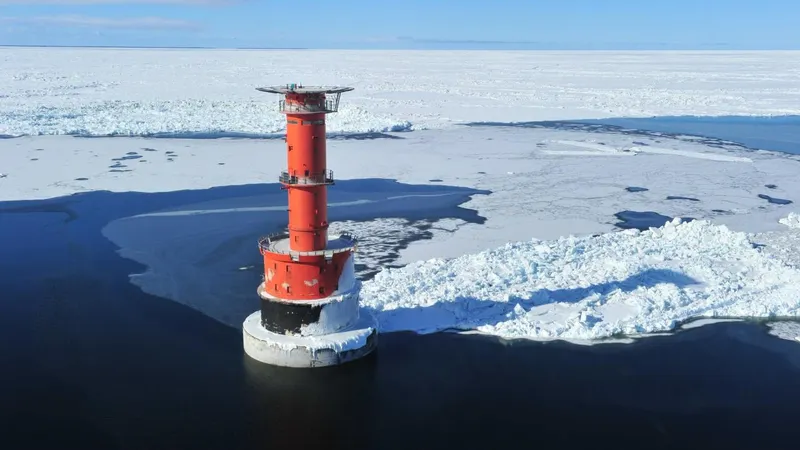
Out at sea, around 20 km northeast of Öregrund in Sweden, a red concrete tower with a helideck on top rises straight from the water. This is Grundkallen lighthouse, which has warned ships off a treacherous shoal off the Uppland coast for more than 160 years. Its story sums up the evolution of navigational safety in the Baltic: from crewed wooden lightships, through a concrete tower sunk onto the seabed, to a fully automated light powered by solar panels.
In brief
The Grundkallen lighthouse, about 20 km north-east of Öregrund in Sweden, warns ships of a shoal off the Uppland coast, and the navigation station has operated there since 1862. Until 1959 five lightships in turn served as the navigation mark on the Grundkallen shoal. In 1959 Sweden's first caisson lighthouse built with telescopic technology, 34 m tall, replaced the lightships. Sjöfartsverket fully automated the Grundkallen lighthouse in 1980, and in 1992 diesel generators were replaced by solar panels.
Five lightships on one shoal
The Grundkallen station was established in 1862, but for almost a century there was no permanent structure there. The shoal lies too far offshore and in water too deep for 19th-century engineers to build a lighthouse, so the light was carried by permanently moored lightships, vessels with a lantern on the mast and a resident crew.
Until 1959 five lightships served the station in turn. The last was lightship No. 30 Grundkallen, built in 1922 at the Karlskrona naval dockyard, which had produced Swedish lightships throughout the 19th century. Sweden used lightships along its entire coast from the 1840s until 1972. Service on board meant weeks at anchor in all weathers, far from port.
Sweden's first telescopic caisson lighthouse
In 1959 the lightship was replaced by a fixed caisson lighthouse, the first in Sweden built using the telescopic method. The structure is built in port, towed to the site and set down on the seabed, after which the tower is raised to its final height. This made it possible to place a permanent light where previously only a ship could stand.
The lighthouse is 34 m tall, with a focal height of 32 m. A two-storey accommodation section sits at the base of the tower and a helideck on top. The red tower stands on a round black caisson. The white, red and green sectors of the light are visible at up to about 9 nautical miles.
Manned for 21 years, then automation and solar power
For its first 21 years the lighthouse had a permanent crew. In 1980 the Swedish Maritime Administration, Sjöfartsverket, fully automated it and withdrew the keepers. The next change came in 1992, when the diesel generators were replaced by solar power and the light received a new Fresnel lens.
Each step cut the cost and risk of maintaining an aid to navigation in open water, while keeping what matters most to shipping: a light in the same place where masters have expected to find it since 1862.
Grundkallen on today's shipping lane
The lighthouse still marks an important route into the Sea of Åland and the Gulf of Bothnia, used by bulk carriers, ferries and other traffic. Alongside the light it carries a racon beacon, making it visible on ships' radar screens. The waters around the shoal remain demanding: in March 2004 the Finnish pusher-barge combination Herakles-Bulk, sailing from Oxelösund with a cargo of coal, sank nearby.
Grundkallen reflects how aids to navigation have developed across the Baltic, including on the Polish coast, where formerly manned lighthouses also operate automatically today and many are open to visitors. Sjöfartsverket asked its followers who has seen Grundkallen with their own eyes, as for many seafarers it is one of the landmarks on the way to the northern Baltic.
Source: Gazeta Morska · Compiled by: Kamil Kusier
Related articles
 Safety and rescue Polish SAR’s new rescue vessel Mistral launched at Kewatec in Finland
 Safety and rescue Icelandic Coast Guard and police delegation visits Polish Border Guard’s Maritime Division
 Safety and rescue Polish Navy helicopter evacuates man from Baltic platform 100 km off Władysławowo
 Navy and defence SNMG2 joins Allied warships in PASSEX as Italy's Mare Aperto 2026 gets under way
 Education 254 people, manikins and life rafts: Maritime University of Szczecin joins national CPR record attempt
 Education Energa's Kropelka Energii blood drive marks 100th edition with over 4,100 litres donated since 2012
Comments (0)
The discussion is moderated by the editors: a comment appears after review. Your e-mail address is not published.
Nobody has commented on this article yet.