









HMS Prince of Wales takes on ammunition in Norway. First resupply outside the UK
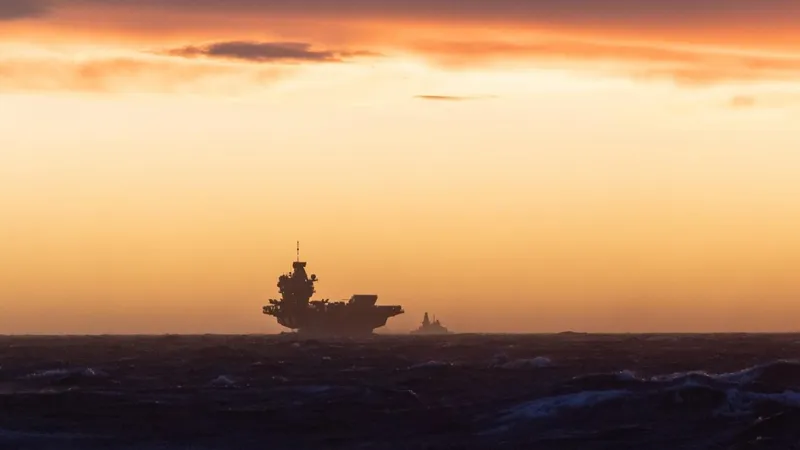
The Royal Navy aircraft carrier HMS Prince of Wales has completed her first resupply in a port outside the United Kingdom. In late October the ship berthed at the Hammernesodden military facility near Namsos, where she took on everything from provisions to ammunition. For Norway, the evolution was a live test of the host nation support on which the reception of allied reinforcements in a crisis or war depends.
In brief
The British aircraft carrier HMS Prince of Wales took on ammunition and supplies outside the United Kingdom for the first time, at the Norwegian military port of Hammernesodden near Namsos. The resupply of HMS Prince of Wales took place at the end of October as part of the British operation Firecrest, involving over 1,200 British personnel. The Norwegian frigate KNM Fridtjof Nansen is escorting HMS Prince of Wales to Oslo, where the Atlantic Future Forum will be held on board on 11-12 November. HMS Prince of Wales is 284 m long and can carry up to 40 aircraft.
Host nation logistics tested at Hammernesodden
According to the Royal Navy, the visit was designed to refine the concept of operations for a large-scale ammunitioning evolution by a Queen Elizabeth-class carrier at the Norwegian facility. The operation grew out of close dialogue between the defence logistics organisations of the two countries.
- Now we are testing in practice what we have talked about, and we can see that it works. Training in peacetime makes us better prepared for the safe transfer of ammunition and other supplies in war or crisis - said Major General Anders Jernberg, head of the Norwegian Defence Logistics Organisation (FLO).
While the carrier was alongside, the Norwegian Home Guard (Heimevernet) was responsible for force protection and site security, one of its primary tasks during allied visits. A Navy guard team placed under Home Guard command helped enforce the military restricted zone on the water, allowing the logistics organisation to run the resupply.
- Carrying out force protection and site security for real is important and motivating for the crew - said Håvard Danielsen, commander of the Namsos Home Guard area in Trøndelag Home Guard District 12.
Fridtjof Nansen in the carrier screen
The Norwegian frigate KNM Fridtjof Nansen has been an integral part of the British carrier strike group in recent weeks, and Norwegian corvettes have also trained with the force. The frigate escorted HMS Prince of Wales into Namsos and is sailing with the group until the port visit to Oslo.
- An aircraft carrier never sails alone and depends on escort vessels. KNM Fridtjof Nansen is now one of those escorts. This is important both for us and for the British. We know our home waters best and are therefore well equipped for force protection - said Commodore Kyrre Haugen, Chief of the Royal Norwegian Navy fleet (Marinen).
In Oslo the carrier will host meetings of military and political leaders on Northern European security, including the Atlantic Future Forum on 11-12 November.
A B-52 escorted by British F-35Bs
The air component produced a first. During exercise Global Thunder, Norwegian F-35As flew alongside British F-35Bs and a US B-52 bomber, the first time a B-52 has been escorted by British F-35s while Norwegian fifth-generation fighters operated with them.
Norwegian Army personnel also acted as Joint Terminal Attack Controllers (JTAC) for British F-35Bs dropping live bombs on targets at the Setermoen range. Under Arctic Sentry, NATO has stepped up its allied presence in the High North.
- Carrier operations along the Norwegian coast are important for a credible defence of Norway and NATO. It is also clear that our allies see the High North and our home waters as an important area for their operations and exercises - said Vice Admiral Rune Andersen, Chief of the Norwegian Joint Headquarters (FOH).
Operation Firecrest in figures
HMS Prince of Wales is 284 metres long, can carry more than 1,600 people and up to 40 aircraft. For Operation Firecrest, the second phase of her 2026 deployment to the Arctic and North Atlantic, she has embarked F-35 jets, Merlin and Wildcat helicopters and Malloy drones, including seven F-35s from 617 Squadron at RAF Marham.
More than 1,200 British service personnel are taking part. The force is operating under NATO command and exercising in the North Atlantic alongside allies including Norway, Denmark and Germany. In recent years carrier groups from the United States, France and the United Kingdom have operated regularly along the Norwegian coast.
Source: Gazeta Morska · Compiled by: Kamil Kusier
Related articles
 Safety and rescue Icelandic Coast Guard and police delegation visits Polish Border Guard’s Maritime Division
 Safety and rescue Polish Navy helicopter evacuates man from Baltic platform 100 km off Władysławowo
 Navy and defence SNMG2 joins Allied warships in PASSEX as Italy's Mare Aperto 2026 gets under way
 Safety and rescue From lightships to solar power: 160 years of the Grundkallen light station
 Education 254 people, manikins and life rafts: Maritime University of Szczecin joins national CPR record attempt
 Education Energa's Kropelka Energii blood drive marks 100th edition with over 4,100 litres donated since 2012
Comments (0)
The discussion is moderated by the editors: a comment appears after review. Your e-mail address is not published.
Nobody has commented on this article yet.