









Poland’s constitutional crisis is also a maritime story
The battle over Poland's Constitutional Tribunal may seem a world away from ports, shipyards and offshore wind farms. It is not. Poland's maritime economy is embarking on investments worth hundreds of billions of zlotys and measured in decades, and their real foundation is not steel or concrete but a predictable state in which the law applies equally to everyone. That is why the events of recent days in Warsaw should concern anyone with a stake in the Baltic, whatever their political sympathies.
In brief
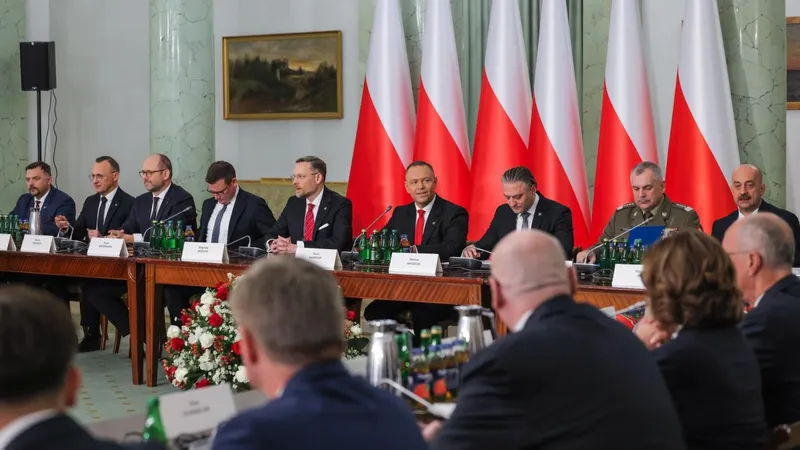
Judge Anna Korwin-Piotrowska announced on 30 October that she was heading the Constitutional Tribunal and ordered a one-month break in the duties of Tribunal president Bogdan Święczkowski and vice-president Bartłomiej Sochański. The General Assembly of Tribunal judges on 3 November gathered eight judges, although the law requires ten when the Tribunal has fifteen judges. Professor Ryszard Piotrowski called the events of 30 October an obvious violation of the constitution. The crisis around the Constitutional Tribunal threatens, according to the editors, maritime investments such as the T5 terminal in Gdańsk worth nearly PLN 1.2 billion.
This is not about whether one likes Prime Minister Donald Tusk, President Karol Nawrocki, Tribunal President Bogdan Święczkowski or any individual judge. It is about the limits of power, respect for the law and the responsibility of those entrusted with running the state. One constitutional crisis cannot be repaired by creating another, the rule of law cannot be restored by methods whose own legality is seriously disputed, and the constitution cannot apply only when it suits the parliamentary majority of the day.
Five days that shook the Tribunal
On 30 October Judge Anna Korwin-Piotrowska, citing her seniority, declared herself the person in charge of the Constitutional Tribunal and ordered an immediate one-month suspension of its President, Bogdan Święczkowski, and Vice-President, Bartłomiej Sochański. She relied on Article 130 of the Law on the System of Common Courts, a provision written for ordinary judges, and invoked a “state of higher constitutional necessity”. Her own status is contested, as she has not taken the oath before the President of the Republic in the manner required of Tribunal judges.
What followed looked more like a standoff than a legal dispute: suspended judges barred from the building, scuffles between police and opposition supporters, and President Karol Nawrocki turning back his plane to Senegal and entering the Tribunal building with Bartłomiej Sochański. On 3 November eight judges attended a General Assembly convened by Anna Korwin-Piotrowska and declared they had a quorum, although the statute requires at least two thirds of the Tribunal's fifteen judges, or ten members.
Supporters of the 30 October moves argue that they were a response to an impasse over judges elected by the current Sejm. Parliament has elected eight judges, five of whom the President has not sworn in. They took their oaths in the Sejm without him, a step the President's office does not recognise, and Tribunal President Bogdan Święczkowski has not allowed them to adjudicate.
Yet the dispute is not only about oaths but also about whether the appointments themselves were valid. The most contested is Maciej Berek, until recently a minister in the current government and a close associate of the Prime Minister. The President's office and some MPs question whether he meets the statutory requirement of ten years of legal practice, and reservations about his candidacy were voiced even within the ruling coalition. Maciej Berek was also among the judges who announced on 30 October that Anna Korwin-Piotrowska was in charge of the Tribunal. On top of that, since the start of its term the current majority has questioned the Tribunal's legitimacy and declined to publish its rulings.
The battle over the Tribunal has lasted a decade, and neither side can now claim to be the sole defender of the constitution. No impasse, whoever contributed to it, justifies tools whose legality is so widely questioned.
Lawyers across the divide
These are not only opposition talking points. Professor Ryszard Piotrowski, one of Poland's best-known constitutional scholars, called the events of 30 October an “obvious violation of the constitution” and an “obvious attack on a constitutional organ of the state”, describing Anna Korwin-Piotrowska's actions as usurpation. Constitutional lawyer Dr Mateusz Radajewski argued in Rzeczpospolita that Bogdan Święczkowski remains the serving President of the Tribunal and that the suspension orders have no legal effect.
Most telling is the view of Professor Marcin Matczak, a long-standing critic of Bogdan Święczkowski, who nonetheless concluded that there is no legal basis for suspending him and warned of a precedent that could backfire on Polish democracy once the governing majority changes. He also criticised the President's night-time entry into the Tribunal building as an intrusion by the executive into the judiciary. That is the essence of the rule of law: even a person part of the political scene would rather not see in office is protected by the rules, and those rules bind everyone, including the head of state.
Why the Baltic needs a predictable state
Poland's maritime economy is among the most capital-intensive parts of its economy. Offshore wind farms such as Baltica 2, Baltic Power, Bałtyk 2 and 3 and BC-Wind are under construction, the Port of Gdańsk has just opened its PLN 1.2 billion T5 installation terminal, and Polskie Elektrownie Jądrowe has applied for a permit to begin preliminary works on the country's first nuclear plant, with cooling tunnels bored under the Baltic seabed. The government is also preparing measures to bring merchant ships back under the Polish flag, from a tonnage tax to income tax relief for seafarers.
Each of these projects rests on laws and decisions that must outlast not one parliamentary term but several decades. An offshore wind developer, a shipowner choosing a flag or a bank financing a terminal all count on the same thing: that the rules will not change overnight and that any dispute over their constitutionality will be settled by a court whose rulings everyone accepts. When the Constitutional Tribunal becomes a battlefield over who runs it, every law can be challenged and none definitively upheld. For maritime investment, that risk translates into higher financing costs, delays and caution among foreign investors.
There is a European dimension too. More than half of the T5 terminal was funded from Poland's National Recovery Plan, and for years the release of EU funds to Poland depended on the state of the rule of law. Each new dispute over the independence of courts weakens the case that Poland is a predictable partner, a case on which future EU support for ports, shipyards and maritime infrastructure depends.
Baltic security cannot wait for the dispute to end
On 3 November, almost at the same moment as the Tribunal's General Assembly, Poland's National Security Council met to discuss current security issues and plans for a permanent US military base in Poland. These are matters that should rise above party politics, yet even the Council met in the shadow of the conflict between the President and the government. For the Baltic, that matters. The sea has become a zone of permanent tension, from damaged subsea cables and the shadow fleet to Russian submarines mapping Allied infrastructure. Poland is buying submarines under the Orka programme, building Miecznik frigates and protecting the Baltic Pipe, power cables and future wind farms, all of which require the commander-in-chief and the government that funds the armed forces to work together.
The state is not a spoil of war
Anyone who spent years criticising the previous government for overstepping its powers cannot stay silent when the same accusations are levelled at those in power now. Anyone who defended the independence of institutions cannot make that defence depend on who happens to run them. The principle cuts both ways and binds every team that takes power. The rule of law does not mean that one's own side may do more because it is supposedly repairing the state. Today one camp reaches for a tool; tomorrow the other will, equally convinced of its good intentions.
The maritime Poland we are building, with ports handling ever larger ships, shipyards winning orders, wind farms in the Baltic and a fleet returning to the white and red flag, needs a state whose institutions are stronger than the people who temporarily run them. The state does not belong to Donald Tusk or Karol Nawrocki, to Jarosław Kaczyński, Władysław Kosiniak-Kamysz, Krzysztof Bosak or any coalition. It belongs to its citizens. And the constitution is their last line of defence against arbitrary power, at sea as on land, where stability and predictability decide whether a ship reaches port.
Source: Gazeta Morska · Compiled by: Kamil Kusier
Related articles
 Safety and rescue Icelandic Coast Guard and police delegation visits Polish Border Guard’s Maritime Division
 Safety and rescue Polish Navy helicopter evacuates man from Baltic platform 100 km off Władysławowo
 Navy and defence SNMG2 joins Allied warships in PASSEX as Italy's Mare Aperto 2026 gets under way
 Safety and rescue From lightships to solar power: 160 years of the Grundkallen light station
 Education 254 people, manikins and life rafts: Maritime University of Szczecin joins national CPR record attempt
 Education Energa's Kropelka Energii blood drive marks 100th edition with over 4,100 litres donated since 2012
Comments (0)
The discussion is moderated by the editors: a comment appears after review. Your e-mail address is not published.
Nobody has commented on this article yet.