









Norwegian submarine Utstein completes NATO patrol guarding offshore oil and undersea infrastructure
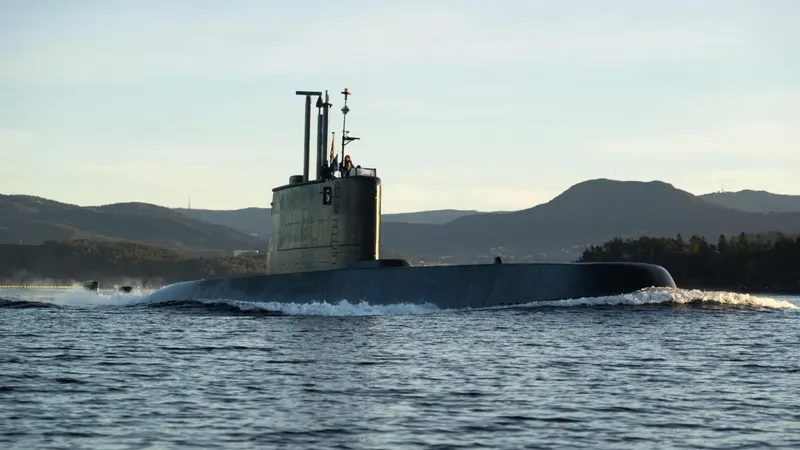
The Royal Norwegian Navy submarine HNoMS Utstein has completed a deployment under NATO command, conducting intelligence, surveillance and reconnaissance patrols around offshore oil installations and critical undersea infrastructure. Operating discreetly beneath the surface, the boat helped the Alliance build and maintain maritime situational awareness, a role that has become central as seabed cables, pipelines and platforms move to the front line of Russian activity.
In brief
The Norwegian Ula-class submarine HNoMS Utstein has completed a NATO-led mission patrolling around offshore oil installations and critical undersea infrastructure. Data from the HNoMS Utstein reconnaissance patrols fed NATO's Maritime Situational Awareness, the shared picture of activity at sea. The submarine Utstein had already patrolled the North Atlantic for NATO in autumn 2024. Norway will replace its Ula-class submarines with Type 212CD boats.
A veteran of NATO patrols
Utstein is an Ula class attack submarine. During the deployment just completed, she monitored maritime activity around offshore oil installations and critical undersea infrastructure, feeding the information into NATO's common maritime picture, which the Alliance uses to understand what is happening in and under its waters.
It is not the boat's first mission for NATO. In autumn 2024 Utstein completed a North Atlantic patrol under the Commander of NATO Submarines, providing situational awareness and deterrence and taking part in Neptune Strike activities alongside the USS Harry S. Truman carrier strike group.
- To have HNoMS Utstein on patrol for NATO strengthens our capabilities and situational awareness in the North. It has been a successful deployment for us, and a valuable experience for the crew - Captain Jim Robertsen, Chief of the Royal Norwegian Submarine Service, said at the time.
Russia maps the seabed, NATO watches from below
Since the destruction of three Nord Stream pipelines in 2022, Allies have shifted their focus to undersea infrastructure, and since 2023 they have observed growing numbers of vessels mapping pipelines, power cables and fibre-optic lines. In April 2026 the UK government told Parliament of a Russian operation in the North Atlantic involving an Akula class submarine and two specialist boats of GUGI, Russia's Main Directorate of Deep-Sea Research. No sabotage took place, London said, but the Russians had invested considerable effort in mapping British undersea infrastructure. In September, Allies prevented three Russian submarines from completing training in Arctic waters near Norway's Svalbard, close to vital data cables.
NATO has responded with a growing set of missions. Baltic Sentry has reinforced the Alliance's presence in the Baltic since January 2025, while the new Arctic Sentry mission covers the High North. Uncrewed systems are playing an increasing role: between March and October 2025, Task Force X-Baltic tested 70 aerial and maritime drones alongside Allied warships, and in February 2026 eight Allies including Poland agreed to fast-track the joint acquisition of new technologies for naval operations and seabed protection. Submarines such as Utstein remain essential where what matters is a long, invisible presence close to protected assets.
From Ula to 212CD, and the Baltic connection
Norway is already preparing to replace its Ula class boats with the new Type 212CD submarine, whose propulsion combines air-independent propulsion with hydrogen fuel cells for significantly greater dive endurance, alongside improved stealth, sound absorption and reduced radiated noise.
The mission also has a direct Baltic dimension. Norwegian North Sea fields supply Poland through the Baltic Pipe, so protecting the kind of infrastructure Utstein patrolled translates directly into Polish energy security. In June 2026 Poland signed a contract for three A26 submarines under its Orka programme, which once in service are expected to carry out comparable tasks in the Baltic: discreet surveillance of the sea area and protection of infrastructure on the seabed.
Source: Gazeta Morska · Compiled by: Kamil Kusier
Related articles
 Safety and rescue Icelandic Coast Guard and police delegation visits Polish Border Guard’s Maritime Division
 Safety and rescue Polish Navy helicopter evacuates man from Baltic platform 100 km off Władysławowo
 Navy and defence SNMG2 joins Allied warships in PASSEX as Italy's Mare Aperto 2026 gets under way
 Safety and rescue From lightships to solar power: 160 years of the Grundkallen light station
 Education 254 people, manikins and life rafts: Maritime University of Szczecin joins national CPR record attempt
 Education Energa's Kropelka Energii blood drive marks 100th edition with over 4,100 litres donated since 2012
Comments (0)
The discussion is moderated by the editors: a comment appears after review. Your e-mail address is not published.
Nobody has commented on this article yet.