









A decade on the front line: Poland's FlyEye drone with Ukraine's 25th Air Assault Brigade
Poland's FlyEye reconnaissance drone has been in daily use by Ukrainian soldiers for more than a decade. Built by Flytronic of Gliwice, part of WB Group, the system serves today with units including the 25th Sicheslav Air Assault Brigade, one of the most battle-hardened formations of the Ukrainian armed forces, which uses it for reconnaissance and fire direction. The first aircraft reached the front in 2015, and since 2025 FlyEye has also been built at a plant in Ukraine. It is one of the longest combat-proven Polish defence products.
In brief
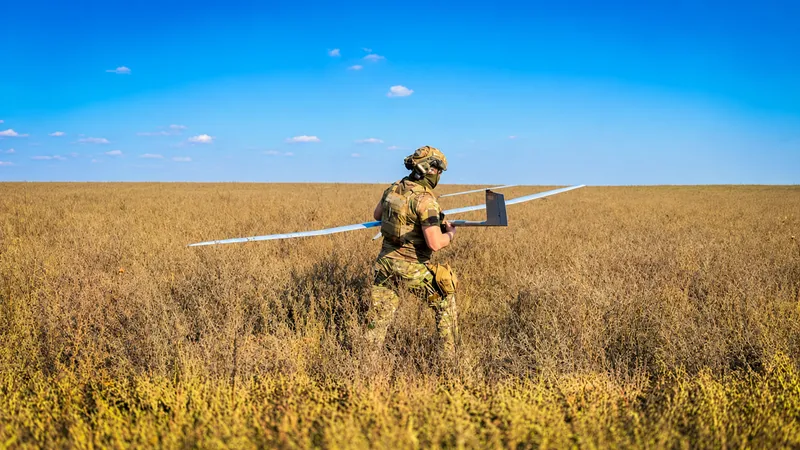
The Polish FlyEye reconnaissance drone, made by Gliwice-based Flytronic of WB Group, serves among others in Ukraine's 25th Separate Sicheslav Airborne Brigade for reconnaissance and fire guidance. The first FlyEye units reached the front in 2015, and since August 2025 the drone has been in serial production at the WB Ukraine plant. The FlyEye drone weighs 11 kg, is hand-launched and operates within a radius of up to 50 km from the operator.
Eleven kilograms, two backpacks and 50 km of range
FlyEye is an electrically powered motor glider developed in 2010. It weighs 11 kg, fits into two backpacks and is launched by hand, with no launcher or runway. It operates up to 50 km from the operator and stays airborne for two to three hours. An interchangeable mission module carries day and thermal cameras, so the drone can observe the battlefield around the clock.
The third generation adds an automatic convoy escort mode and target tracking. In Ukraine FlyEye is used above all for reconnaissance and artillery spotting, feeding imagery into systems that cut the time between detecting a target and engaging it.
On the front since 2015, built in Ukraine since 2025
WB Group has exported its systems to Ukraine since 2014, and the first FlyEye platforms reached Ukrainian users in 2015. Over more than a decade the group has built close relations with the Ukrainian armed forces and receives direct feedback from the battlefield, which returns to its engineers as successive modifications. Ukraine is today one of the system's largest users, with FlyEye arriving through government contracts, international aid and crowdfunding alike.
In early 2025 FlyEye production began at the plant of WB Ukraine, a subsidiary established in the late 2010s that had previously handled servicing, repairs and spare parts. Serial production has been running since August 2025. For security reasons the production was not announced until a visit by Piotr Łukasiewicz, head of Poland's diplomatic mission in Kyiv. The plant's location has not been disclosed.
Poland's largest private defence manufacturer
WB Group is the second-largest player in Poland's defence industry after the state-owned Polska Grupa Zbrojeniowa and by far the largest private one. It employs 3,000 people, half of them engineers. Alongside FlyEye it produces the Warmate loitering munition and communications systems, and exports to military customers in Europe and Asia. Its experience in Ukraine, where drones must operate under heavy jamming and electronic warfare, is now one of the group's strongest assets on export markets.
FlyEye is also a proven system in the Polish armed forces, used for years by the land forces. Lessons from Ukraine feed directly into how Polish operators train for contested electromagnetic environments, including on the coast and over the sea, where unmanned reconnaissance is growing in importance.
Source: Gazeta Morska · Compiled by: Kamil Kusier
Related articles
 Energy and offshore Equinor takes over Bałtyk 2 and 3 O&M base in Łeba. Port to serve 1.44 GW of offshore wind for 30 years
 Navy and defence Port Gdański Eksploatacja secures NATO NCAGE code. Gdańsk port company lines up for defence tenders
 Shipbuilding industry Ex-Enterprise towed to Mobile under $418.5m contract. Test case for Nimitz-class disposal begins
 Energy and offshore Energa renames Gdańsk gas plant company as foundations for 6,000-tonne turbine and boiler are laid
 Equipment and technology WB Group takes Polish drones from Tokyo to SOFEX in Jordan in a single week
 Ports and logistics PGE books Gdańsk’s T5 terminal for the long haul: Baltica 2 first, then more offshore wind farms
Comments (0)
The discussion is moderated by the editors: a comment appears after review. Your e-mail address is not published.
Nobody has commented on this article yet.