









Ex-Enterprise towed to Mobile under $418.5m contract. Test case for Nimitz-class disposal begins
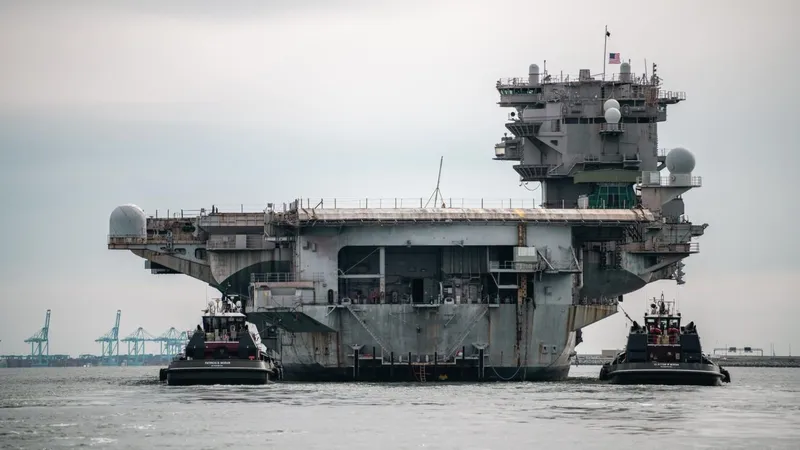
NorthStar Maritime Dismantlement Services has taken charge of the world's first nuclear-powered aircraft carrier. The former USS Enterprise (CVN 65) left Newport News Shipbuilding, the Virginia yard of Huntington Ingalls Industries (HII), under tow on 2 November 2026, bound for a commercial dismantling facility in Mobile, Alabama. There the company will break up, recycle and dispose of the 95,000-ton hull under a $418.5m US Navy contract due for completion in September 2030.
In brief
The hull of the former USS Enterprise (CVN 65), the first nuclear-powered aircraft carrier, has left Newport News Shipbuilding under tow for Mobile, Alabama. NorthStar Maritime Dismantlement Services will dismantle USS Enterprise under a contract worth 418.5 million dollars, with work due to finish in September 2030. The compartments of the eight reactors of USS Enterprise will go to the Department of Energy site at Hanford. The US Navy treats the USS Enterprise dismantling as a model before retiring the Nimitz-class carriers, with USS Nimitz due to leave service in 2027.
A commercial yard instead of a naval shipyard
The tow left Pier 2 at Newport News around midday Eastern time. The decision to send the carrier to the private sector dates back to 2023, when the US Navy opted for commercial dismantlement rather than its public shipyards. Its assessment found that the commercial route could roughly halve disposal costs compared with the alternatives, shorten the schedule and free public yard capacity for maintenance of the active fleet.
NorthStar, based in Vernon, Vermont, is carrying out the work with Modern American Recycling and Radiological Services, part of Modern American Recycling Services. In Mobile the carrier will be dismantled near the hulk of the ocean liner SS United States, which is due to leave shortly on its own final voyage to become an artificial reef.
Eight reactor plants inside a 342-metre hull
The contract covers the entire vessel, including its eight defueled reactor plants, which once drove four propeller shafts. Recovered material will be recycled where possible, while low-level radioactive waste and other hazardous material will go to licensed disposal sites. The reactor compartments are destined for the Department of Energy's Hanford site in Washington State, where the US Navy stores the spent reactors of its fleet.
Scale is what separates the job from submarine recycling. A submarine's reactor compartment is cut out as a single section and shipped away. On Enterprise the compartments are too large for that, so the hull itself has to be taken apart around them, with the low-level radiation in the compartments managed throughout.
Three bills for one carrier
NorthStar first won the dismantling work in June 2025 with a $536.7m firm-fixed-price contract. In July 2026 the company was awarded a new contract worth $418.5m. That sum comes on top of $902m spent on the carrier's inactivation and $111m on storage at Newport News.
Rehearsal for the Nimitz class
The project is the first of its kind and doubles as a template for retiring the Nimitz-class carriers. In 2024 the US Navy set up a dedicated Nuclear-Powered Aircraft Carrier Inactivation and Disposal Program Office within Naval Sea Systems Command.
The lead ship of the class, USS Nimitz (CVN 68), is due to leave active service in 2027. HII's Newport News Shipbuilding division received $96m in March for advanced planning and long-lead materials.
A million nautical miles under nuclear power
Enterprise was ordered on 15 November 1957, christened on 24 September 1960 by Bertha Irene Franke, wife of Navy Secretary William B. Franke, and commissioned on 25 November 1961. Built at Newport News, she was the eighth US Navy ship to carry the name. Over 51 years of service she took part in the Cuban Missile Crisis, the Vietnam War and operations in Afghanistan and Iraq.
In 1964, together with the nuclear-powered cruiser USS Long Beach and USS Bainbridge, she circled the globe without refuelling in Operation Sea Orbit. By the end of her 22nd and final deployment in 2012 she had logged more than one million nautical miles. The carrier was inactivated in December 2012, returned to Newport News in June 2013 for defuelling and was decommissioned on 3 February 2017, the first nuclear-powered carrier in US Navy history to go through the process.
- Enterprise will always be remembered for her proud legacy of service, a legacy made possible by the Sailors and support personnel whose dedication kept her mission-ready - said Kevin Cormier, Deputy Portfolio Acquisition Executive Maritime for Aircraft Carriers.
HII builds the successor
HII is the US Navy's largest shipbuilder, and Newport News is the only yard in the United States that builds nuclear-powered aircraft carriers. It supported Enterprise across her entire lifecycle, from construction through her refuelling overhauls to inactivation and defuelling. A new USS Enterprise (CVN 80), a Gerald R. Ford-class carrier, is now under construction at the same yard.
- From construction through inactivation, the skilled shipbuilders of HII are proud to have supported the entire lifecycle of this mighty aircraft carrier - HII said.
Source: Gazeta Morska · Compiled by: Kamil Kusier
Related articles
 Energy and offshore Equinor takes over Bałtyk 2 and 3 O&M base in Łeba. Port to serve 1.44 GW of offshore wind for 30 years
 Navy and defence Port Gdański Eksploatacja secures NATO NCAGE code. Gdańsk port company lines up for defence tenders
 Energy and offshore Energa renames Gdańsk gas plant company as foundations for 6,000-tonne turbine and boiler are laid
 Equipment and technology WB Group takes Polish drones from Tokyo to SOFEX in Jordan in a single week
 Ports and logistics PGE books Gdańsk’s T5 terminal for the long haul: Baltica 2 first, then more offshore wind farms
 Safety and rescue Polish SAR’s new rescue vessel Mistral launched at Kewatec in Finland
Comments (0)
The discussion is moderated by the editors: a comment appears after review. Your e-mail address is not published.
Nobody has commented on this article yet.