









WB Group takes Polish drones from Tokyo to SOFEX in Jordan in a single week
Poland's largest private defence company showed its unmanned systems on three continents in the space of a week. On 28 October WB Group presented its new turbojet-powered Gladius 2 effector at the Polish Embassy in Tokyo, during celebrations of the centenary of the 1926 Warsaw-Tokyo-Warsaw flight. At the same time, from 27 to 29 October, its stand at the SOFEX exhibition in Aqaba, Jordan, received Prince Faisal bin Al Hussein and the chairman of Jordan's joint chiefs of staff, days after Nigeria's defence minister visited the company at AFRIDEX in Lagos.
In brief
Grupa WB presented the turbojet-powered Gladius 2 effector at the Polish Embassy in Tokyo during the centenary celebrations of the Warsaw-Tokyo-Warsaw flight. The Tokyo ceremony took place on 28 October 2026. Prince Faisal bin Al Hussein and Major General Majdi al-Harasis visited the Grupa WB stand at the SOFEX fair in Aqaba, held from 27 to 29 October. Nigerian Defence Minister General Christopher Gwabin Musa viewed the Grupa WB offer on 26 October at the AFRIDEX fair in Lagos.
A centenary in Tokyo and a turbojet loitering munition
In 1926 two Polish military aviators, pilot Lieutenant Bolesław Orliński and mechanic Sergeant Leonard Kubiak, flew a biplane from Warsaw to Tokyo and back. The round trip, made with the technology of the day by airmen from a state that had regained independence only eight years earlier, remains a symbol of the courage of Polish aviation and a reference point in Poland's relations with Japan. The centenary ceremony took place on 28 October 2026, Japan time, at the Embassy of the Republic of Poland in Tokyo, hosted by chargé d'affaires a.i. Konrad Pawlik and defence attaché Colonel Maciej Remkowski.
WB Group used the occasion to show its combat-proven Warmate family, including the newest, low-observable Gladius 2 effector fitted with a turbojet engine, a development of the Gladius system the Polish Armed Forces ordered in May under the country's largest ever unmanned systems contracts. The company describes Japan and the wider Asia-Pacific as one of its most important directions for international cooperation, with potential for joint projects in aerial and maritime unmanned systems. Poland and Japan are developing a strategic partnership that includes security, and WB Group argues that direct contacts between the defence industries of allied and partner states are gaining importance as security challenges grow in both Europe and the Indo-Pacific.
Royal visit at SOFEX in Aqaba
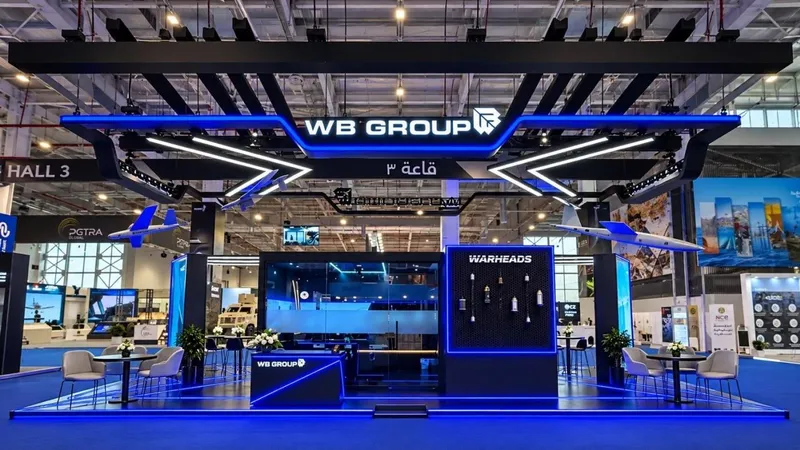
WB Group returned to the Special Operations Forces Exhibition and Conference (SOFEX), one of the Middle East's leading defence shows, held in Aqaba from 27 to 29 October. On the opening day its stand was visited by Prince Faisal bin Al Hussein and Major General Majdi Al-Harasis, Chairman of the Joint Chiefs of Staff of the Jordan Armed Forces, together with Brigadier General Muhammad Al-Yamani, director of the Joint Operations Department, and Brigadier General Shadi Al-Khashashneh, director of the Planning and Organisation Department. Other visitors included Brigadier Muhammad Daradka, director of the Special Communications Division, officers from the Unmanned Aircraft Systems Data Integration Centre, and Muhammad Batran, Director General of the state Jordan Design and Development Bureau.
The company showed its FT-5 reconnaissance UAV in a hybrid-powered variant with an observation payload, also available with a synthetic aperture radar or ELINT sensors, alongside the much smaller hand-launched FlyEye, which WB Group describes as best in class for its low logistical footprint. The Warmate loitering munition family was presented with a range of warheads, from multipurpose fragmentation-blast to anti-armour and thermobaric, combining with reconnaissance platforms into strike-reconnaissance sets such as Flymate and Gladius. According to the company, its unmanned systems have served multiple users for 15 years and have been proven in combat, including in Ukraine, in an environment of intense electronic warfare. Also on display was AMSTA, a border and critical infrastructure protection system built around a network of perimeter seismic sensors that can be combined with other sensors and reconnaissance drones.
Lagos, Tokyo, Aqaba: three markets in one week
The week began in Africa. On 26 October, the first day of the inaugural AFRIDEX exhibition in Lagos, Nigeria's Minister of Defence General (retired) Christopher Gwabin Musa visited the WB Group stand for a briefing on border security and critical infrastructure protection systems. West Africa, the Middle East and East Asia have different requirements, but a common thread: buyers in all three regions are looking for combat-proven unmanned systems and partners willing to localise production, something WB Group has already done with its FlyEye line in Ukraine and its Delta WB joint venture in Georgia.
WB Group is the largest private technology group in Poland's defence sector and one of the largest in Europe, with a portfolio spanning communications, command and fire control systems, software-defined tactical radios and unmanned aerial, land and maritime platforms. A presence on three continents in a single week signals a company that has outgrown its home market and is competing for orders in regions where, until recently, only larger and longer-established suppliers were in the running.
Source: Gazeta Morska · Compiled by: Kamil Kusier
Related articles
 Energy and offshore Equinor takes over Bałtyk 2 and 3 O&M base in Łeba. Port to serve 1.44 GW of offshore wind for 30 years
 Navy and defence Port Gdański Eksploatacja secures NATO NCAGE code. Gdańsk port company lines up for defence tenders
 Shipbuilding industry Ex-Enterprise towed to Mobile under $418.5m contract. Test case for Nimitz-class disposal begins
 Energy and offshore Energa renames Gdańsk gas plant company as foundations for 6,000-tonne turbine and boiler are laid
 Ports and logistics PGE books Gdańsk’s T5 terminal for the long haul: Baltica 2 first, then more offshore wind farms
 Safety and rescue Polish SAR’s new rescue vessel Mistral launched at Kewatec in Finland
Comments (0)
The discussion is moderated by the editors: a comment appears after review. Your e-mail address is not published.
Nobody has commented on this article yet.