









REPMUS 26 off Tróia. Four weeks of uncrewed systems testing with 36 navies taking part
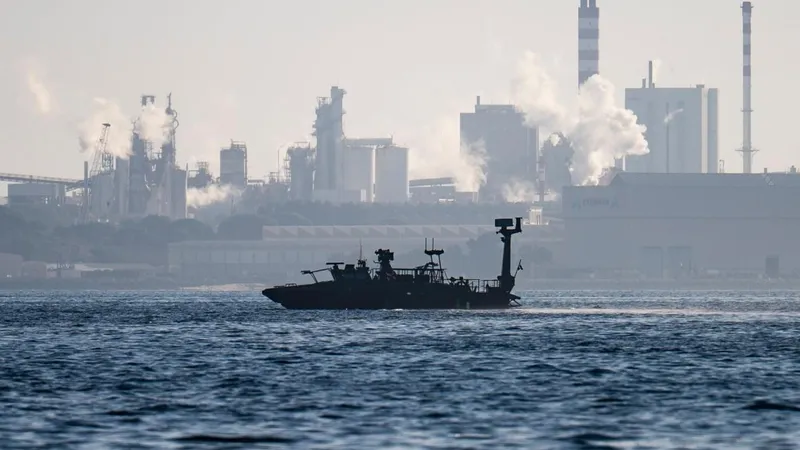
Sailors of Poland's 13th Minesweeper Squadron, named after Fleet Admiral Andrzej Karweta, took part in the REPMUS 2026 exercise in Portugal. Specialists from its clearance diver group worked with allies, using uncrewed systems, on searching for, identifying and classifying mine threats. This year's edition drew participants from 26 countries, with a further ten taking part as observers.
In brief
Mine clearance divers from the 13th Minesweeper Squadron took part in the REPMUS 2026 exercise in Portugal, practising the search, identification and classification of mine threats with unmanned systems. The REPMUS 2026 exercise runs from 31 August to 25 September near Tróia and Sesimbra, with 26 states, ten observer nations and more than 300 unmanned systems. Results from REPMUS 26 are to feed the NATO Defence Planning Process (NDPP) and the EU Capability Development Plan (CDP).
REPMUS is now the largest experimentation exercise with maritime uncrewed systems in the world, and the place where it is decided which of those systems make it into naval inventories.
Three hundred uncrewed systems across 400 square miles
This year's sixteenth edition runs from 31 August to 25 September around the Tróia peninsula and Sesimbra, south of Lisbon. It involves more than 1,500 people, over 300 uncrewed surface, underwater and air systems and 14 support vessels, working an exercise area of more than 400 square nautical miles.
The scale is growing fast. In 2023 NATO reported just over 90 uncrewed systems and eleven ships. In three years the number of systems under test has more than tripled.
The exercise runs in four phases: system setup and network integration, experimentation with new solutions, operational serials building a recognised picture and fusing data, and final evaluation. NATO's Dynamic Messenger exercise attaches from 15 September, carrying the experimentation into an operational scenario.
Mine countermeasures as a Polish speciality
The presence of the 13th Minesweeper Squadron is no accident. Mine countermeasures are an area where the Polish Navy holds a real and recognised position within NATO, built on the Kormoran II-class minehunters and on decades of clearing the Baltic of ordnance from both world wars.
It is also the area where uncrewed systems are changing working methods fastest. The classic pattern, in which a ship enters a mined area and risks its own hull, is giving way to one in which an underwater vehicle goes first and the ship stays outside the danger zone. Searching for, identifying and classifying objects, precisely what the Polish divers practised, is now the work of a sonar and vehicle operator as much as of a diver.
From experiment to order
The most significant change this year concerns what happens to the results. REPMUS 26 has been tied to NATO's Rapid Adoption Action Plan and is to feed both the NATO Defence Planning Process and the EU Capability Development Plan.
That means trials off Tróia do not end with a report for participants but flow into the documents on which nations base their procurement. For companies it is the shortest route from prototype to tender requirement, and for navies a way of testing equipment before signing a contract rather than after.
The exercise is organised by the Portuguese Navy at its Naval Operational Experimentation Centre in Tróia, together with NATO's Centre for Maritime Research and Experimentation, the Maritime Unmanned Systems initiative and Allied Maritime Command, alongside the engineering faculty of the University of Porto and, since 2024, the European Defence Agency.
What was being tested this year
This year's experiments focused on uncrewed underwater sensors from a range of manufacturers, and on enabling a single operator to control multiple systems of different types through a common interface. The goal is a persistent underwater picture and the protection of port infrastructure and coastal waters.
Rheinmetall, present since 2024 as a systems integrator, argues that mission success is decided not by the performance of an individual platform but by how platforms are networked together. The same conclusion has emerged from NATO exercises over the past year, as uncrewed systems entered anti-submarine serials and large land exercises.
Connectivity without satellites, and fleets of drones
Alongside the navies, dozens of suppliers are working at the Tróia range, and their trials show where the field is heading.
Norway's Maritime Robotics deployed three uncrewed surface vessels, Mariner, Mariner X and Sentry, validating how autonomous systems improve efficiency, sustain a persistent picture and shorten decision cycles. The company ties this directly to safeguarding territorial waters and critical subsea energy and data infrastructure.
The most interesting thread, though, concerns communications. Finland's KNL, working with Turku University of Applied Sciences, tested cognitive HF radio technology, known as CNHF, on an uncrewed surface vessel. The question behind it is how to keep a link to an uncrewed platform when mobile networks and satellite communications are unavailable or jammed. The trials provided practical evidence that infrastructure-independent beyond-line-of-sight connectivity is achievable over long distances.
For the Baltic that is a first-order issue. Jamming and spoofing of satellite navigation signals are a constant there, and an uncrewed vessel without a link is either useless or dangerous.
Some companies describe their work as part not only of REPMUS but also of the parallel NATO exercise Dynamic Bold Machina 2026. Last year the attached Dynamic Messenger exercise carried experimentation into an operational scenario, with the Ukrainian navy leading the opposing force for the first time.
The Baltic side of the same problem
Everything tested in Portugal applies directly to the Baltic. Protecting undersea infrastructure after a series of damaged cables and pipelines, maintaining persistent surveillance under NATO's Baltic Sentry activity, defending ports against uncrewed surface vessels and conducting classic mine countermeasures are the Polish Navy's daily tasks.
Poland has its own designs in this field, including WB Group's StormRider 850 uncrewed surface vessel, which in September simulated an attack on the naval base in Gdynia during the Dzielny Okoń-26 exercise. The presence of Polish clearance divers at REPMUS is the other side of the same process: checking how such systems behave in a multinational scenario, with other nations' equipment in the same network.
Source: Gazeta Morska · Compiled by: Kamil Kusier
Related articles
 Energy and offshore Equinor takes over Bałtyk 2 and 3 O&M base in Łeba. Port to serve 1.44 GW of offshore wind for 30 years
 Navy and defence Port Gdański Eksploatacja secures NATO NCAGE code. Gdańsk port company lines up for defence tenders
 Shipbuilding industry Ex-Enterprise towed to Mobile under $418.5m contract. Test case for Nimitz-class disposal begins
 Energy and offshore Energa renames Gdańsk gas plant company as foundations for 6,000-tonne turbine and boiler are laid
 Equipment and technology WB Group takes Polish drones from Tokyo to SOFEX in Jordan in a single week
 Ports and logistics PGE books Gdańsk’s T5 terminal for the long haul: Baltica 2 first, then more offshore wind farms
Comments (0)
The discussion is moderated by the editors: a comment appears after review. Your e-mail address is not published.
Nobody has commented on this article yet.