









WB Group and Kongsberg to build unmanned maritime systems in Gdynia. Radmor grows to 2,000 jobs
At Radmor in Gdynia, a plant of the WB Group, Deputy Prime Minister and Defence Minister Władysław Kosiniak-Kamysz announced the next stage of the "Kaszubia Green Industrial District" project: cooperation between the WB Group and Norway's Kongsberg Defence & Aerospace in unmanned maritime systems, and new industrial investment in Pomerania. 150 million zloty has already been invested in the Gdynia site, the figure is to reach 800 million in the near future, and the WB Group's employment in Pomerania is to grow from 1,500 to as many as 2,000.
In brief
Grupa WB will cooperate with Norway's Kongsberg Defence & Aerospace on unmanned maritime systems, Deputy Prime Minister Władysław Kosiniak-Kamysz announced on 7 October at Radmor in Gdynia. PLN 150 million has already been invested in the Radmor site in Gdynia, and the amount is soon to reach 800 million. Grupa WB employment in Pomerania is to grow from 1500 to as many as 2000 people. The announcement is another stage of the Kaszubia Green Industrial District project.
The conference took place on Wednesday 7 October with the Norwegian ambassador, WB Group chief executive Piotr Wojciechowski and members of Kongsberg's management present. The minister tied the investment directly to the EU's SAFE programme, from which Poland finances arms purchases, and to his own decision to use it.
- We are at Radmor, in a company that is growing, that is building, that is increasing employment. And this is happening thanks to the SAFE programme. It is tangible proof that our decision, often going against certain intentions, brings specific contracts for the Polish Armed Forces and also brings jobs, here in Gdynia, in Pomerania, in Kashubia, in the Green Industrial District - said Władysław Kosiniak-Kamysz.
Surface drones and the SAN system
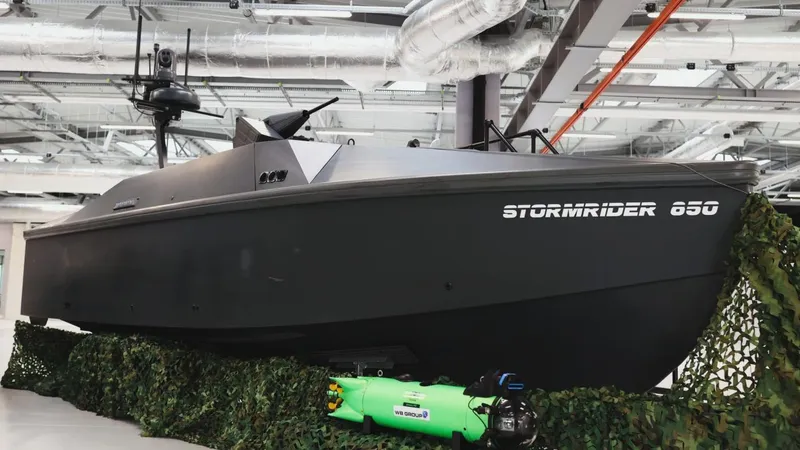
Unmanned surface vessels were shown at the plant, meant, as the minister put it, for deterrence and defence. The cooperation with Kongsberg concerns precisely that domain: unmanned maritime systems, where the WB Group brings competence from aerial drones and loitering munitions and the Norwegians experience from anti-ship missiles and naval systems. Kongsberg is also a partner in the SAN counter-drone system being built with Polska Grupa Zbrojeniowa and the Pomeranian company APS, which the minister cited as an example of linking security with the economy.
- The coming months mean millions in investment. 150 million already invested in the site we are in today; in the near future that will reach 800 million. On top of that Kongsberg, our partners from Norway. Together we are building a counter-drone system, the SAN system, where there is APS, also from Pomerania, there is Polska Grupa Zbrojeniowa, there is Kongsberg - the deputy prime minister said.
The minister recalled the three priorities he has set for the Polish Armed Forces: drones and counter-drone systems, long-range precision strike and artificial intelligence, and added that in Gdynia all three come together, because today there is neither management of a modern army nor construction of platforms without AI, and conventional equipment cannot move without a drone umbrella.
- The WB Group is the best example of wise investment in human capital and new technologies across the whole country. I have had the chance to watch it up close for four years, how you develop your company, how you are a showcase for Poland, how you sell your equipment to our NATO allies. Radmor is an investment that already provides employment for 1,500 people, and soon that may be as many as 2,000 for the whole WB Group located here in Pomerania, especially in Gdynia - Władysław Kosiniak-Kamysz stressed.
What Kaszubia is
The "Kaszubia Green Industrial District" is a state initiative of defence significance, providing for the development of industry, energy and critical infrastructure across the Pomeranian, West Pomeranian and Kuyavian-Pomeranian provinces. The project is to integrate new technologies with the construction of an industrial and logistics base for national security and forms part of the Baltic Sea regional security concept the minister launched last year. The idea is that investment in industry, logistics and technology should translate directly into defence capability, with the benefits staying in the region, including its local governments.
- It is very important to us that Polish industry can cooperate with partners from the Baltic Sea basin, from the region, so that we are safer in terms of the supply chain, so that we can rebuild this whole technological competence and so that our domestic industry has the opportunity to make its presence felt widely in the world. This is a historic moment for Gdynia, for Pomerania, for Poland and for the whole Baltic Sea basin - said Maciej Samsonowicz, adviser to the defence minister, chairman of the working group and author of the Green Industrial District concept.
The minister thanked Gdynia, the Pomeranian province and the local governments involved in the project, stressing that the local community is to benefit from investment in the defence industry.
Gdynia as a drone hub
For Pomerania the announcement has a practical dimension. Radmor, a maker of military radios for decades, is becoming the centre within the WB Group around which the production of unmanned systems and counter-drone systems is growing, and Kongsberg's entry means that the Norwegian firm, supplier of NSM missiles to the Polish Navy and a partner in the Orka programme through Saab Kockums, is tying part of its activity to Gdynia. A week earlier Radmor's chief executive Bartłomiej Zając gave the inaugural lecture on technological sovereignty at the Polish Naval Academy's opening of the academic year, and the academy launched a specialisation in unmanned weapon systems. The plant that is to employ two thousand people and the academy that is to train officers for it are a few kilometres apart.
The questions that remain open after the conference concern specifics: which vessels are to be built with Kongsberg and on what timescale, whether they will be produced in Gdynia, and when the first of them will reach the Polish Navy. For now it is known that the place, the money and the partners are there.
Source: Gazeta Morska · Compiled by: Kamil Kusier
Related articles
 Energy and offshore Equinor takes over Bałtyk 2 and 3 O&M base in Łeba. Port to serve 1.44 GW of offshore wind for 30 years
 Navy and defence Port Gdański Eksploatacja secures NATO NCAGE code. Gdańsk port company lines up for defence tenders
 Shipbuilding industry Ex-Enterprise towed to Mobile under $418.5m contract. Test case for Nimitz-class disposal begins
 Energy and offshore Energa renames Gdańsk gas plant company as foundations for 6,000-tonne turbine and boiler are laid
 Equipment and technology WB Group takes Polish drones from Tokyo to SOFEX in Jordan in a single week
 Ports and logistics PGE books Gdańsk’s T5 terminal for the long haul: Baltica 2 first, then more offshore wind farms
Comments (0)
The discussion is moderated by the editors: a comment appears after review. Your e-mail address is not published.
Nobody has commented on this article yet.