









Convoys return to the Baltic. An exercise showed how hard it is to shield merchant ships from an uncrewed attacker
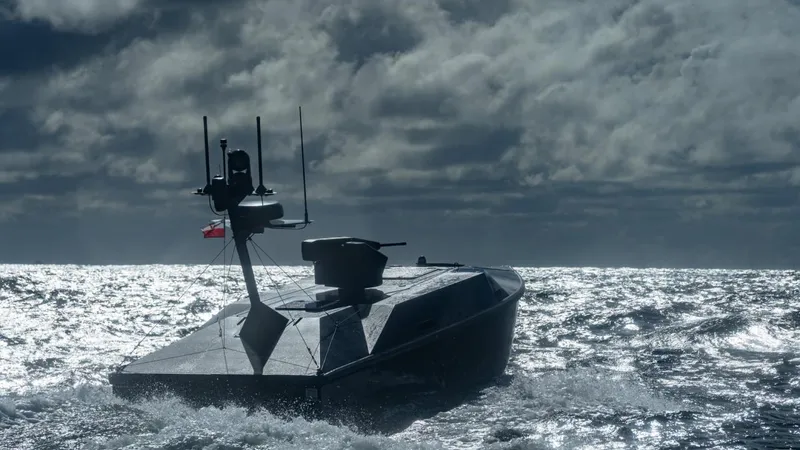
Ships of Poland's 3rd Ship Flotilla practised protecting a convoy against an attack by an uncrewed surface vessel during the Dzielny Okoń-26 exercise, with a StormRider USV playing the attacker. The episode itself was short, but it touches on something rarely discussed in Poland even though it determines the country's supply: whether and how merchant shipping in the Baltic can be protected once a threat appears.
In brief
The StormRider unmanned surface vessel played an enemy attacking a convoy whose escort was practised by warships of the 3 Ship Flotilla during Dzielny Okoń-26. The Maritime Component Command in Gdynia has a Cooperation with Shipping Branch that takes part in NATO work on Naval Cooperation and Guidance for Shipping procedures. More than one hundred and thirty million tonnes of cargo pass through Polish ports every year. The Miecznik programme is to give the Polish Navy three frigates built at PGZ Stocznia Wojenna.
A convoy is a term from the shipping industry rather than a tactics manual. It means a group of merchant ships moved together, in a set formation and under the protection of warships, because sailing alone has become too risky. In the history of both the Baltic and the Atlantic the practice has always returned at the same moment: when losses in shipping stopped being acceptable.
How convoy protection differs from defending a port
Earlier episodes of the same exercise dealt with defending a naval port, a fixed installation. There the defender knows the geography, has permanent observation posts, prepared arcs of fire and a physical barrier at the harbour entrance. Zones can be designated in advance where any contact is treated as suspect.
A convoy has none of that. It is moving, so the background changes by the hour and a threat can come from any direction at any point along the route. Escorts have to hold formation around the protected ships, divide sectors of responsibility among themselves and maintain a common picture in which everyone sees the same thing at the same time. The decision to open fire is taken next to merchant vessels, often in an area used by shipping, fishing boats and leisure craft.
Then there is pace. An uncrewed surface vessel of the StormRider class reaches speeds unavailable to a merchant ship and presents a small, low target with a weak radar signature, particularly in a sea state that breaks up the picture on screen. Detection comes late and the time to react is measured in minutes or seconds.
Why the Baltic is a difficult sea for this
The Baltic is shallow, narrow and crowded. Several thousand ships are on it at any moment, and the distances between shipping lanes and neighbouring territorial waters are short. A convoy has nowhere to run and no room to disperse, while an escort has limited space to manoeuvre and very little time to identify an object closing at speed.
Add conditions that degrade sensors: wave clutter, precipitation, refraction over cold water and the increasingly common jamming and spoofing of satellite navigation signals. Recent years have also brought a series of damaged cables and pipelines, after which NATO launched its Baltic Sentry activity, and the constant presence of shadow fleet vessels.
The precedents are recent, and they involve merchant ships
This is not a theoretical scenario. In the Red Sea, uncrewed surface vessels were used against merchant shipping, with consequences ranging from damage to vessels being lost. Owners responded by changing routes, absorbing higher insurance rates and abandoning the Suez Canal for the passage around Africa, adding weeks to voyages and pushing up freight costs worldwide.
In the Black Sea, the grain corridor operated under the cover of Ukrainian coastal defences and within a regime of close coordination between the military and merchant shipping. It was there that it became clear that what decides the outcome is not only the number of warships but the procedures, the communications and the confidence of masters in the guidance they receive.
Both cases showed the same thing. An attack on merchant shipping does not have to sink many ships to achieve its aim. It is enough for underwriters to raise rates and for owners to start avoiding the area.
NCAGS, where the navy talks to the shipowner
In NATO, cooperation between navies and merchant shipping is handled under Naval Cooperation and Guidance for Shipping. It is a set of procedures and structures through which the military passes owners and masters information on threats, recommended routes, reporting rules and the terms for joining a convoy, and through which it receives their observations from sea in return.
Poland is part of that system. The Maritime Operations Centre, which serves as the Maritime Component Command in Gdynia, has a shipping cooperation branch whose officers take part in the NATO standardisation bodies dealing with NCAGS, alongside representatives of Allied Maritime Command at Northwood and the NATO Shipping Centre. The same command coordinates Polish participation in NATO's Baltic Sentry activity and works with civilian state authorities.
The purpose is practical. The master of a merchant ship is not subordinate to the military and is under no obligation to follow its orders, so the entire system rests on guidance, trust and a functioning flow of information. If an owner does not know how a convoy assembles or what to report, no escort will work, because the ships will not be in the right place at the right time. The question is therefore not whether the procedures exist, but how well owners and masters know them and how often they are exercised together.
For the Polish economy this is a first-order issue. More than 130 million tonnes of cargo pass through the country's ports each year, including fuels, grain, containers and project cargo for the energy sector. Allied logistics travel the same route. In a crisis the bottleneck will not be warships but the ability to keep a regular flow of ships moving into Gdynia, Gdańsk and Świnoujście.
Who would escort those convoys
Convoy protection requires units able to conduct air and surface defence, with sensors capable of picking a small object out of the waves, and to work with aircraft and shore-based surveillance. In practice that means frigates, corvettes and patrol vessels, along with uncrewed systems acting as a forward eye.
The Polish Navy is entering this field during a generational change. The Miecznik programme is to deliver three frigates, built at PGZ Stocznia Wojenna, while uncrewed capabilities are being developed in parallel. Until those enter service, protecting merchant traffic rests on units that are already committed to other tasks: patrolling, mine countermeasures and protection of undersea infrastructure.
The arithmetic is easy to describe and hard to solve. Escorting even a small convoy ties up several warships for many hours, and during that time none of them is doing anything else. Against an opponent using cheap uncrewed vessels, the cost of defence rises faster than the cost of attack, which is precisely the mechanism that has pushed navies back towards guns and low-cost effectors.
What remains from the exercise
The convoy episode signals that the Polish Navy is practising a scenario beyond the protection of its own installations. That is welcome, because the ability to keep shipping moving under threat is as much a part of national security as base defence.
It also raises questions no tactical exercise can answer. How many ships can be escorted, and how often; how frequently the shipping cooperation procedures are exercised together with owners and the maritime administration; and whether, in a crisis, the flow of information between a merchant ship's bridge and a command post would work as smoothly as it does in training.
Those questions are worth asking now, while they are still part of an exercise rather than of a situation in which a tanker waits at anchor for a decision on whether it may enter port.
Source: Gazeta Morska · Compiled by: Kamil Kusier
Related articles
 Safety and rescue Polish SAR’s new rescue vessel Mistral launched at Kewatec in Finland
 Safety and rescue Icelandic Coast Guard and police delegation visits Polish Border Guard’s Maritime Division
 Safety and rescue Polish Navy helicopter evacuates man from Baltic platform 100 km off Władysławowo
 Navy and defence SNMG2 joins Allied warships in PASSEX as Italy's Mare Aperto 2026 gets under way
 Safety and rescue From lightships to solar power: 160 years of the Grundkallen light station
 Education 254 people, manikins and life rafts: Maritime University of Szczecin joins national CPR record attempt
Comments (0)
The discussion is moderated by the editors: a comment appears after review. Your e-mail address is not published.
Nobody has commented on this article yet.