









74 unauthorised drone flights over the Port of Gdańsk. Fines of up to 24,000 zloty, confiscation and prison
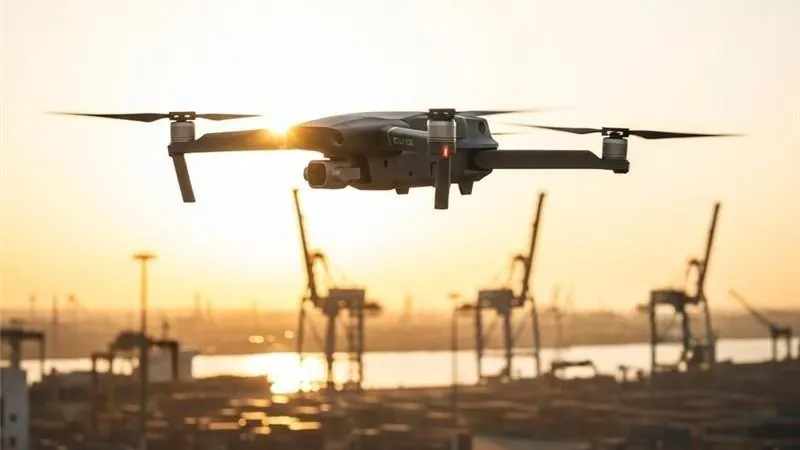
The Port of Gdańsk Operations Centre has recorded 74 incidents involving unauthorised drone flights over the port area this year, an average of around nine a month. The port reminds the public that, as a facility of fundamental importance to the national economy, it is covered by DRA (Drone Restricted Area) zones, and that violating them can result in confiscation of equipment, a fine of up to 24,000 zloty and, in extreme cases, imprisonment. That applies equally to an amateur flight to capture a sunset over the quays.
In brief
The Port of Gdańsk Operations Centre has recorded 74 unauthorised drone flights over the port area since January, an average of about nine a month. The Port of Gdańsk is covered by DRA zones, Drone Restricted Areas, and violating them carries confiscation of equipment, a fine of up to PLN 24 thousand and, in extreme cases, imprisonment. A legal flight requires operator registration at drony.gov.pl, checking the airspace in the Drone Tower app, flying no higher than 120 metres and the consent of the Port of Gdańsk Operations Centre. The Port of Gdańsk stresses that even an amateur flight for a sunset shot can end in criminal proceedings.
The port's statement comes at a moment when unmanned aircraft are the number one topic on the Polish coast, from the Russian Gerbera found on Monday on a beach near Jarosławiec to the debate on protecting critical infrastructure in the Baltic. The Port of Gdańsk points to the other side of the phenomenon: hundreds of thousands of private drones in the hands of users who often do not know that the same restrictions apply over a port as over an airport or a military base.
Nine violations a month
The figure of 74 covers only flights detected by port security since January. The port does not say how many ended in police intervention or criminal proceedings, but the scale alone shows that the problem is constant rather than occasional. On average, every third or fourth day a drone appears without permission over terminals, quays and port channels.
The port stresses that drone technology offers enormous possibilities but demands responsibility. Every flight in the port zone is a potential risk to ship traffic, crane operations and people working on the terminals. A drone colliding with a gantry crane, falling into a tank of hazardous cargo or distracting a pilot during mooring are scenarios that, in a port handling tens of millions of tonnes of cargo a year, are far from abstract.
Penalties as at an airport
DRA zones were introduced in Poland under regulations on unmanned aircraft and cover facilities requiring special protection: airports, military units, power plants, refineries and seaports. Entering such a zone without permission carries an administrative penalty, and where a hazard is created, criminal liability as well. The Port of Gdańsk names three consequences outright: confiscation of equipment, a fine of up to 24,000 zloty and, in extreme cases, prison.
In practice, as the port notes, even an amateur flight made for a striking shot can end in a criminal case if protected airspace was breached. Ignorance of the zone boundaries is no defence.
How to fly legally near the port
The Port of Gdańsk gives a four-point guide for anyone wishing to fly in the port area lawfully. First, register as an operator at drony.gov.pl and mark the drone with the operator number. Second, depending on the drone's weight, free online training and an examination may be required. Third, before every flight check airspace availability in the Drone Tower app and fly in accordance with the rules, within visual line of sight and no higher than 120 metres. Fourth, every flight over the port area requires the consent of the Port of Gdańsk Operations Centre, issued after the relevant documents have been submitted in advance.
The last point is the key one and the most often overlooked. Operator registration and a green light in Drone Tower do not replace the port's consent, because the DRA zone is managed by the port operator, not solely by the Polish Air Navigation Services Agency.
Port security is economic security
The Port of Gdańsk closes its statement with a reminder that the port's security is the security of maritime transport, the regional economy and thousands of people. At a time when Baltic states are investing in drone detection and neutralisation systems and operators of critical infrastructure are expanding their monitoring centres, 74 unauthorised flights over a single port in eight and a half months are a good illustration of the scale of the challenge. Most were probably unwitting hobbyists, but a port security system has to treat every such flight the same way until it establishes who is flying and why.
Source: Gazeta Morska · Compiled by: Michał Iwański
Related articles
 Safety and rescue Polish SAR’s new rescue vessel Mistral launched at Kewatec in Finland
 Safety and rescue Icelandic Coast Guard and police delegation visits Polish Border Guard’s Maritime Division
 Safety and rescue Polish Navy helicopter evacuates man from Baltic platform 100 km off Władysławowo
 Navy and defence SNMG2 joins Allied warships in PASSEX as Italy's Mare Aperto 2026 gets under way
 Safety and rescue From lightships to solar power: 160 years of the Grundkallen light station
 Education 254 people, manikins and life rafts: Maritime University of Szczecin joins national CPR record attempt
Comments (0)
The discussion is moderated by the editors: a comment appears after review. Your e-mail address is not published.
Nobody has commented on this article yet.