









Polish president at Westerplatte: remembrance of 1 September demands truth and responsibility
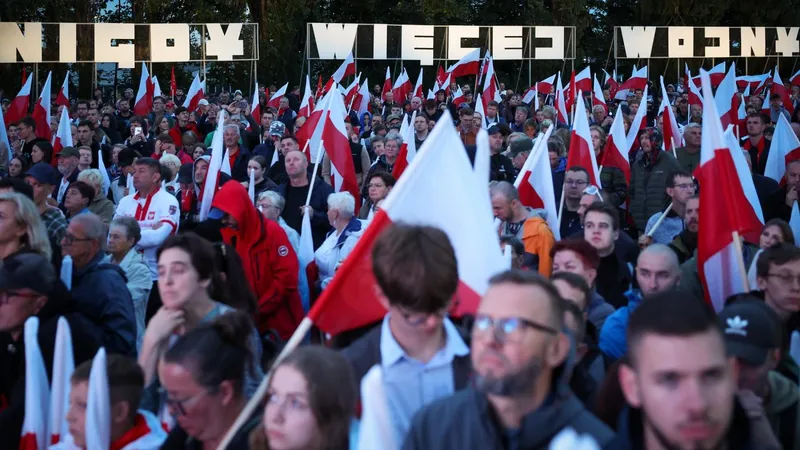
At exactly 4:45 am, the hour of the first salvo fired by the battleship Schleswig-Holstein, the main ceremonies marking the 87th anniversary of the outbreak of the Second World War began at Westerplatte, the peninsula at the entrance to the port of Gdańsk. President Karol Nawrocki said that remembrance of 1 September demands truth and responsibility, and called Westerplatte the most important symbol of that war for Poles. From the peninsula he also appealed to the German chancellor and the German nation to settle the issue of war reparations and compensation, indicating that the funds should go to the Polish Armed Forces and the domestic defence industry.
In brief
President Karol Nawrocki appealed to the German Chancellor and the German nation to settle the issue of reparations and compensation, indicating that the funds should go to the Polish Armed Forces and the domestic defence industry. The main observances of the 87th anniversary of the outbreak of the Second World War began at Westerplatte at 4:45 with the participation of Prime Minister Donald Tusk and Deputy Prime Minister Władysław Kosiniak-Kamysz, and the military fired 12 gun salutes. Karol Nawrocki called Westerplatte the most important symbol of that war for Poles and asked the Polish government for support in efforts to obtain reparations.
Sirens at 4:45 am by the Monument to the Coast Defenders
The ceremonies at the Monument to the Coast Defenders opened with the sound of air-raid sirens, followed by a staged roar of gunfire and flares symbolising incoming shells. Those gathered sang the national anthem, the Polish flag was raised, and the Peace Torch was lit by a cadet of the Polish Naval Academy. After the roll call of remembrance, the military fired a 12-gun salute. Earlier, a wreath inscribed From the Nation had been laid at the Cemetery of Polish Army Soldiers at Westerplatte.
The ceremonies were attended by President Karol Nawrocki, Prime Minister Donald Tusk and Deputy Prime Minister and Defence Minister Władysław Kosiniak-Kamysz, as well as the Chief of the General Staff, General Wiesław Kukuła, the Mayor of Gdańsk Aleksandra Dulkiewicz, veterans, soldiers, scouts and residents of the Tricity.
Truth has its symbols
The president devoted the first part of his address to memory and responsibility for history. He stressed that Westerplatte is for Poles the most important symbol of that war, a symbol of struggle, while Wieluń, bombed the same morning, remains a symbol of suffering, and he recalled the hecatomb of the Polish nation under German and Soviet occupation.
– Remembrance of 1 September demands truth and responsibility from us, and truth has its symbols, it has its facts, truth also has its signs – said Karol Nawrocki.
An appeal for reparations
The strongest element of the speech was an appeal addressed directly to Berlin. The president said that the truth about the Second World War is little known in Germany and problematic also for those in power, and that the German capital still lacks a monument to the Polish victims of the war. Successive German governments have long maintained that the issue of reparations is legally closed.
– I appeal from here, from Westerplatte, to the German chancellor and the German nation - let us settle the matter of reparations and compensation – said Karol Nawrocki.
The president argued that the payment of reparations is not merely a question of settling the past.
– Not only for historical justice, but also for the future. So that we do not have to take Western loans, so that we receive what we are owed. Today these reparations can serve security. Let us be together in this task. I ask the Polish government for support in seeking reparations. This is an appeal that flows from Westerplatte – said Karol Nawrocki.
The president indicated that the funds obtained from Germany should go to the Polish Armed Forces and the domestic defence industry. From the stage he also turned directly to Prime Minister Donald Tusk, asking for joint, cross-party action on reparations.
The prime minister and the defence minister also spoke
Prime Minister Donald Tusk spoke about unity above divisions, recalling that the defenders of Westerplatte had one uniform and one order, and about the limit of political dispute beyond which it stops being a dispute and becomes a gift to those who wish Poland ill. He also warned against the consequences of concessions to Russia and said that the coming months, this autumn and winter, may prove decisive for the independence of Ukraine, but also for the security of Poland and the entire free world. Deputy Prime Minister Władysław Kosiniak-Kamysz stressed in turn that courage cannot be the only equipment of a Polish soldier - we cover his address in a separate article. The Mayor of Gdańsk Aleksandra Dulkiewicz also took the floor, reminding those gathered that war knows neither sex nor age.
Source: Gazeta Morska · Compiled by: Kamil Kusier
Related articles
 History Two Lancaster wrecks, one operation. The bombers fell over the Baltic laying mines still disarmed today
 History Seven dead in war, seven in peacetime. Błyskawica turns 90 and still flies the ensign
 Shipbuilding industry Batavia goes ashore. The Dutch show what to do with a ship no longer worth keeping afloat
 History 17 September 1939. The Soviets invaded Poland. Aggression, deportations and Katyn
 Navy and defence 563 years ago Gdańsk and Elbląg destroyed the Teutonic fleet. 44 vessels against 30 privateers
 History Nearly 5,000 motorcycles ride to Piaśnica. The memory of a crime the Germans failed to burn
Comments (0)
The discussion is moderated by the editors: a comment appears after review. Your e-mail address is not published.
Nobody has commented on this article yet.