









Polish Navy marks 108 years of independence in Gdynia and Świnoujście as Gdynia celebrates its centenary
Sailors of the Polish Navy stood guard of honour at the Maritime Poland Monument in Gdynia and marched through the streets of Świnoujście on 11 November, as Poland marked the 108th anniversary of regaining independence. In both naval towns the day was shared with residents, and in Gdynia it carried extra weight: the city is celebrating 100 years since it received its town charter.
In brief
The Polish Navy marked the 108th anniversary of Poland regaining independence on 11 November together with the residents of Gdynia and Świnoujście. In Gdynia, the Gdynia Independence Parade marched along Świętojańska Street to the Monument to Maritime Poland, where a salute was fired from the deck of ORP Błyskawica. In Świnoujście, sailors of the 8th Coastal Defence Flotilla walked in a ceremonial procession and showed military equipment at an independence picnic after the official part. Gdynia is celebrating this year the centenary of receiving municipal rights in 1926.
Gdynia: a parade down Świętojańska Street and a 100-metre flag
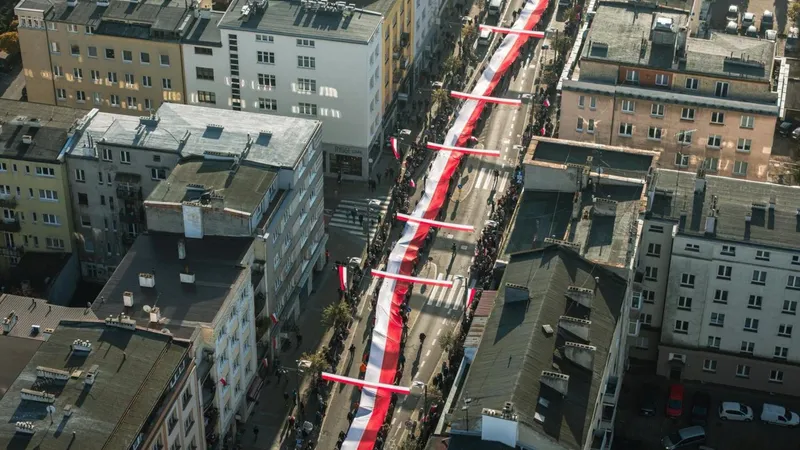
At noon the Gdynia Independence Parade set off from the City Hall and moved along Świętojańska Street to Kościuszko Square. Schoolchildren, sports clubs, associations, vintage car enthusiasts and families walked together, carrying a 100-metre white-and-red flag prepared by residents for the city's centenary.
The march ended at the Maritime Poland Monument, where official ceremonies were held with a Polish Navy guard of honour, city authorities, the Navy's command and delegations of civic organisations. The programme included the national anthem, a roll call of remembrance, a gun salute from the museum ship ORP Błyskawica, a march-past by the guard of honour and the laying of a wreath on behalf of the nation.
ORP Błyskawica, moored a short walk from the monument, is the oldest preserved destroyer in the world and a veteran of the entire Second World War at sea. The Naval Museum in Gdynia opened its doors free of charge for the day.
Świnoujście: sailors of the 8th Coastal Defence Flotilla march with residents
At the western end of the Polish coast, celebrations began with a Mass in the Garrison Church. A ceremonial procession then passed through the streets of Świnoujście, with sailors of the 8th Coastal Defence Flotilla marching alongside local government representatives and residents.
In the presence of a Navy guard of honour, representatives of the armed forces, local authorities and uniformed services paid tribute to those who fought for a free Poland. The Military Band from Szczecin provided the music, and the City Council held a ceremonial session. The official part was followed by an independence picnic, with displays of military equipment by the 8th Flotilla and artistic performances.
A navy founded seventeen days after independence
Poland returned to the map of Europe on 11 November 1918, after 123 years of partition by Russia, Prussia and Austria. Seventeen days later, on 28 November, Józef Piłsudski signed the decree establishing the Polish Navy, with Colonel Bogumił Nowotny as its first chief.
The young state understood from the outset that independence required access to the sea. On 10 February 1920, in Puck, General Józef Haller performed Poland's symbolic wedding to the sea. Two years later parliament decided to build a port at Gdynia, then a small fishing village.
Gdynia at 100: a city built for a free Poland
Gdynia received its town charter in 1926 and within little more than a decade became one of the most modern ports on the Baltic and the main base of the Polish fleet. No other Polish city owes its existence so directly to independence.
The naval port at Oksywie, the shipyards and the Polish Naval Academy remain part of the city's everyday landscape. That is why a parade ending at the Maritime Poland Monument is more than a tradition here. It is how the people of Gdynia remind themselves each year where their city came from.
The fleet guarding the Baltic 108 years on
The sailors who stood guard of honour on 11 November serve in a navy undergoing its largest modernisation in decades. In August, ORP Wicher, the first frigate of the Miecznik programme, was launched at PGZ Stocznia Wojenna in Gdynia. The minehunter ORP Mewa is deployed with Standing NATO Mine Countermeasures Group 1 until the end of the year, and further Kormoran II class ships are under construction in Gdańsk.
The fleet's tasks are as concrete today as they were in 1918: protecting the ports that handle most of Poland's trade, shipping lanes, gas terminals, subsea cables and offshore wind farms. On the Baltic, the independence regained 108 years ago has its guardians, and in Gdynia and Świnoujście the people of the coast came out to stand with them.
Source: Gazeta Morska · Compiled by: Kamil Kusier
Related articles
 History Seven dead in war, seven in peacetime. Błyskawica turns 90 and still flies the ensign
 Shipbuilding industry Batavia goes ashore. The Dutch show what to do with a ship no longer worth keeping afloat
 History 17 September 1939. The Soviets invaded Poland. Aggression, deportations and Katyn
 Navy and defence 563 years ago Gdańsk and Elbląg destroyed the Teutonic fleet. 44 vessels against 30 privateers
 History Nearly 5,000 motorcycles ride to Piaśnica. The memory of a crime the Germans failed to burn
 History Suicide according to the secret police, murder according to Solidarity. IPN seeks answers 43 years on
Comments (0)
The discussion is moderated by the editors: a comment appears after review. Your e-mail address is not published.
Nobody has commented on this article yet.