









Gdańsk conservator moves to expropriate the port workers’ Maritime Culture House in Nowy Port
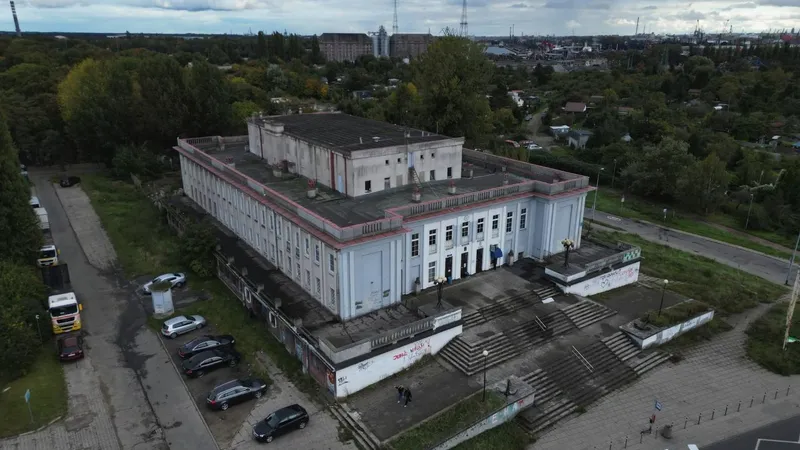
The Pomeranian Provincial Conservator of Monuments has asked the City of Gdańsk to begin expropriation proceedings against the Maritime Culture House (Morski Dom Kultury) in the port district of Nowy Port and to transfer the listed building to the State Treasury. After two decades of decay, the socialist realist landmark that served Gdańsk's port workers for forty years now has a real chance of being saved.
In brief
Morski Dom Kultury in Nowy Port may become property of the State Treasury after the Pomeranian Voivodeship Monuments Conservator asked the City of Gdańsk to expropriate the historic building. The Łódź company Central Fund Of Immovables, perpetual usufructuary since 2006, failed to carry out ordered works despite a warning in July 2023 and a fine. The socialist realist Morski Dom Kultury building, opened on 7 November 1954, was entered in the monuments register in 2012. The City of Gdańsk will conduct the expropriation proceedings for Morski Dom Kultury.
Years of ignored orders
The building's perpetual usufructuary since 2006 has been Central Fund Of Immovables, a property company based in Łódź. According to the conservator, the owner is unable to care for the monument properly and its condition continues to deteriorate. Since 2022 the conservator's office has inspected the building several times and ordered the owner to secure the roof, repair the gutters, remove damp plaster, treat the walls for fungus and replaster where necessary. A formal warning followed in July 2023, then a fine. In summer 2024, after the fine was imposed, the owner applied for and received a permit for the works, yet no repairs were carried out, not even basic protective measures. The most urgent threat is to the interiors, which are at risk from a leaking roof.
Expropriation is the strongest tool Polish heritage law offers when a listed building faces destruction and its owner fails to act, and it is used rarely. In this case, the conservator sees no alternative.
- If the building remains in the hands of its current owner, it will undoubtedly be completely destroyed and degraded - the conservator states in the justification of the application.
A culture palace for the port
The Maritime Culture House opened on 7 November 1954. Designed by architect Witold Rakowski, the socialist realist building was at the planning stage meant to echo Warsaw's Palace of Culture and Science, and formed part of an ambitious scheme to build a new city centre for Gdańsk in Nowy Port, replacing the war-ravaged historic core. The wider plan was abandoned after 1956, but the culture house was completed.
The building belonged to the Port of Gdańsk, and port workers and their families were its main audience. It housed a theatre, a cinema, a café and a reading room, and hosted language courses, music and dance events, as well as photography, ship modelling and dance classes for children. In 1958 it staged the first premiere of the Musical Theatre, which moved to Gdynia two years later. The port authority sold the building in the 1990s, ending its original role.
A community that never gave up
Residents of Nowy Port have been fighting for the building for more than three decades. In 1992 they founded the Maritime Culture House Society to restore its cultural role, and it was thanks to the society's efforts that the building was entered in the register of monuments in 2012. The listing decision ranked it among the most important examples of architecture built on the Polish coast after 1945, and the building was protected in its entirety, as much of its original interior has survived.
The Nowy Port District Council has welcomed the conservator's move. The decision now lies with the City of Gdańsk, which will conduct the expropriation proceedings. After years of orders that never turned into repairs, the case is for the first time heading in a direction that gives one of Gdańsk's most distinctive post-war buildings a genuine chance of survival.
Source: Gazeta Morska · Compiled by: Kamil Kusier
Related articles
 Energy and offshore Equinor takes over Bałtyk 2 and 3 O&M base in Łeba. Port to serve 1.44 GW of offshore wind for 30 years
 Navy and defence Port Gdański Eksploatacja secures NATO NCAGE code. Gdańsk port company lines up for defence tenders
 Shipbuilding industry Ex-Enterprise towed to Mobile under $418.5m contract. Test case for Nimitz-class disposal begins
 Energy and offshore Energa renames Gdańsk gas plant company as foundations for 6,000-tonne turbine and boiler are laid
 Equipment and technology WB Group takes Polish drones from Tokyo to SOFEX in Jordan in a single week
 Ports and logistics PGE books Gdańsk’s T5 terminal for the long haul: Baltica 2 first, then more offshore wind farms
Comments (0)
The discussion is moderated by the editors: a comment appears after review. Your e-mail address is not published.
Nobody has commented on this article yet.