









Batavia goes ashore. The Dutch show what to do with a ship no longer worth keeping afloat
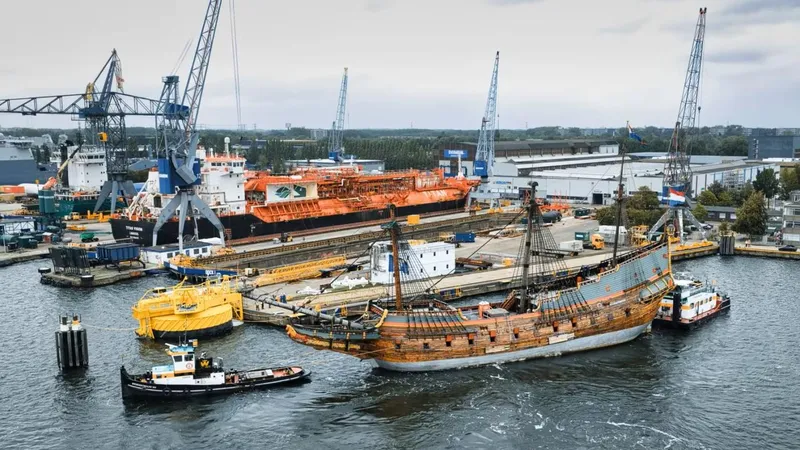
The replica of the Batavia, a 56-metre Dutch East India Company ship of 1628, is ending 31 years afloat. On 19 September the vessel returned to Damen Shiprepair Amsterdam, the yard from whose dock she was launched in 1995, and on 1 October she is due to be hauled ashore at Museum Batavialand in Lelystad, where she will stand in a steel cradle.
In brief
Museum Batavialand in Lelystad will place the Batavia replica on land in a 90-tonne steel cradle, as the wooden hull needs protection after 31 years in the water. Niron Staal built the cradle, and Damen Shiprepair Amsterdam is carrying out the operation in Dock 4, measuring 450 by 39 metres with an 8-metre draught. Hauling the Batavia replica ashore in Lelystad is scheduled for 1 October. The replica of the 56-metre ship from 1628 was launched on 10 April 1995.
It is an operation worth watching from the Polish shore. For weeks Poland has been arguing over where the sail training ship Dar Młodzieży should go when she retires and what keeping her as a museum would cost. The Dutch are answering the same question in practice.
A ship built by young people
The replica was built between 1985 and 1995 by Willem Vos, using traditional techniques and materials. From the outset the project had a social dimension: dozens of young people learned traditional carpentry and shipwrighting on the hull. On 10 April 1995 the Batavia was lowered into the water from Dock 4 of the Amsterdam yard and towed to Lelystad, where for three decades she was the museum's main attraction and a living monument to craftsmanship.
A wooden hull, however, does not age like a steel one. After 31 years in the water the museum concluded that the only way to preserve the ship for future generations was to take her out of it.
Ninety tonnes of steel under the hull
The museum commissioned Niron Staal, a sister company of the Damen yard, to build a cradle of 90 tonnes of steel. It took two months to construct on the yard's premises, was then blasted and painted, and the museum added timber so that the hull would have a cushioned landing.
The yard lifted the cradle onto a transport pontoon and submerged it in Dock 4, which measures 450 by 39 metres. The dock's 8-metre draught is what makes it one of the few places in the Netherlands where such an operation is possible at all, since the combined draught of pontoon and ship is what counts. The Batavia will be towed into the dock and positioned over the cradle, the dock pumped dry, and the ship slowly lowered into place. The pontoon will then be refloated with the hull on it and set off on the final voyage to Lelystad.
Before that, museum volunteers will spend several days removing the 20-kilogramme lead ballast pigs that have kept the ship stable in the water. In Lelystad self-propelled modular transporters will pull her ashore.
The same yard, a different generation
For Damen Shiprepair Amsterdam the project closes a circle. The yard's commercial manager, Paul van de Craats, recalls hearing stories of the Batavia's launch from colleagues when he joined in 2000, and following her construction as a naval architecture student in the 1990s. Some of those workers are involved in the current operation.
The yard links the project to its own programmes training young people for careers in ship repair. The statement makes an argument rarely heard in Poland: preserving maritime heritage and preserving shipyard trades are one and the same task.
What it means for Dar Młodzieży
The Batavia's story shows three things missing from the Polish debate.
First, taking a ship out of the water is a decision about costs. A hull afloat needs dockings, underwater maintenance, a crew and supervision. A hull ashore needs a single expensive operation and a cradle, and after that mainly a roof or good preservation. Gdynia talks of 25 to 50 million zloty for conversion and 2.5 to 4 million a year for upkeep, but nobody has costed the dry-land option.
Second, such an operation needs infrastructure: a 450-metre dock with an 8-metre draught, a pontoon, a steel company on hand. Poland's largest docks are in Gdańsk, Gdynia and Szczecin, and the question of which could take a 112-metre sailing ship on a pontoon is a concrete one, not a rhetorical one.
Third, the Dutch did not frame the matter as a contest between cities. The yard, the steel company, the museum and the volunteers work on one project, each with a role. In Poland the discussion began with the question of who should get the ship, rather than what to do with it.
The Batavia is not a template to copy, because Dar Młodzieży is steel and can sail for years yet. She is an example that the decision about a historic ship's future begins with engineering and money, and ends with an address.
Source: Gazeta Morska · Compiled by: Kamil Kusier
Related articles
 Energy and offshore Equinor takes over Bałtyk 2 and 3 O&M base in Łeba. Port to serve 1.44 GW of offshore wind for 30 years
 Navy and defence Port Gdański Eksploatacja secures NATO NCAGE code. Gdańsk port company lines up for defence tenders
 Shipbuilding industry Ex-Enterprise towed to Mobile under $418.5m contract. Test case for Nimitz-class disposal begins
 Energy and offshore Energa renames Gdańsk gas plant company as foundations for 6,000-tonne turbine and boiler are laid
 Equipment and technology WB Group takes Polish drones from Tokyo to SOFEX in Jordan in a single week
 Ports and logistics PGE books Gdańsk’s T5 terminal for the long haul: Baltica 2 first, then more offshore wind farms
Comments (0)
The discussion is moderated by the editors: a comment appears after review. Your e-mail address is not published.
Nobody has commented on this article yet.