









17 September 1939. The Soviets invaded Poland. Aggression, deportations and Katyn
On 1 September 1939 Germany attacked Poland. On 17 September the Red Army crossed the border from the east. It was not an accident, it was not a mission to protect anyone, and it was not a response to the supposed collapse of the Polish state. It was a planned act of aggression by the Soviet Union, the execution of an agreement made earlier by Joseph Stalin and Adolf Hitler. Behind the Soviet tanks came arrests, executions, the deportation of entire families, the Sovietisation of the occupied lands and, finally, Katyn. On 17 September 1939 one of the most tragic chapters in the history of the Second Polish Republic began.
In brief
The Red Army crossed the border of the Republic of Poland on 17 September 1939, implementing the secret protocol of the Ribbentrop-Molotov Pact of 23 August 1939. Units of the Border Protection Corps fought at Szack on 28 and 29 September, and Grodno defended itself from 20 to 22 September. According to the IPN, at least 320 thousand Polish citizens were deported in four deportations of 1940 and 1941, and in spring 1940 the NKVD murdered nearly 22 thousand citizens of the Republic of Poland, including Rear Admiral (lower half) Xawery Czernicki, co-founder of the naval port in Gdynia. The IPN is conducting an investigation into the killing of at least 21,768 Polish citizens.
The decision was taken in Moscow, in agreement with Berlin
On the morning of 17 September 1939 Poland had been at war with Germany for more than two weeks. The Polish Army was fighting in the west, north and south of the country. Warsaw was under bombardment, the Hel Peninsula, Modlin and Lwów were still holding out, and Polish units were trying to stem the German advance. The Polish state, however, still existed. The government was functioning, the president held office, the army was fighting, and the Polish authorities had taken no decision to capitulate. It was then that a second army approached from the east. At dawn on 17 September the Red Army crossed the frontier of the Republic along its entire length. The Soviets attacked a state already at war with the Third Reich.
Moscow tried to give the invasion a veneer of legality. During the night the Polish ambassador in Moscow, Wacław Grzybowski, was handed a note in which the Soviet authorities claimed that the Polish state had ceased to exist and that its government had left the country. The Soviet Union presented its intervention as a necessity to protect the Ukrainian and Belarusian population. Wacław Grzybowski refused to accept the note. It was a propaganda construct designed to hide the real nature of events. Poland's eastern frontier had been crossed by foreign troops, and the aim of the operation was to seize territory belonging to the Republic. The Soviets did not march into no man's land. They marched into Poland.
Most importantly, the decision to enter Poland was not taken on 17 September. It had been taken earlier, in Moscow, in agreement with Berlin. The Molotov-Ribbentrop Pact of 23 August 1939 was formally a non-aggression treaty between the Third Reich and the Soviet Union, but its secret additional protocol carved out spheres of interest for both powers in Central and Eastern Europe. In that plan Poland was divided between its two totalitarian neighbours. A few days later Germany attacked from the west. On 17 September Joseph Stalin carried out the Soviet part of the bargain. That is why 17 September cannot be told as an event detached from the German aggression. Both dates belong to a single story: the partition of Poland by two totalitarian powers.
Poland did not surrender without a fight
In Polish memory 17 September is associated above all with the hopeless position of a state attacked simultaneously by Germany and the Soviet Union. It should not be forgotten, however, that Polish soldiers resisted in the east as well, and did so for nearly two weeks after the Soviet entry. Units of the Border Protection Corps (KOP) took up the fight against the Red Army. There were engagements in which the Poles inflicted serious losses on the Soviets. The KOP grouping under General Wilhelm Orlik-Rückemann fought the Battle of Szack on 28 and 29 September, and a special place in memory belongs to the defence of Grodno on 20-22 September. The city held out for three days, with scouts and schoolchildren joining the defence. The symbol of that fight became thirteen-year-old Tadeusz Jasiński, whom Soviet tank crews tied to the hull of a tank as a human shield; he died in his mother's arms.
Grodno matters also because it shows the nature of the Soviet aggression. There was street fighting in the city, and after its capture the Soviets executed captured defenders. At Mielniki, wounded KOP soldiers and officers taken prisoner after the fighting at Szack were murdered. At Mokrany, officers of the Pinsk Flotilla captured by the Red Army were handed over to a local militia and shot. These events show that 17 September was not merely a movement of troops on a map. From the first hours of the Soviet occupation came repression and crimes against Polish soldiers.
Poland's situation was nonetheless tragic. In the west it was fighting Germany, in the east it had been attacked by the Soviet Union, and the expected military help from its Western allies did not arrive on a scale that could change the course of the campaign. By the end of September the Soviets had occupied the eastern provinces of the Republic. In the west the fight against Germany continued. Warsaw capitulated on 28 September, Modlin a day later, Hel on 2 October, and the last major battle of the September campaign ended at Kock on 6 October. Poland lost the military campaign, but that did not mean the end of Polish resistance.
Soviet occupation. First the state, then the individual
The full apparatus of the Soviet state followed close behind the Red Army. The occupied lands were subjected to a violent political, social and economic transformation. Polish institutions were dissolved, Soviet administrative structures introduced, property nationalised and Soviet passports imposed. Schools and education were subordinated to the new system, while arrests and repression began against anyone deemed a threat to the Soviet order. The aim of this policy, as Poland's Institute of National Remembrance (IPN) notes, was the Sovietisation of the occupied territory, the erasure of every trace of Polish statehood and the subjugation of the population to the new system.
The essence of the occupation was therefore an attempt to rebuild an entire society. A person who had been a citizen of the Republic the day before was to become a Soviet citizen. Anyone connected with the state, the army, the police, the administration, the railways, the forestry service or public life became particularly suspect to the new authorities. A veneer of legality for the annexation was to be provided by elections to assemblies that then petitioned for the incorporation of the occupied territory into the Soviet Union. In reality the decision had been taken in Moscow, and the local population was placed under the pressure of the new regime. The eastern provinces of the Second Republic ceased to be part of the Polish state.
The deportations began. Whole families vanished into railway wagons
Among the most massive forms of Soviet repression were the deportations. On the night of 9 to 10 February 1940 the first great wave began. Its victims were above all military and civilian settlers and forestry workers, together with their families. According to IPN, around 140,000 Polish citizens were deported at that time. A few months later, on 13 April, the second great deportation began, targeting among others the families of officers, policemen, officials and other people persecuted by the Soviet authorities. Some 60,000 to 61,000 people were taken. Further deportations followed in the summer of 1940 and in June 1941. According to IPN's figures, at least 320,000 Polish citizens were deported in the four great waves of 1940-1941.
Behind those numbers were real families. Women, children, the elderly and the sick lost their homes within a few hours. Soviet officers appeared at night or before dawn, allowed little time to pack the barest essentials, and then transported entire families to railway stations. There the cattle wagons waited, to become the scene of journeys lasting days into the depths of the Soviet Union. People were sent to Siberia, Kazakhstan, the Far North and other remote regions. Many died on the way or after arrival, where they were forced to work in appalling conditions. The names of these people have been collected for years by the Index of the Repressed, now maintained by IPN: hundreds of thousands of records, each of them a single human being.
The deportations were not random wartime chaos. They were an element of Soviet policy, directed against specific social groups, especially those that could provide support for Polish statehood and Polish identity. Removing these people was meant to ease the Sovietisation of the occupied lands. Deportation was thus at once a punishment of the individual and a tool for reshaping an entire society.
Katyn. A shot at the Polish elite
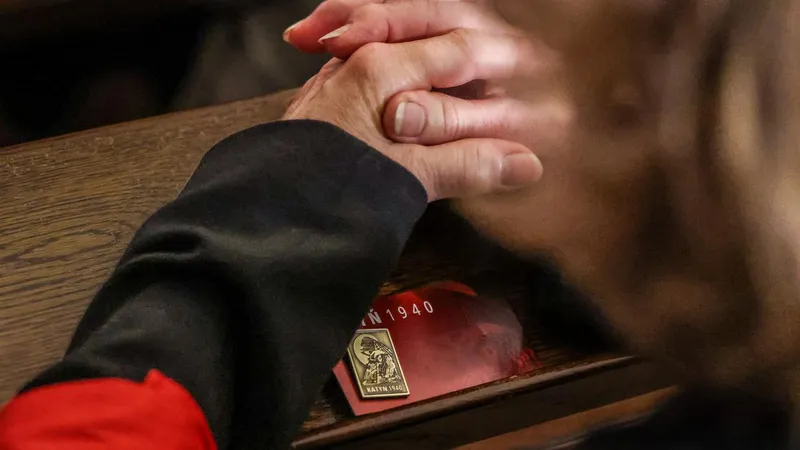
If the deportations were meant to break society and remove people deemed dangerous, Katyn was the next, still more brutal stage of the same policy. On 5 March 1940 the Politburo of the Soviet Communist Party took the decision to murder Polish prisoners of war and prisoners. In the spring of 1940 NKVD officers killed nearly 22,000 citizens of the Republic. Among the victims were around 14,500 prisoners of war, mainly officers and policemen from the camps at Kozelsk, Starobelsk and Ostashkov, and around 7,300 prisoners held in Soviet jails in occupied Poland.
It was no random massacre. The murdered belonged to Poland's military and state elite: officers, policemen, officials and members of the intelligentsia, the great majority of them reservists, and in civilian life doctors, teachers, engineers and lawyers. What they had in common was their connection to the Polish state and their status as its citizens. The Soviet authorities judged them people who could not be subordinated to the new system. The decision of 5 March 1940 was aimed at those who might one day form the cadres of a reborn Poland.
Katyn is not a single place. The name became the symbol of the whole crime. Prisoners from Kozelsk were murdered at Katyn, those from Starobelsk in Kharkiv, and the policemen from Ostashkov in Kalinin, today's Tver. Prisoners from the jails were executed in Minsk, Kyiv, Kharkiv and Kherson, among other places. Soviet documents that survive to this day allow the scale of the operation to be reconstructed. IPN is conducting an investigation into the killing of at least 21,768 Polish citizens.
For Poland's coast the crime also has a maritime dimension. Rear Admiral Xawery Czernicki, head of the technical services of the Polish Navy command, one of the builders of the naval port at Gdynia and of Poland's shipbuilding industry, was held at Kozelsk and died at Katyn. Generals Mieczysław Smorawiński and Bronisław Bohatyrewicz were murdered, as was the only woman among the Katyn victims, Second Lieutenant Janina Lewandowska, a pilot. Among the 21,768 names are also officers of the Pinsk Flotilla and the Polish Navy who fell into Soviet captivity after 17 September.
First they killed. Then they lied
The Katyn massacre had one more dimension. The Soviets wanted not only to kill people but to hide their responsibility for the deaths. When Germany revealed the graves at Katyn in 1943, Soviet propaganda immediately tried to shift the blame onto the Germans. After the war the Katyn lie was written into the official narrative of the communist states. For decades it was impossible in Poland to say openly that the NKVD and the Soviet authorities were responsible.
That is why the history of 17 September carries such particular weight. The Soviet aggression was not merely an attempt to seize part of Polish territory. It was accompanied by an attempt to destroy the Polish elite, deport whole social groups and subjugate the population to a new system. And when part of the crime came to light, a struggle began for control over memory. The state that had murdered tried at the same time to decide who would be named the murderer. The memory of Katyn survived thanks to the victims' families, the émigré community, historians and people who for decades refused to accept the lie as truth.
17 September changed the map of Poland for ever
For an inhabitant of Lwów, Wilno, Grodno, Tarnopol, Stanisławów or Nowogródek, 17 September was the day after which his world began to disappear. The state of which he was a citizen changed. The law, the school, the administration and the economy changed. Some went to prison, others to deportation wagons, others still to prisoner-of-war camps. Some died in executions. For many families the war meant not only death but the collapse of their entire former life.
After the war Poland's border was moved westwards. The eastern borderlands, the Kresy, were left outside the Polish state, and millions of people were resettled. Not all the inhabitants of the former eastern lands of the Second Republic could return home. Some found themselves within Poland's new borders, some remained in territory incorporated into the Soviet Union, and some had already been deported into the depths of the Soviet empire. In Pomerania that is visible to this day. After 1945 Gdańsk, Gdynia, Sopot and the smaller towns of the coast were largely settled by people from Wilno, Grodno, Lwów and the Nowogródek region. For a large part of the region's population 17 September is not a date from a textbook but the story of parents and grandparents who came here because they could no longer return to their own homes.
That is why 17 September is not merely a military date. It is the date on which hundreds of thousands of people lost their homes, the date on which Soviet terror began in the eastern lands of the Republic, the date that leads through the deportations and Katyn to the post-war redrawing of borders. Within a few years the world that generations of Kresy inhabitants had built was destroyed. What remains are cemeteries, photographs, letters, memories and names. And the memory of families who knew for decades that their loved ones had not died in some anonymous wartime catastrophe. They were murdered or deported by a specific system and a specific regime.
Two aggressions, one partition
Remembering the Soviet aggression takes nothing away from the memory of the German invasion. On the contrary, only remembering both makes it possible to understand Poland's tragedy in 1939. On 1 September the Third Reich attacked. On 17 September the Soviet Union attacked. Both states acted for their own reasons and pursued their own interests, but in the first weeks of the war their actions produced a common result: the partition of the Republic's territory and the destruction of its independent state. The Molotov-Ribbentrop Pact was not a footnote to the history of the war. It was one of the key documents that made that scenario possible.
There is no need, then, to choose which occupier to remember more. Nor to soften one of these events in order to stress the importance of the other. Poland was attacked by Germany and by the Soviet Union. Terror was applied in both occupied zones, though the two systems had their own ideologies, institutions and methods. The Germans pursued an occupation policy based on Nazi racism and plans of extermination; the Soviets one based on communist dictatorship, class and political repression, deportations and the liquidation of the structures of the Polish state. History does not need simplification to be tragic enough.
87 years on. Behind the numbers stand names
Today, 87 years after the Soviet aggression, what matters most are the names. The individual must not be allowed to vanish behind the great numbers. Behind the figure of 22,000 Katyn victims stand Rear Admiral Xawery Czernicki, General Mieczysław Smorawiński, Second Lieutenant Janina Lewandowska and thousands of reserve officers, policemen and officials whose names can be found today on the NKVD transport lists. Behind the figure of more than 320,000 deportees stand families who one winter night were torn from their homes and loaded into wagons heading east, and whose fates are reconstructed by the Index of the Repressed. History becomes real only when we see the human being behind the statistic.
On 17 September 1939 the Soviets invaded Poland, breaking the Treaty of Riga of 1921 and the Polish-Soviet non-aggression pact of 1932, extended two years later until 1945, while carrying out their earlier arrangements with the Third Reich. Then came occupation, terror, deportations, executions and Katyn. Then came decades in which the truth about some of these events could not be spoken. The Soviet Union disappeared from the map, but its crimes did not disappear with it. The documents, the graves, the lists of names and the families' memories remain. And so does the date: 17 September 1939.
It is a day of remembrance for a state attacked by two totalitarian neighbours. For soldiers who fought despite a hopeless situation. For families torn from their homes and sent thousands of kilometres to the east. For Polish officers and servants of the state murdered by the NKVD. For the Kresy, cut off from Poland. And, finally, for a truth that for decades was covered with a lie.
17 September is not a date that needs embellishing. It is enough to tell the truth. The Red Army marched into Poland, and behind it came a system that, through repression, deportation, murder and Sovietisation, tried to take from the Poles not only their land but their state, their memory and their identity. That day began a history that must not be forgotten.
Source: Gazeta Morska · Compiled by: Kamil Kusier
Related articles
 History Gdańsk conservator moves to expropriate the port workers’ Maritime Culture House in Nowy Port
 History Polish Naval Museum in Gdynia opens its doors on Independence Day, 11 November
 History Two Lancaster wrecks, one operation. The bombers fell over the Baltic laying mines still disarmed today
 History Seven dead in war, seven in peacetime. Błyskawica turns 90 and still flies the ensign
 Shipbuilding industry Batavia goes ashore. The Dutch show what to do with a ship no longer worth keeping afloat
 Navy and defence 563 years ago Gdańsk and Elbląg destroyed the Teutonic fleet. 44 vessels against 30 privateers
Comments (0)
The discussion is moderated by the editors: a comment appears after review. Your e-mail address is not published.
Nobody has commented on this article yet.