









563 years ago Gdańsk and Elbląg destroyed the Teutonic fleet. 44 vessels against 30 privateers
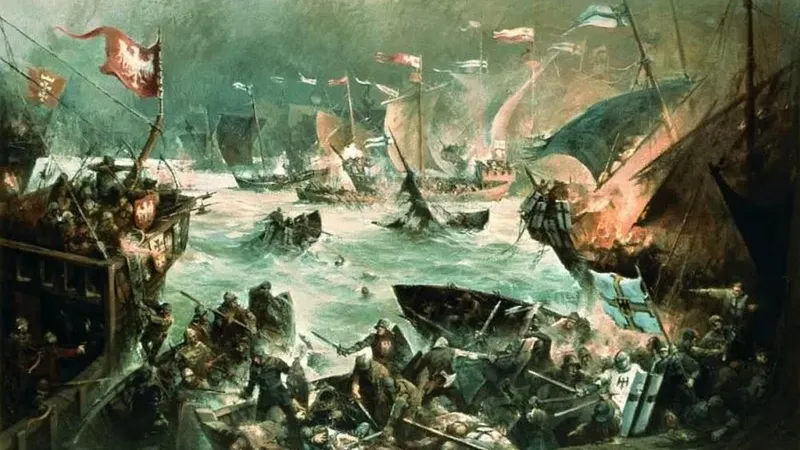
On 15 September 1463, on the waters of the Vistula Lagoon between today's Kamionek Wielki and Suchacz, the fleet of Gdańsk and Elbląg surrounded and destroyed a Teutonic flotilla led in person by Grand Master Ludwig von Erlichshausen. The Teutonic Knights had 44 vessels and around 1,500 men; the Polish-Prussian side had 30 to 32 ships. The outcome was decided by the experience of the privateers, surprise and fire. It was the largest naval battle of medieval Poland and one of the decisions that sealed the recovery of Gdańsk Pomerania in the Peace of Toruń of 1466.
In brief
The fleet of Gdańsk and Elbląg destroyed on 15 September 1463 in the Zatoka Świeża bay on the Vistula Lagoon a Teutonic Order flotilla commanded by Grand Master Ludwig von Erlichshausen. The Teutonic Knights had 44 vessels and about 1,500 men, while the Polish-Prussian side had 30 to 32 ships under privateer captains Wincenty Stolle, Maciej Kolmener and Jakub Vochs. The privateers encircled the enemy in a crescent formation, set many vessels on fire with burning bolts and carried out boardings, and the Grand Master fled by boat to Königsberg. After the battle Gniew capitulated in early 1464, and the Second Peace of Toruń of 1466 restored Gdańsk Pomerania to Poland.
The Thirteen Years' War is usually told through its land battles: the defeat at Chojnice in 1454 and the victory at Świecino in 1462. Yet the conflict in which the Prussian Confederation and King Casimir IV Jagiellon faced the Teutonic Order was to a large extent decided on the water. For years the Gdańsk privateer fleet cut Königsberg off from supplies and reinforcements from the Empire, and the battle on the lagoon paralysed the Order's operations on the lower Vistula. Without control of the Baltic and the lagoon, Poland would not have regained Pomerania.
Gniew, the key to the lower Vistula
In the summer of 1463 everything revolved around Gniew. The Teutonic commandery castle on the Vistula blocked the river route between Gdańsk and Toruń, guarded the crossing that linked Prussia with Pomerania and the Empire, and was therefore the Order's most important stronghold in the Vistula delta. At the end of July it was besieged by royal mercenaries under Piotr Dunin, supported by contingents from Gdańsk and Tczew. Assaults failed, so the Poles decided to starve the fortress out.
Grand Master Ludwig von Erlichshausen resolved to relieve Gniew. The plan was ambitious: assemble a flotilla near Königsberg, load it with troops and supplies, cross the Vistula Lagoon, enter the delta by the Szkarpawa channel and link up with the mercenaries of Bernard von Zinnenberg, known in Polish sources as Szumborski, who were operating in Pomerania. The combined army was to restore the Order's control of the lower Vistula. The only way to do it quickly was by water.
Around 44 vessels were gathered near Königsberg. They were not warships in the modern sense but river and coastal craft, barges, flat-bottomed boats and fishing boats, onto which some 1,500 soldiers and sailors were embarked. The mere fact that assembling the flotilla took a long time decided what followed, because it gave Gdańsk time to prepare.
The blockade on the Szkarpawa
In early September the Teutonic flotilla entered the lagoon and headed south towards the Żuławy lowlands and the Leniwka, the left arm of the Vistula mouth. On 9 September, at Żuławki on the Szkarpawa, it ran into a blockade. The men of Gdańsk had sunk a large barge, fitted out for defence, at a narrow point of the river and stationed armed privateer craft behind it. The Knights could not break through, and no relief from Bernard von Zinnenberg arrived. After several days of waiting, on 13 September, the Grand Master ordered a withdrawal to the lagoon.
That was the moment the Polish-Prussian commanders had been waiting for. The Gdańsk ships were commanded by the experienced privateers Wincenty Stolle and Maciej Kolmener, the Elbląg ships by Jakub Vochs, who had earlier served Gdańsk. Royal mercenaries were also on board. The fleet set off in pursuit of the retreating enemy. After a night near Tujsk, the Knights came out onto the lagoon and stopped in its south-eastern bay, close to the shore off today's Suchacz and Kamionek Wielki, not far from Tolkmicko. At a night council Wincenty Stolle, Maciej Kolmener and Jakub Vochs agreed a plan: close the Knights' route onto the lagoon and encircle them in a crescent formation.
A crescent, hand cannons and burning bolts
At dawn on 15 September fog lay over the bay. The Gdańsk and Elbląg ships formed up in silence in a wide crescent around the Teutonic flotilla crowded against the shore. The Knights were taken completely by surprise. On the order to attack, the privateers moved in from all sides at once.
The battle opened with an exchange of fire. Neither side had proper shipboard artillery beyond a handful of guns, so the fighting was done with hand cannons, matchlocks, crossbows and bows. The most effective weapons proved to be arrows and bolts wrapped in burning rags: the Gdańsk and Elbląg sailors set many Teutonic craft alight, and on tightly packed wooden boats the fire spread in moments. Then came the boarding actions. On crowded decks, in the smoke, the fighting was hand to hand, and the advantage of crews hardened in privateer warfare over mercenaries and impressed fishermen was overwhelming.
The Grand Master's flotilla ceased to exist. Almost every vessel was captured or burned, the Knights lost several hundred killed and several hundred prisoners, and Ludwig von Erlichshausen escaped by boat to Königsberg. Losses on the Polish-Prussian side were slight.
What the battle decided
The consequences came quickly. Gniew, with no hope of relief, capitulated at the beginning of 1464, and the Order lost the ability to operate in the Vistula delta and on the lagoon. Bernard von Zinnenberg, who was to have joined the Grand Master, was left alone in Pomerania. For Gdańsk the battle confirmed once and for all its mastery of the waters between the Vistula and Königsberg; for Elbląg, which stood with the Prussian Confederation throughout the war, it was one of the defining moments in the city's history.
Three years later, in the Second Peace of Toruń, Poland regained Gdańsk Pomerania, the Chełmno Land and Warmia, and the Order became a vassal of the Polish king. Military historians, among them Józef Wiesław Dyskant in his monograph on the battle and Edmund Kosiarz in his history of naval battles in the Baltic, agree that the Thirteen Years' War was won to a large degree on the water: through the blockade of Königsberg and the destruction of the Order's fleet on the lagoon.
A battle Poland remembers poorly
Despite its scale and importance, the battle on the Vistula Lagoon remains in the shadow of Grunwald and Chojnice. There are several reasons. It involved no great ships and no names that made it into the textbooks; privateers and townsmen fought it, not knights. It was fought on water, which for centuries Poland did not regard as a battlefield. And it was a victory of Prussian cities fighting for their own privileges at the king's side, which did not fit the simple story of Polish chivalry against the Order.
Elbląg is trying to rebuild that memory. Since 2023, the 560th anniversary, re-enactments have been staged on the water at Tolkmicko, and local sailing clubs and museums remind visitors that the largest naval battle of medieval Poland took place a few kilometres from the city. The battle was painted by the marine artists Marian Mokwa and Henryk Baranowski, whose 1988 canvas of the battle is held by the National Maritime Museum in Gdańsk.
A lagoon that is a shipping route again
There is one more reason to remember the battle today. The Vistula Lagoon, for centuries a closed body of water with its only exit to the sea through the Strait of Baltiysk on the Russian side, has had its own channel through the Vistula Spit since 2022, and Elbląg is returning to its role as a seaport. The waters on which control of the lower Vistula was decided in 1463 are once again the subject of a dispute over access, navigation and security, this time between Poland and Russia.
The victory on the lagoon is a reminder of a simple rule that has not changed in 563 years: whoever controls the water at the mouth of the Vistula decides what happens on the land behind it. In 1463 the privateers of Gdańsk and Elbląg understood that. It would be well if those who today plan ports, channels and the defence of the Polish coast understood it too.
Source: Gazeta Morska · Compiled by: Kamil Kusier
Related articles
 History Two Lancaster wrecks, one operation. The bombers fell over the Baltic laying mines still disarmed today
 History Seven dead in war, seven in peacetime. Błyskawica turns 90 and still flies the ensign
 Shipbuilding industry Batavia goes ashore. The Dutch show what to do with a ship no longer worth keeping afloat
 History 17 September 1939. The Soviets invaded Poland. Aggression, deportations and Katyn
 History Nearly 5,000 motorcycles ride to Piaśnica. The memory of a crime the Germans failed to burn
 History Suicide according to the secret police, murder according to Solidarity. IPN seeks answers 43 years on
Comments (0)
The discussion is moderated by the editors: a comment appears after review. Your e-mail address is not published.
Nobody has commented on this article yet.