









Nearly 5,000 motorcycles ride to Piaśnica. The memory of a crime the Germans failed to burn
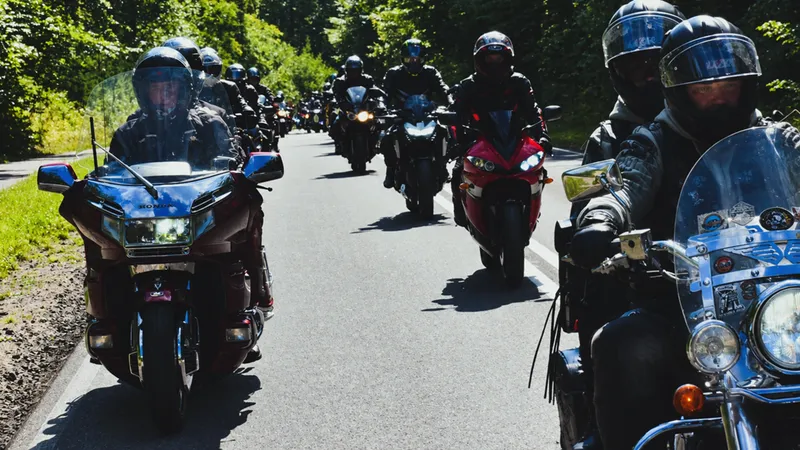
By the time the first motorcycles reached the Piaśnica forest, the last were still leaving the market square in Wejherowo. The column of the ninth Piaśnica Motorcycle Rally stretched for more than 10 kilometres on Saturday, with close to 5,000 machines taking part. Never before had so many riders made the journey to Piaśnica to honour the victims of the German mass executions of 1939-1940. In a place where the Germans murdered between 13,000 and 14,000 people and later tried to burn every trace, several thousand people stood in silence. It happened on 12 September, the anniversary of the Battle of Vienna and the feast of the Most Holy Name of Mary, a coincidence the priests celebrating mass in the forest did not let pass unnoticed.
In brief
Nearly 5,000 motorcycles rode on Saturday 12 September from Wejherowo to the Piaśnica forest in the ninth Piaśnica Motorcycle Rally, with the column stretching over more than 10 kilometres. The rally set off at 14:00 from Jakub Wejher Square, and a holy mass began in the forest at 15:00. In Piaśnica the Germans murdered between 12 and 14 thousand people from October 1939 until spring 1940, and in 1944 Stutthof prisoners were forced to dig up the graves and burn the bodies. Rally organiser Marcin Drewa, president of the Amor Patriae Suprema Lex association, says the rally began nine years ago with a few dozen motorcycles.
The rally set off at 14:00 from Plac Jakuba Wejhera. Before the engines drowned out everything else, the riders were welcomed by the Wejherowo Municipality Brass Band. At the monument to the town's founder, flares were lit, red smoke briefly hid the facades of the tenement houses, and a single cry rose from thousands of throats: honour and glory to the heroes. Only then did the column move. For long minutes the town turned into a single, slowly flowing river of chrome, leather and white-and-red flags. Residents stood on pavements, in windows and on balconies, children waved from their parents' shoulders, drivers of halted cars got out and filmed on their phones. The column had no end.
Ten kilometres of remembrance
The scale of this year's edition is best captured in one sentence: the head of the column was already in the forest while its tail was still standing in the square. Nearly 5,000 motorcycles is not just a record for the rally. It is one of the largest motorcycle rides Pomerania has ever seen, and proof that the memory of Piaśnica has stopped being a local matter, a matter for Wejherowo and its district. It has become a matter for people from all over the country, who came on Saturday of their own accord, at their own expense and out of their own need.
– This is a sight you truly cannot forget. More than ten kilometres of motorcycles, nearly five thousand participants, and the moment when the first motorcycles were already in Piaśnica while others were still leaving the Wejherowo market square. But for us that number is not the most important thing. What matters most is why we are here. Thousands of people came not only to ride this route together, but above all to pay tribute to the victims of Piaśnica and to show that we will remember their fate. When you see this column, it is hard to believe there are so many of us. But what makes an even greater impression is the awareness of where we are going. Every motorcycle, every family, every participant in this rally is today part of the living memory of Piaśnica – said Marcin Drewa, organiser of the rally and president of the Amor Patriae Suprema Lex association.
The riders came from Kashubia, from the Tricity, from all of Pomerania and from distant parts of Poland. They rode in club colours and alone, on heavy cruisers and on small machines, as whole families and in groups of friends. What united them was that all were heading to the same place: a forest that for half a year was the largest killing ground in Pomerania.
Piaśnica. A crime the Germans wanted to leave no trace of
To understand why several thousand people fall silent in a forest clearing, one has to know what happened there. Piaśnica is the largest site of mass executions in Pomerania from the opening months of the Second World War, often called the Pomeranian Katyń. The Germans began killing there in October 1939, a few weeks after occupying Gdynia and Wejherowo, and did not stop until spring 1940. The perpetrators were SS and police personnel together with members of the Selbstschutz, a paramilitary formation of local ethnic Germans who, as late as the summer of 1939, had been neighbours of their future victims. It was they who supplied the names, they who made the arrests, and often they who stood over the pits.
The crime was planned in cold blood. Under the so-called Intelligenzaktion, the occupier set out to destroy the Polish leadership class of Pomerania: teachers, priests, officials, doctors, lawyers, social and local government activists, scouts, merchants, people who in Wejherowo, Gdynia, Puck and the surrounding villages were somebody. Their guilt was that they were Polish, that they could think, and that others listened to them. They were brought to the forest by lorry, in batches, usually at dawn, lined up over pits dug in advance and shot. Women and children were not spared. Witnesses and post-war investigations produced accounts of brutality that are hard to repeat: of people murdered in front of their families, of the wounded finished off, of children killed without a single shot.
Behind the crime stood a plan, and behind the plan a man. Albert Forster, Gauleiter of the Reichsgau Danzig-West Prussia, made no secret of what the occupation of Pomerania was meant to achieve. Polishness was to be uprooted from this land entirely, and the words attributed to him about destroying the Polish nation from the cradle remain among the most chilling sentences left behind by the German administration in Pomerania. Piaśnica was the first and bloodiest chapter of that programme. The aim was not to defeat an opponent but to ensure there was no opponent: no teacher teaching in Polish, no priest hearing confession in Polish, no child speaking Polish to its mother.
Piaśnica received victims from beyond Pomerania too. The Germans brought people here by train from inside the Reich, including Poles and Czechs living in Germany and psychiatric patients, German citizens among them, whom the Third Reich had deemed unworthy of life. The same forest ended them all. The number of victims is estimated at 12,000 to 14,000, and the exact figure will never be known, because in 1944, as the front approached Pomerania, the perpetrators returned to the scene of the crime. Prisoners from the Stutthof concentration camp were forced to dig up the graves and burn the bodies on pyres, and when the work was done they were murdered themselves. The Germans wanted Piaśnica to leave no trace, no witness and no name.
They failed. Fragments of bone and personal belongings were found after the war, the accounts of the few survivors were recorded, families kept searching for their relatives for decades, and the forest itself remains one vast cemetery. Among the murdered was Sister Alicja Kotowska, superior of the Resurrectionist convent in Wejherowo, killed in November 1939 while holding Jewish children close to her on the way to her death. Pope John Paul II beatified her in 1999 as one of the 108 Polish martyrs of the Second World War. Piaśnica therefore has not only its victims but also its patron.
When five thousand engines fall silent
In the Piaśnica forest the riders were met by the Kosakowo Municipality Brass Band, and at 15:00 a solemn mass began. It was celebrated by Father Daniel Nowak, protonotary apostolic and chaplain of the Piaśnica Family Association, Father Jerzy Kraśnicki of MIVA Polska, chaplain to motorists, and Father Marcin Możejko SDB, parish priest of the Exaltation of the Holy Cross parish in Rumia.
The roar of several thousand engines died away. Among the pines, at the site of the mass graves, people who an hour earlier had formed the loudest ride in the region stood in silence. That contrast is the heart of the rally: noise and power on the road, silence and concentration at the destination. Nobody had to ask for quiet. It came by itself, with the first words of the liturgy.
– The motorcycles are very visible here, there are several thousand of them, there is enormous noise, emotion and energy. But when we reach Piaśnica, all of that recedes into the background. What remains is silence, prayer and awareness of the place we are in. And that is exactly the point. We want to use the strength of our community to remind people of history, and not allow Piaśnica to become just a name on a map. The solemn mass is a very important part of this day for us, because there are places and events in history where a person simply needs to stop, pray and think. We want to entrust to God those who were murdered here, but also our families, our community and our homeland. It is a moment of calm after the enormous energy of the whole rally – Marcin Drewa explained.
Vienna, the Name of Mary and the words about the cradle
The date gave the liturgy an additional dimension, and the priests addressed it directly. 12 September is the anniversary of the Battle of Vienna in 1683, in which the army of King John III Sobieski halted the Ottoman advance on Europe. It is also the feast of the Most Holy Name of Mary, extended to the whole Church by Pope Innocent XI precisely in thanksgiving for the victory at Vienna. The homily recalled that Poles had for centuries stood in defence not only of their own borders but of Christian Europe as a whole, and that those same Poles, 256 years after Vienna, lay in the Piaśnica pits, murdered by a nation that claimed to be the heart of that Europe. Mary, whose name the Church honours on this day, was in that homily the one to whom both the victors of Vienna and the victims of the forest are entrusted.
The strongest words, however, were about the cradle. The priest recalled the programme of the German occupation of Pomerania, under which the Polish nation was to be destroyed from the cradle, starting with the youngest, with those who were only learning to speak. He turned the metaphor around: if the Germans wanted to kill Polishness from the cradle, then from the cradle it must now be passed on. The memory of Polish heroes and martyrs will never die as long as there are parents who bring their children here, and as long as the children know why they came. The cradle that was meant to be the place where a nation died is to be the place where a nation begins to remember.
The homily also recalled the words of John Paul II about the blood of martyrs from which new life grows, and the thought that a nation able to kneel at the graves of its witnesses is not a defeated nation. Those who died in Piaśnica gave their lives not for an abstraction but for a concrete fidelity: to God, to their homeland, to their own conscience. Prayers were said for the murdered, for their families, for those who survived and carried the memory through years of silence, and also for the living: for the riders, their families and for Poland. A prayer for peace, spoken over pits holding the victims of war, sounded different from the way it sounds in church.
A child on a motorcycle, memory for generations
Each of the nine rallies has been about these people. The motorcycle is only the means: it is easier to gather thousands of people under the banner of a shared ride than under the banner of a history lesson. But when the column stops in the forest, the lesson teaches itself. The organisers care most that the youngest learn it, and Saturday's rally showed the lesson is reaching its audience. Children in oversized helmets rode in the column, pressed against their parents' backs. In the forest they stood beside them, quietly, as if they understood more than could be expected.
– I am very glad that whole families take part in this event. Parents come with children, young people, older riders. That is extremely important to us, because historical memory cannot be locked away in textbooks. A child who came here with its parents today may, in a few or a dozen years, bring its own child. That is how memory truly lasts. Today's rally is precisely such a bridge between memory and the present. We are showing that young people, families, riders, whole communities want to know history and want to talk about it – Marcin Drewa said.
Marcin Drewa stresses that Piaśnica is part of the history of this land and part of local identity, and that a future cannot be built by forgetting what happened here. Hence the invitation not only to riders but to the residents of Wejherowo, Pomerania and all of Poland to come, stop and learn this history. The place, he says, deserves memory, respect and the presence of people.
– A nation that forgets its victims loses part of its own memory. We do not want to forget. Piaśnica is one of those places that remind us what a high price the people of this land paid for being Polish, for being themselves, for having their families, their lives and their dreams. That is why we come here every year. Not out of a duty set by the calendar, but out of an inner need of the heart – Marcin Drewa added.
Prayer and music on the same day
After the religious part, the participants did not disperse. A festival and three concerts awaited the riders and residents and closed the day. The programme is deliberate and, as the organiser argues, in no way at odds with the gravity of the place. On the contrary: it is the sense of community that brings people back to the rally every year and makes them bring others with them. Those murdered in Piaśnica had their families, their holidays and their music. The joy of the living is no betrayal of their memory. It is proof that the plan to destroy a nation did not succeed.
– We wanted this to be an event with two dimensions. On one side there is prayer, remembrance and tribute to those who died here. On the other there is community, people meeting, music and the joy of being able to be together. That is not a contradiction. Remembrance does not have to mean only sorrow. We can remember those who are no longer with us and at the same time be glad that today we can live, meet and be together in a free Poland – Marcin Drewa said.
The rally began nine years ago with a few dozen motorcycles. Today it requires securing a ten-kilometre route, coordination with the emergency services and logistics on the scale of the largest outdoor events in the region. The organisers do not hide that the scale took them by surprise.
– We did not expect the event to grow to this scale. Today we have almost five thousand motorcycles, an enormous column stretching for more than ten kilometres, and people who came here not only from the immediate area. It shows there is a huge need for community, but also a need to remember. And we as organisers feel an enormous responsibility to develop this idea while never losing what is its most important meaning – Marcin Drewa concluded.
Piaśnica did not become a name on a map
The invitation to the tenth, jubilee edition was issued on Saturday itself. If this year's turnout is any guide, Wejherowo will have to prepare for an even longer column next year.
For decades Piaśnica was a place spoken of quietly. Today, once a year, several thousand engines speak of it, and then, in the forest, several thousand people fall silent together. The Germans wanted to burn this memory together with the bodies and to destroy a nation from the cradle. They burned nothing and destroyed nothing that mattered. On Saturday, children stood at the Piaśnica graves who in a dozen years will bring their own. There could be no clearer sign that the memory of the murdered has survived and is in good health.
From the editors
We are pleased that KPH Group, publisher of Daily Mare and Gazeta Morska, was able this year to join the organisers of the Piaśnica Motorcycle Rally, and that our partners, including Enterosoft, joined the event with us. We do not treat this as a one-off patronage. Awareness of history, remembrance of the victims and respect for the heroes and martyrs of Poland are values on which we want to build our presence in the region. Piaśnica is a reminder that memory does not survive on its own. It needs people who will come, stand and say aloud that they have not forgotten. On Saturday there were several thousand of them. We want there to be even more next year.
Source: Gazeta Morska · Compiled by: Kamil Kusier
Related articles
 History Two Lancaster wrecks, one operation. The bombers fell over the Baltic laying mines still disarmed today
 History Seven dead in war, seven in peacetime. Błyskawica turns 90 and still flies the ensign
 Shipbuilding industry Batavia goes ashore. The Dutch show what to do with a ship no longer worth keeping afloat
 History 17 September 1939. The Soviets invaded Poland. Aggression, deportations and Katyn
 Navy and defence 563 years ago Gdańsk and Elbląg destroyed the Teutonic fleet. 44 vessels against 30 privateers
 History Suicide according to the secret police, murder according to Solidarity. IPN seeks answers 43 years on
Comments (0)
The discussion is moderated by the editors: a comment appears after review. Your e-mail address is not published.
Nobody has commented on this article yet.