









New Discoveries at the Medieval Port of Puck - Underwater Archaeologists Resume Work after Hiatus
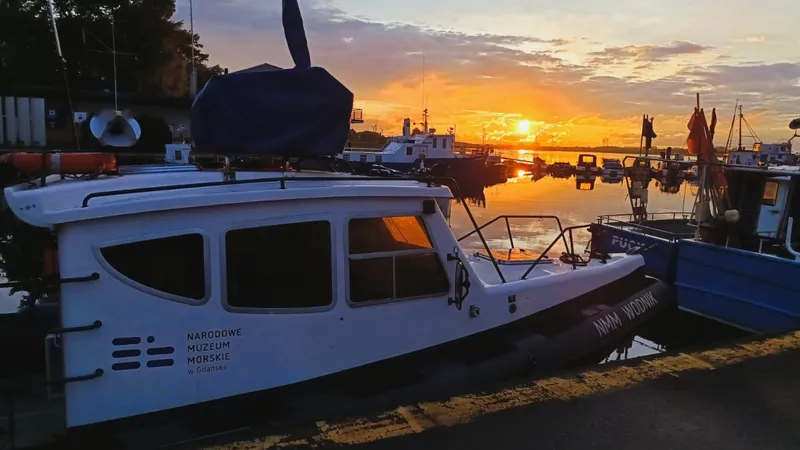
Following a three-year hiatus, the Underwater Research Department of the National Maritime Museum in Gdańsk has resumed archaeological operations at one of Poland’s most significant submerged heritage sites – the medieval port in Puck. The 2025 field season has yielded a number of valuable findings and generated new data crucial to reconstructing the historical role and structure of the port within the maritime and trade networks of the medieval Baltic region.
In brief
The Underwater Research Department of the National Maritime Museum in Gdańsk has resumed research on the medieval port in Puck after a three-year break. The team of Dr Krzysztof Kurzyk, Janusz Różycki, Paweł Litwinienko and Zbigniew Jarocki carried out test surveys using metal detectors and ejectors, despite heavy overgrowth of the seabed by filamentous algae. A fragment of a wooden hook structure next to the wreck of the P2 warboat was cleaned and underwater photogrammetry was performed for a 3D model. A split plank, wooden structural hooks, a fragment of an oar and early medieval pottery were added to the collections of the National Maritime Museum.
Led by Dr. Krzysztof Kurzyk and supported by Janusz Różycki, Paweł Litwinienko, and Zbigniew Jarocki, the research team conducted targeted excavations and exploratory probes in key areas previously identified as high-potential zones. Particular attention was given to locations associated with earlier discoveries from the Roman influence period and the early Middle Ages. By employing metal detectors and ejector dredges, the team was able to significantly improve efficiency despite worsening underwater conditions caused by aggressive filamentous algae growth, which increasingly obscures submerged structures and complicates documentation efforts.
A notable highlight of the season was the cleaning and documentation of a wooden hook structure located near the previously excavated combat boat wreck (P2). Using underwater photogrammetry, the team produced high-resolution imagery that will form the basis of a detailed 3D reconstruction. Timber samples were also taken for dendrochronological analysis, which will assist in dating the structures and determining the origin of the wood used.
New artefacts recovered during this campaign have now entered the collections of the National Maritime Museum in Gdańsk. Among them are: a plank likely from a jetty or causeway, structural wooden hooks, a fragment of an oar, and early medieval ceramics. Each of these items contributes to a broader understanding of the port’s construction, usage, and strategic importance in the maritime landscape of the southern Baltic during the Middle Ages.
- Biological and environmental changes are rapidly degrading underwater cultural heritage, says Dr. Krzysztof Kurzyk, Head of the Underwater Research Department. - This reality pushes us to accelerate our documentation and conservation efforts before these artefacts are lost to time. It’s a race against natural decay, and one that requires both technological precision and long-term preservation strategies.”
Analysis of the newly acquired materials is ongoing. Preliminary results will be published and shared with the international maritime heritage community. As the research progresses, the Puck harbour site continues to emerge as a critical node in the historical seascape of the Baltic – not only as a commercial hub, but as a site of strategic military and infrastructural relevance in medieval northern Europe.
Source: Gazeta Morska · Compiled by: Kamil Kusier
Related articles
 History Polish Naval Museum in Gdynia opens its doors on Independence Day, 11 November
 History Two Lancaster wrecks, one operation. The bombers fell over the Baltic laying mines still disarmed today
 History Seven dead in war, seven in peacetime. Błyskawica turns 90 and still flies the ensign
 Shipbuilding industry Batavia goes ashore. The Dutch show what to do with a ship no longer worth keeping afloat
 History 17 September 1939. The Soviets invaded Poland. Aggression, deportations and Katyn
 Navy and defence 563 years ago Gdańsk and Elbląg destroyed the Teutonic fleet. 44 vessels against 30 privateers
Comments (0)
The discussion is moderated by the editors: a comment appears after review. Your e-mail address is not published.
Nobody has commented on this article yet.