









Ancient Roman Terracotta Head Recovered by Italian Navy Divers
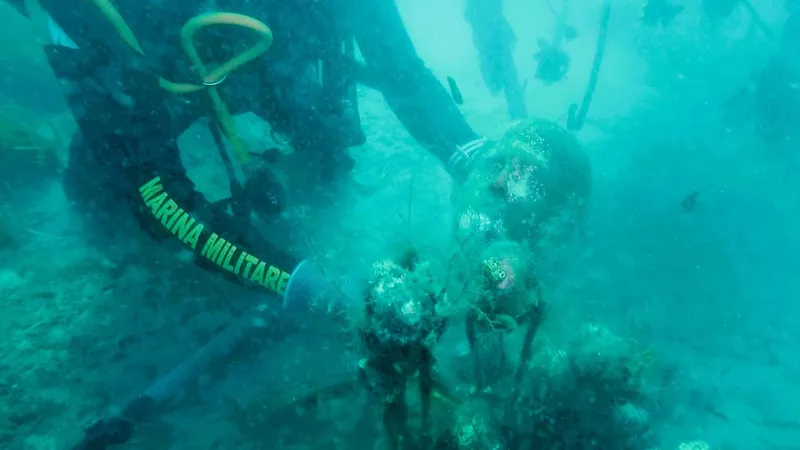
An underwater operation conducted near the islet of Coltellazzo has led to the remarkable recovery of a Roman-era terracotta head, retrieved by specialist divers from the Italian Navy. The artifact, depicting a young male figure, was discovered entangled in an old fishing net after lying hidden beneath the sea for centuries.
In brief
Military divers from the Italian Navy's Nucleo SDAI recovered a Roman-period terracotta head depicting a young man near the islet of Coltellazzo. The artefact lay underwater for centuries, trapped in an old fishing net. The find was handed over to the Soprintendenza Archeologica Belle Arti e Paesaggio, where it will undergo conservation work. Nucleo SDAI operates within COMSUBIN and specialises in identifying and neutralising underwater threats in Italian territorial waters.
The recovery was carried out by the SDAI Unit (Servizio Difesa Antimezzi Insidiosi)—part of the Italian Navy’s elite COMSUBIN (Comando Subacquei ed Incursori). Once secured by the Navy’s expert clearance divers, the artifact was handed over to the Soprintendenza Archeologica Belle Arti e Paesaggio (ABAP), the national agency responsible for cultural heritage. The artifact will now undergo conservation procedures.
This significant find adds to the rich underwater archaeological heritage of the Italian coastline and highlights the growing role of naval forces in the protection and preservation of submerged cultural assets.
COMSUBIN: Italy’s Elite Maritime Special Forces
COMSUBIN, the Command of Underwater and Incursion Units of the Italian Navy, is one of the country’s most advanced military formations, combining special forces and underwater operations capabilities. It comprises two main components:
- GOI (Operational Raiders Group) – specialized in maritime special operations, reconnaissance, sabotage, and counter-terrorism.
- GOS (Operational Divers Group) – focused on underwater EOD (Explosive Ordnance Disposal), salvage, submarine rescue, and maritime archaeological support.
The SDAI Unit, a subdivision of GOS, is tasked with the detection and neutralization of underwater threats such as naval mines and unexploded ordnance. In recent years, SDAI divers have increasingly been called upon to assist in cultural heritage operations, particularly where historic artifacts are at risk from modern marine activity.
The recovery off Coltellazzo is yet another example of the Italian Navy’s commitment not only to maritime security but also to safeguarding the historical legacy that lies beneath the surface of the Mediterranean.
Source: Gazeta Morska · Compiled by: Kamil Kusier
Related articles
 History Gdańsk conservator moves to expropriate the port workers’ Maritime Culture House in Nowy Port
 History Polish Naval Museum in Gdynia opens its doors on Independence Day, 11 November
 History Two Lancaster wrecks, one operation. The bombers fell over the Baltic laying mines still disarmed today
 History Seven dead in war, seven in peacetime. Błyskawica turns 90 and still flies the ensign
 Shipbuilding industry Batavia goes ashore. The Dutch show what to do with a ship no longer worth keeping afloat
 History 17 September 1939. The Soviets invaded Poland. Aggression, deportations and Katyn
Comments (0)
The discussion is moderated by the editors: a comment appears after review. Your e-mail address is not published.
Nobody has commented on this article yet.