









Keel laid for the Westerplatte museum project. Major heritage investment launched in Gdańsk
On 25 April 2026, a ceremonial cornerstone was laid at Westerplatte in Gdańsk, formally marking the symbolic start of construction of the Westerplatte Museum - a branch of the Museum of the Second World War in Gdańsk. The event gathered government representatives, local authorities, military honour guards, veterans’ organisations, and witnesses of history.
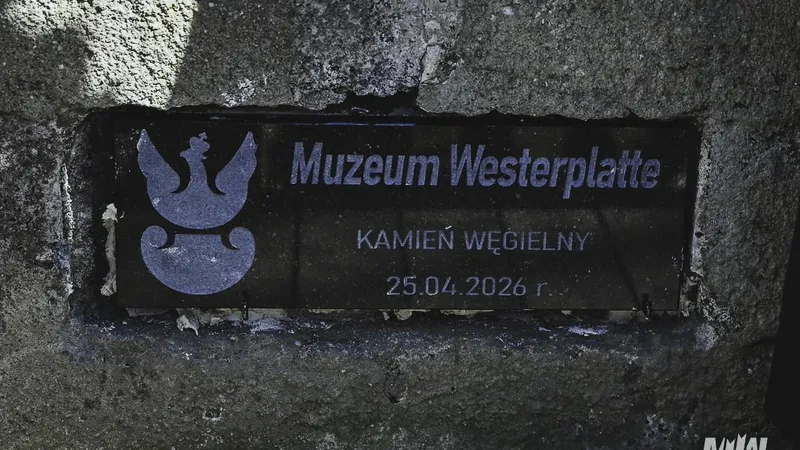
In brief
The foundation stone for the Westerplatte Museum, a branch of the Museum of the Second World War in Gdańsk, was laid at Westerplatte in Gdańsk. The investment is carried out under a government programme adopted by Council of Ministers resolution number 230/2023, with total outlays for 2023 to 2027 exceeding PLN 304 million. The first stage covers the reconstruction of the layout of the Military Transit Depot, including six ammunition shelters, and part of the site is to be opened in the second half of 2027. The second stage is an underground museum of about 7 thousand square metres, with the whole to be completed in 2030.
The ceremony took place near the remains of Warehouse No. 1, a historically significant site linked to the 1939 defence of Westerplatte, widely regarded as the opening battle of World War II.
“A place of special memory and responsibility”
During the ceremony, Minister of Culture and National Heritage Marta Cienkowska addressed attendees:
- We meet in a place that holds a unique position in local, national, and global memory. It was here that the Second World War symbolically began, and therefore we are fully aware of the responsibilities resting upon us. We fulfil them by telling the truth about the heroism of the defenders of Westerplatte, about the suffering of civilian prisoners, and about those who survived the war and for decades safeguarded the memory of this peninsula. We continue their efforts by creating a new museum and restoring visibility to the relics of the Military Transit Depot – silent witnesses of the first moments of the war, she said.
As she added:
- We also fulfil an obligation to future generations, because Westerplatte remains a call to oppose propaganda, lies, and aggression. Our role is to preserve memory and foster dialogue between nations, ensuring visitors receive a reliable narrative and dignified conditions for learning history. This mission continues every day – through the work of archaeologists, museum professionals, and all those who, through their presence and commitment, help preserve the memory of Westerplatte, said Marta Cienkowska.
Long-term preparation behind the project
Although construction formally begins in 2026, the investment is the result of many years of conceptual, historical, and archaeological work led by the Museum of the Second World War in Gdańsk.
Key contributions in earlier phases included institutional and research leadership by figures such as Karol Nawrocki, currently President of the Republic of Poland, and historian Grzegorz Berendt. During this period, archaeological investigations at Westerplatte were expanded, enabling systematic documentation and exposure of remnants of the former Military Transit Depot. These works formed the foundation for the current investment programme.
Scope of phase I works
The first phase focuses on restoring the historical spatial layout of the Military Transit Depot. Planned works include:
- Reconstruction of historical pathways and selected structures, including the station manager’s building and six ammunition shelters
- Conservation and exposure of archaeological relics
- Reconstruction of the historical railway layout
- Landscape organisation with unified small architecture and heritage-style lighting
- Removal of architectural barriers and introduction of accessibility features, including tactile models for visually impaired visitors
- Implementation of site monitoring systems and visitor infrastructure improvements
A portion of the site is expected to be opened to visitors in the second half of 2027.
Archaeology and second-phase development
Parallel archaeological works are currently underway in the northern section of the so-called “New Barracks” area. These studies, scheduled to continue until August 2026, aim to secure and document additional heritage remains and define their future exhibition strategy.
The second phase of the investment will include the construction of an underground museum facility of approximately 7,000 m², including a 2,800 m² permanent exhibition dedicated to the defence of Westerplatte, the fate of Polish soldiers, and the broader history of the peninsula.
Funding and timeline
The project is implemented under the government programme “Construction of the Westerplatte and 1939 War Museum,” adopted by Resolution No. 230/2023 of the Council of Ministers. Total allocated funding for 2023–2027 exceeds PLN 304 million.
The construction tender is planned for Q2 2026, with works expected to begin in Q3–Q4 2026. Completion of the entire investment is scheduled for 2030.
Source: Gazeta Morska · Compiled by: Kamil Kusier
Related articles
 History Two Lancaster wrecks, one operation. The bombers fell over the Baltic laying mines still disarmed today
 History Seven dead in war, seven in peacetime. Błyskawica turns 90 and still flies the ensign
 Shipbuilding industry Batavia goes ashore. The Dutch show what to do with a ship no longer worth keeping afloat
 History 17 September 1939. The Soviets invaded Poland. Aggression, deportations and Katyn
 Navy and defence 563 years ago Gdańsk and Elbląg destroyed the Teutonic fleet. 44 vessels against 30 privateers
 History Nearly 5,000 motorcycles ride to Piaśnica. The memory of a crime the Germans failed to burn
Comments (0)
The discussion is moderated by the editors: a comment appears after review. Your e-mail address is not published.
Nobody has commented on this article yet.