









December 1970: remembering the maritime workers of Gdynia
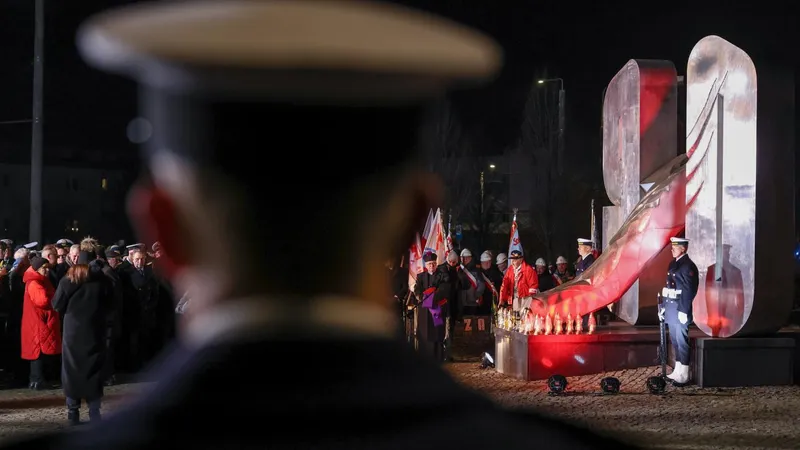
On the 55th anniversary of the December 1970 events, the President of the Republic of Poland paid tribute to the victims of the tragic shootings in Gdynia, laying a wreath at the Monument to the Victims of December 1970 and attending a commemorative ceremony. For Poland’s maritime sector, the anniversary carries a profound meaning, rooted in the history of port workers, shipyard employees and the wider coastal industry.
In brief
The President of the Republic of Poland laid a wreath at the Monument to the Victims of December 1970 in Gdynia and took part in a Roll Call of Remembrance on the 55th anniversary of the massacre of workers. In December 1970 the army opened fire on workers walking to work at the shipyard in Gdynia. The President stressed that national memory must stand on the side of the victims, truth and justice, and pointed to December 1970 as one of the milestones leading to the birth of Solidarity, a movement with roots in shipyards and ports. An illumination of the facade of the Presidential Palace closed the commemorations.
Gdynia, a city built from the sea and national ambition, has long been a pillar of Poland’s maritime economy. In December 1970, it was this very workforce – shipyard workers and port employees on their way to work – who became victims of state violence. The tragedy struck at the heart of a community that formed the backbone of Poland’s shipbuilding, port operations and maritime logistics.
The President emphasized that national memory must stand with the victims, truth and justice, and against those who ordered the use of force against workers demanding dignity, fair living conditions and social solidarity. He recalled that the events of December 1970 directly influenced the emergence of the Solidarity movement, which later reshaped not only Poland’s political landscape but also labor relations across key industrial sectors, including maritime industries.

For today’s maritime economy, the legacy of December 1970 is a reminder that sustainable port development, technological progress and competitiveness must be built on respect for workers’ rights and human dignity. Modern Gdynia, now a rapidly developing hub for ports, logistics and maritime technologies, continues to draw strength from this historical experience.
The commemorative illumination displayed on the Presidential Palace underscored the lasting importance of the sacrifices made by coastal workers, whose struggle became an integral part of Poland’s path to freedom and economic sovereignty.
Source: Gazeta Morska · Compiled by: Kamil Kusier
Related articles
 History Two Lancaster wrecks, one operation. The bombers fell over the Baltic laying mines still disarmed today
 History Seven dead in war, seven in peacetime. Błyskawica turns 90 and still flies the ensign
 Shipbuilding industry Batavia goes ashore. The Dutch show what to do with a ship no longer worth keeping afloat
 History 17 September 1939. The Soviets invaded Poland. Aggression, deportations and Katyn
 Navy and defence 563 years ago Gdańsk and Elbląg destroyed the Teutonic fleet. 44 vessels against 30 privateers
 History Nearly 5,000 motorcycles ride to Piaśnica. The memory of a crime the Germans failed to burn
Comments (0)
The discussion is moderated by the editors: a comment appears after review. Your e-mail address is not published.
Nobody has commented on this article yet.