









45 years under sail: STS Pogoria. A Polish maritime icon designed by Zygmunt Choreń
On June 1st, 1980, in the port of Gdańsk, the Polish flag was raised for the first time aboard STS Pogoria – the pioneering Polish sail training ship that launched a new era in modern tall ship design. Commissioned by Polish Television (TVP) and built at the Gdańsk Shipyard, Pogoria was originally intended as a floating platform for youth maritime education and the television programme "Latający Holender" (The Flying Dutchman), aimed at inspiring young people to discover the world of sailing.
In brief
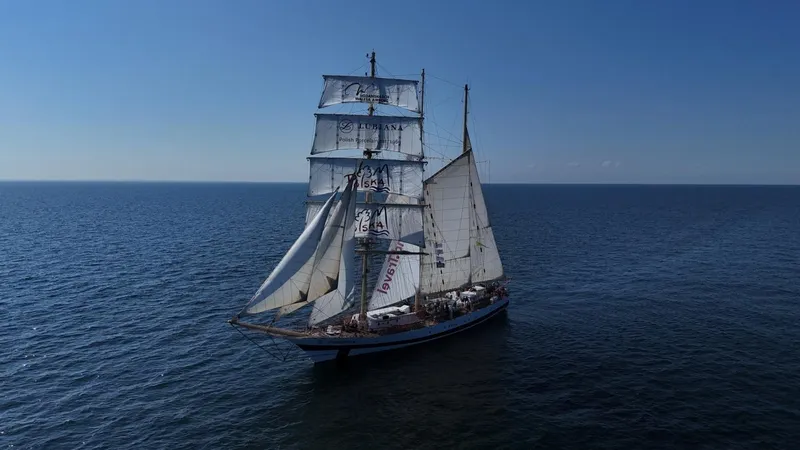
STS Pogoria is celebrating 45 years since its flag was first raised on 1 June 1980 in Gdańsk. The three-masted barquentine, almost 50 metres long, was built at Stocznia Gdańska on the order of Telewizja Polska for the programme Latający Holender and currently sails under the flag of Sail Training Association Poland. STS Pogoria was designed by Zygmunt Choreń, the designer of, among others, Dar Młodzieży, Fryderyk Chopin, Iskra II and Royal Clipper, currently the largest sailing ship in the world.
STS Pogoria / fot. Dawid Ziniewicz
As a three-masted barkentine nearly 50 meters in length, Pogoria was the first large sail training vessel in postwar Poland designed specifically to combine traditional seamanship with modern construction and safety standards. Today, 45 years later, she continues to serve under the Polish flag with Sail Training Association Poland (STAP), taking part in international regattas such as The Tall Ships Races and delivering hands-on maritime training to young sailors from around the world.
Zygmunt Choreń – architect of modern tall ships
Pogoria was designed by Zygmunt Choreń, a naval architect, experienced sailor, and participant in the Whitbread Round the World Race. Often referred to as the "father of modern tall ships," Choreń successfully blended classical lines with advanced engineering to produce vessels that are both seaworthy and iconic.
A graduate of the Gdańsk University of Technology and Leningrad Shipbuilding Institute, Choreń founded his own design office, Choreń Design & Consulting, which has since become a global leader in tall ship architecture. His designs are known for their elegant silhouettes, safety, and functionality – particularly for training, educational, and expedition purposes.
The Choreń fleet – a global legacy
The launch of Pogoria marked the beginning of a remarkable design lineage. Choreń's tall ships now sail under various flags across the world, including:
- Dar Młodzieży (Poland) – the flagship of the Gdynia Maritime University
- Fryderyk Chopin (Poland) – a two-masted brig for youth sail training
- Iskra II (Poland) – sail training ship of the Polish Navy
- Alexander von Humboldt II (Germany)
- Mir, Nadezhda, Pallada (Russia, Ukraine) – sister ships designed in the 1980s
- Royal Clipper (Bahamas) – currently the largest full-rigged sailing ship in the world
- Running on Waves (Cyprus) – luxury class boutique cruise tall ship
- Golden Horizon (formerly Flying Clipper) – the largest sailing ship in history, currently sailing under the Croatian flag
Choreń’s vessels sail in the Baltic, the Mediterranean, the Caribbean, and even the Pacific. His impact on modern sail training is hard to overstate – with Pogoria being the very first testament to his vision and craftsmanship.
With 45 years of service, STS Pogoria remains a proud ambassador of Polish maritime heritage – a ship that not only shaped a generation of sailors but also gave rise to a fleet that continues to carry the spirit of sail training around the globe.
Source: Gazeta Morska · Compiled by: Kamil Kusier
Related articles
 History Two Lancaster wrecks, one operation. The bombers fell over the Baltic laying mines still disarmed today
 History Seven dead in war, seven in peacetime. Błyskawica turns 90 and still flies the ensign
 Shipbuilding industry Batavia goes ashore. The Dutch show what to do with a ship no longer worth keeping afloat
 History 17 September 1939. The Soviets invaded Poland. Aggression, deportations and Katyn
 Navy and defence 563 years ago Gdańsk and Elbląg destroyed the Teutonic fleet. 44 vessels against 30 privateers
 History Nearly 5,000 motorcycles ride to Piaśnica. The memory of a crime the Germans failed to burn
Comments (0)
The discussion is moderated by the editors: a comment appears after review. Your e-mail address is not published.
Nobody has commented on this article yet.