









Thirty Polish submariners in Karlskrona, training exactly as a Swedish crew would
Around thirty Polish submariners are in Karlskrona preparing for service aboard the submarine HMS Södermanland. The training is run by Sweden's Naval Warfare Centre, Sjöstridsskolan, and covers all of the boat's systems, from propulsion through sonar to the combat management system.
In brief
About thirty Polish submariners are training in Karlskrona for service aboard the submarine HMS Södermanland. The Swedish Naval Warfare School, Sjöstridsskolan, is giving the Polish personnel the same course as the Swedish crew, covering propulsion, sonar and the combat management system. Sweden is leasing the A17-class HMS Södermanland to Poland as a bridging solution in the Orka programme, alongside a contract for three A26 submarines worth about 47 billion Swedish kronor. No date has been given for HMS Södermanland to raise the Polish flag.
It is the first concrete figure to emerge from the Polish-Swedish side of the Orka programme, and an answer to the question that matters more in this programme than delivery dates. The issue is not when the submarines arrive, but whether there will be crews to man them.
The same course as a Swedish crew
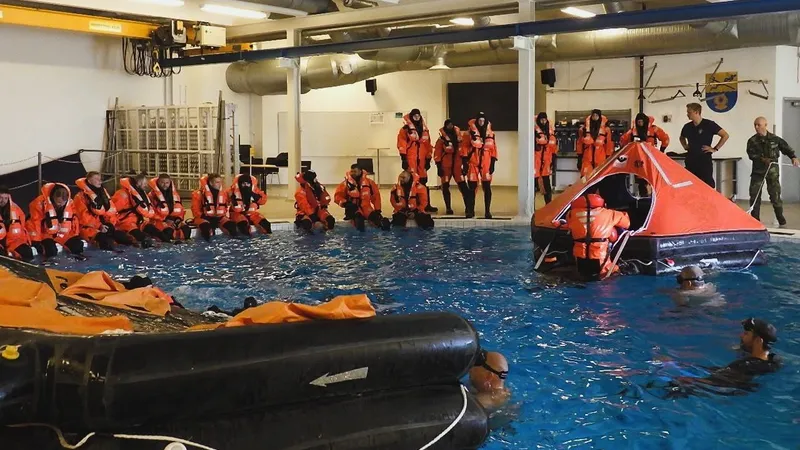
The Swedish navy stresses that the Polish personnel are taking exactly the same course as a Swedish submarine crew, covering technical systems, sensors and weapons. Classroom work alternates with practical exercises, and beyond equipment handling the programme includes firefighting and medical care, situations that demand teamwork and composure under pressure.
Sjöstridsskolan supports the First Submarine Flotilla with instructors, simulators, teaching facilities and equipment. The training is to continue until the level of experience is reached that allows operations with the submarine under Polish command and the Polish flag.
That condition is qualitative rather than a date in a calendar. In submarine training it is the only honest way to set it, because readiness is determined by specific people mastering procedures on a specific boat, not by hours logged.
Why Södermanland
HMS Södermanland is an A17-class boat, modernised and fitted with newer onboard systems, which Sweden is leasing to Poland as a stop-gap. The lease was signed alongside the contract for three A26-type submarines under the Orka programme, concluded in Gdynia on 29 June and corresponding to around SEK 47 billion, with deliveries running to 2038.
Swedish submarine design is consistent, and many solutions used on older boats reappear on newer ones, particularly in safety, tactics and rescue systems. Time spent on an A17 is therefore not lost when crews move to the A26. In the other direction, Polish personnel are to take part in testing and evaluation of the Swedish boats HMS Blekinge and HMS Skåne.
Crews are the bottleneck, not steel
The Polish Navy currently operates a single submarine, the 40-year-old Kilo-class ORP Orzeł. Since the Kobben-class boats were withdrawn in 2021, the number of billets where experience can be gained underwater has fallen sharply.
In this branch that is a more serious problem than hull age. A sonar operator, a weapons officer, an engineer and a commanding officer take years to train, and none of those specialities can be produced on a simulator alone. Once continuity of service underwater is broken, rebuilding the skills takes longer than buying the equipment.
Thirty people in Karlskrona are therefore not a training episode but the first element of rebuilding the crew base. If the plan holds, those same people will later train the next crews at home.
What is still unknown
There is no word on when Södermanland is to raise the Polish flag, how many sailors the training will ultimately cover, or whether further intakes in Karlskrona are planned. Nor is it clear where the boat will be based once handed over, or how responsibility for its technical support will be divided.
The Swedish navy describes the whole effort as part of the Orka programme and of the strategic partnership between Sweden and Poland in the underwater domain. That shift in language matters, because it describes capability built together, step by step, rather than a one-off equipment transaction.
Source: Gazeta Morska · Compiled by: Michał Iwański
Related articles
 Navy and defence ORP Mewa marks four months with SNMCMG1. Poland's first Kormoran II deployment runs to year-end
 Shipbuilding industry Ex-Enterprise towed to Mobile under $418.5m contract. Test case for Nimitz-class disposal begins
 Navy and defence Norwegian submarine Utstein completes NATO patrol guarding offshore oil and undersea infrastructure
 History Polish Naval Museum in Gdynia opens its doors on Independence Day, 11 November
 Equipment and technology Saab unveils Sea Giraffe AMB D naval radar with 250 km air surveillance range
 Navy and defence Polish minehunters and NATO group search Gulf of Gdańsk port approaches
Comments (0)
The discussion is moderated by the editors: a comment appears after review. Your e-mail address is not published.
Nobody has commented on this article yet.