









ORP Gopło will not be preserved intact. Prototype laminate minesweeper passes to Poland's Military Property Agency
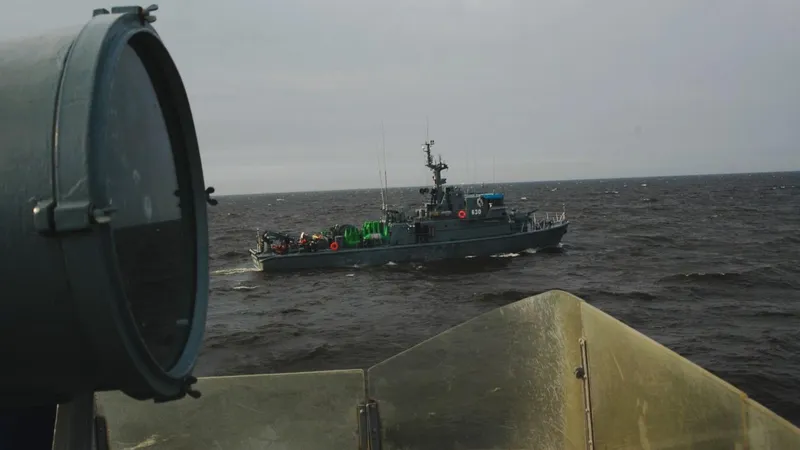
The Polish Navy has been ordered to settle the accounts on the decommissioned minesweeper ORP Gopło (630) and hand her over to the Military Property Agency (AMW), ending hopes of keeping the ship intact. Gopło was the prototype of Project 207 and Poland's first minesweeper with a laminate hull. A community of nearly 25,000 people operating as the Association of Enthusiasts of ORP Ślązak and Supporters of the Navy has spent the months since her decommissioning looking for a home for her ashore or afloat, and is now appealing for institutional backers.
In brief
The Polish Navy has been ordered to settle the accounts of the prototype minesweeper ORP Gopło (630) and hand it over to the Military Property Agency. ORP Gopło, the first Polish minesweeper with a laminate hull, was built by Stocznia Marynarki Wojennej in Gdynia, with its ensign raised on 13 March 1982 and lowered on 13 March 2026. The Stowarzyszenie Entuzjastów ORP Ślązak i Sympatyków Marynarki Wojennej, a community of nearly 25 thousand people, proposed displaying the ship in places including Puck and is appealing for support to preserve ORP Gopło.
A prototype designed and built in Poland
Gopło was built at the Naval Shipyard (Stocznia Marynarki Wojennej) in Gdynia, the yard now operating as PGZ Stocznia Wojenna. Lamination of the hull began on 7 January 1979, she was launched on 16 April 1981 and commissioned on 13 March 1982. She was later upgraded to the 207DM standard.
After trials with the 13th Minesweeper Squadron at Hel, she joined the Training and Research Ships Squadron in Gdynia-Oksywie in 1995 and served for years as a testbed for new mine countermeasures equipment. The yard went on to build twelve Project 207P minesweepers and four upgraded Project 207M ships, which incorporated solutions first proven aboard Gopło. Her ensign was lowered for the last time on 13 March 2026, exactly 44 years after it was first raised.
- She was the prototype of Project 207, designed entirely by Polish engineers and built by the hands of Polish shipbuilders at the Naval Shipyard in Gdynia. She served under the Navy's ensign for 44 years, and many hundreds of sailors passed through her decks, for whom she was a second home - the community said.
From a museum display to a sailing ship
The first concept was to display the whole ship at the Naval Museum in Gdynia, between the submarine ORP Sokół and the conning tower of ORP Dzik, but a visualisation showed she would block the view of the entire outdoor exhibition. A second idea was to cut away the deck from bow to stern, complete with superstructure and equipment, so that visitors could walk inside. The museum currently has no funds for such a project.
The tall ship designer Zygmunt Choreń also looked at converting the minesweeper into a sailing vessel, though the idea did not go beyond a site visit. The community also approached the Kołobrzeg Maritime Open-Air Museum at the Polish Arms Museum and the National Maritime Museum in Gdańsk, in connection with a planned maritime exhibition in Jastarnia, a port Gopło often visited during her service.
A berth where the Polish Navy began
The strongest case was made to Puck. It was there that General Józef Haller performed Poland's wedding to the sea on 10 February 1920, there that the Polish Navy established its first base, and there that the Naval Air Squadron was stationed between the wars. Earlier surveys showed that Gopło's laminate hull was in the best condition of any ship in the series, and the community argues that removing the shafts and propellers and laminating over all openings would allow her to remain on the water for years. Berthed in Puck, the prototype of Poland's minesweepers would return to the place where the Polish Navy began, restoring the town's historic role at least as a museum.
Initial enthusiasm in Puck did not lead to a decision. The community has also pointed to Hel, where the ship was based for many years, and to the Coastal Defence Museum there as a possible host.
An appeal before the handover
Once the ship passes to the Military Property Agency, the options for preserving her will narrow considerably. The community is therefore calling on institutions and individuals who could take the initiative forward.
- Perhaps some institutions or individuals will come forward to support our idea, because otherwise all the renown of the Polish sailor and shipbuilder will go to waste - the community appealed.
Gopło's operational tasks have passed to the Kormoran II class minehunters ORP Kormoran, ORP Albatros and ORP Mewa, the last of which is currently deployed with Standing NATO Mine Countermeasures Group 1. The experience gathered aboard the 1982 prototype shaped the generations of Polish minesweepers that followed her.
Source: Gazeta Morska · Compiled by: Kamil Kusier
Related articles
 Shipbuilding industry Ex-Enterprise towed to Mobile under $418.5m contract. Test case for Nimitz-class disposal begins
 Navy and defence Norwegian submarine Utstein completes NATO patrol guarding offshore oil and undersea infrastructure
 History Polish Naval Museum in Gdynia opens its doors on Independence Day, 11 November
 Equipment and technology Saab unveils Sea Giraffe AMB D naval radar with 250 km air surveillance range
 Navy and defence Polish minehunters and NATO group search Gulf of Gdańsk port approaches
 Safety and rescue Polish Navy helicopter evacuates man from Baltic platform 100 km off Władysławowo
Comments (0)
The discussion is moderated by the editors: a comment appears after review. Your e-mail address is not published.
Nobody has commented on this article yet.