









Saab unveils Sea Giraffe AMB D naval radar with 250 km air surveillance range
Saab has introduced Sea Giraffe Agile Multi Beam D (AMB D), the latest evolution of its Giraffe AMB naval radar family. The 3D radar detects, tracks and classifies air targets at up to 250 km and surface targets at up to 50 km, from aircraft and missiles to drones and crewed or uncrewed surface vessels. It pairs Active Electronically Scanned Array hardware with a new software-defined architecture designed for continuous upgrades through the life of the ship.
In brief
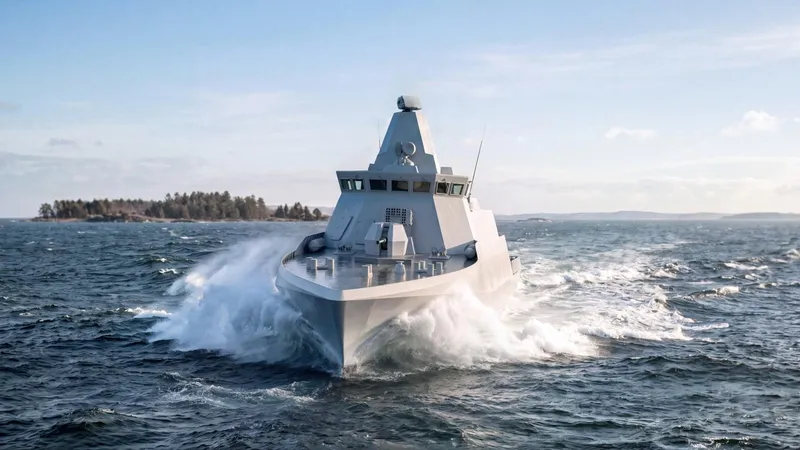
Saab unveiled the Sea Giraffe AMB D naval radar, which detects air targets at ranges of up to 250 km and surface targets up to 50 km. The Sea Giraffe AMB D radar tracks and classifies drones, missiles and uncrewed surface vessels, among others. Sea Giraffe AMB D combines an AESA antenna with a software-defined architecture that allows new functions to be added through software updates. Radars of the Sea Giraffe AMB family operate on Swedish Visby-class corvettes and US Independence-class LCS ships.
Built for a crowded threat picture
The target set reflects how naval warfare has changed. Alongside aircraft and missiles, Sea Giraffe AMB D is designed to pick up drones and uncrewed surface vessels, a category that moved from the margins to the centre of maritime threat assessments after naval drones became one of the most effective anti-ship weapons in the Black Sea. A radar that covers both the air picture and the sea surface in one sensor gives a ship's crew an earlier and more complete view of what is approaching.
Saab positions the radar as a source of early warning and accurate target data for decision-making in distributed, multi-domain operations. In that kind of fight, where ships, aircraft and shore units share a common picture, the quality of each sensor feeding the network becomes the foundation of operational advantage.
Jamming resistance and a software-defined core
For contested waters, the radar combines advanced Electronic Counter-Countermeasures (ECCM) against jamming with a modular architecture that eases integration with combat management and other shipboard systems. The software-defined design means new functions and responses to emerging threats can be added through updates rather than hardware replacement, a significant consideration for navies planning ships that will serve for three decades or more. Saab also highlights the radar's low footprint, which matters on smaller combatants where topside space and weight are at a premium.
- Sea Giraffe AMB D takes a proven naval radar capability to the next level, combining increased performance with a low footprint and an architecture built for continuous development. It is designed to meet the demands of today's naval forces while giving customers the flexibility to evolve with future threats - said Carl-Johan Bergholm, head of Saab's business area Surveillance.
From Visby to the US Navy, and a growing Polish connection
The new variant builds on more than 70 years of Saab radar development and over two decades of operational service by the Sea Giraffe AMB family. Radars from the family equip, among others, the Swedish Navy's Visby class corvettes and the US Navy's Independence class Littoral Combat Ships, where the radar is designated AN/SPS-77. In the D variant, Saab has combined AESA hardware with a new software architecture and modern processing, with the main gains in air surveillance performance.
The launch also lands in a market where Saab's naval footprint in the Baltic is expanding. In June 2026 Poland signed a contract for three A26 submarines to be built by Saab Kockums in Karlskrona under the Orka programme, in the presence of Prime Ministers Donald Tusk and Ulf Kristersson. Saab is also prime contractor for Poland's two Delfin signals intelligence ships, and its RBS15 anti-ship missiles have been selected for the Miecznik frigates under construction in Gdynia. With Polish suppliers already entering the A26 supply chain, each new generation of Saab naval sensors carries growing relevance for the Polish Navy and its industrial partners.
Source: Gazeta Morska · Compiled by: Kamil Kusier
Related articles
 Energy and offshore Equinor takes over Bałtyk 2 and 3 O&M base in Łeba. Port to serve 1.44 GW of offshore wind for 30 years
 Navy and defence Port Gdański Eksploatacja secures NATO NCAGE code. Gdańsk port company lines up for defence tenders
 Shipbuilding industry Ex-Enterprise towed to Mobile under $418.5m contract. Test case for Nimitz-class disposal begins
 Energy and offshore Energa renames Gdańsk gas plant company as foundations for 6,000-tonne turbine and boiler are laid
 Equipment and technology WB Group takes Polish drones from Tokyo to SOFEX in Jordan in a single week
 Ports and logistics PGE books Gdańsk’s T5 terminal for the long haul: Baltica 2 first, then more offshore wind farms
Comments (0)
The discussion is moderated by the editors: a comment appears after review. Your e-mail address is not published.
Nobody has commented on this article yet.