









Sea Shadow, a ghost ship that haunted the future of naval warfare
When the Sea Shadow (IX-529) emerged from secrecy in the 1990s, it looked like something out of science fiction—a stealth warship capable of slipping through enemy waters undetected. But rather than heralding a new age of naval dominance, this technological marvel ended up as little more than a footnote in history. What went wrong?
In brief
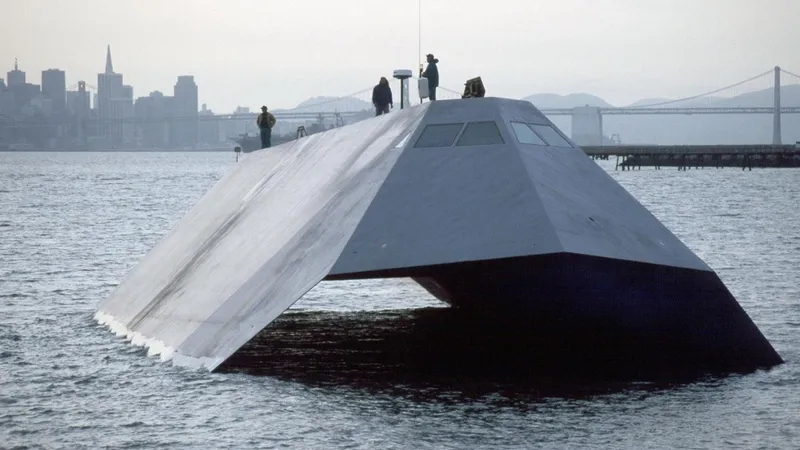
The Sea Shadow (IX-529), a stealth test vessel built for the U.S. Navy and DARPA inside the Hughes Mining Barge (HMB-1), was scrapped in 2012 after museum preservation attempts failed. Designed by Lockheed's Skunk Works in the early 1980s, the Sea Shadow combined radar-absorbing angular surfaces with a Small Waterplane Area Twin Hull configuration for stability in rough seas. Limited size, no weaponry and a top speed of only 14 knots ruled out operational use. Sea Shadow stealth technology later influenced designs such as the Zumwalt-class destroyers.
Sea Shadow | fot. Wikimedia Commons
A stealth experiment born in the cold War
Developed in the early 1980s under a top-secret U.S. Navy and DARPA initiative, the Sea Shadow was built inside the Hughes Mining Barge (HMB-1) to test cutting-edge stealth and stability technologies at sea. Designed by Lockheed's Skunk Works, the vessel featured sharp angles and radar-absorbing surfaces, making it nearly invisible to detection systems.
A visionary design with practical flaws
The Sea Shadow utilized the Small Waterplane Area Twin Hull (SWATH) configuration, which provided remarkable stability even in rough waters. Its angular shape and composite materials minimized radar signatures. However, it was plagued by critical limitations: it was too small for practical naval operations, lacked weaponry, and had a maximum speed of only 14 knots—far too slow for modern combat scenarios.
A legacy in scraps
By the mid-1990s, the U.S. Navy had already shifted focus away from the Sea Shadow. Stored in drydock for years, it was ultimately decommissioned. Attempts to preserve it as a museum piece failed, and in 2012, the once-revolutionary ship was scrapped.
Despite its fate, the Sea Shadow's stealth technology paved the way for modern warships, influencing designs like the Zumwalt-class destroyers. It may have been a ghost ship, but its legacy still lingers in the shadows of naval warfare.
Source: Gazeta Morska · Compiled by: Kamil Kusier
Related articles
 Navy and defence HMS Prince of Wales takes on ammunition in Norway. First resupply outside the UK
 Navy and defence ORP Mewa marks four months with SNMCMG1. Poland's first Kormoran II deployment runs to year-end
 Shipbuilding industry Ex-Enterprise towed to Mobile under $418.5m contract. Test case for Nimitz-class disposal begins
 Navy and defence Norwegian submarine Utstein completes NATO patrol guarding offshore oil and undersea infrastructure
 History Polish Naval Museum in Gdynia opens its doors on Independence Day, 11 November
 Equipment and technology Saab unveils Sea Giraffe AMB D naval radar with 250 km air surveillance range
Comments (0)
The discussion is moderated by the editors: a comment appears after review. Your e-mail address is not published.
Nobody has commented on this article yet.