Polish universities and industry join forces to develop dual-use autonomous underwater drone swarms
Gdańsk University of Technology, AGH University of Science and Technology, and PGZ Naval Shipyard have signed a letter of intent to jointly develop advanced autonomous underwater vehicles (AUVs) capable of operating in coordinated swarms. The dual-use systems are intended for both defense applications and the protection of critical subsea infrastructure.
business education maritime economy pomerania shipbuilding industry equipment and technology tricity news19 march 2026 | 07:07 | Source: Gazeta Morska | Prepared by: Kamil Kusier | Print
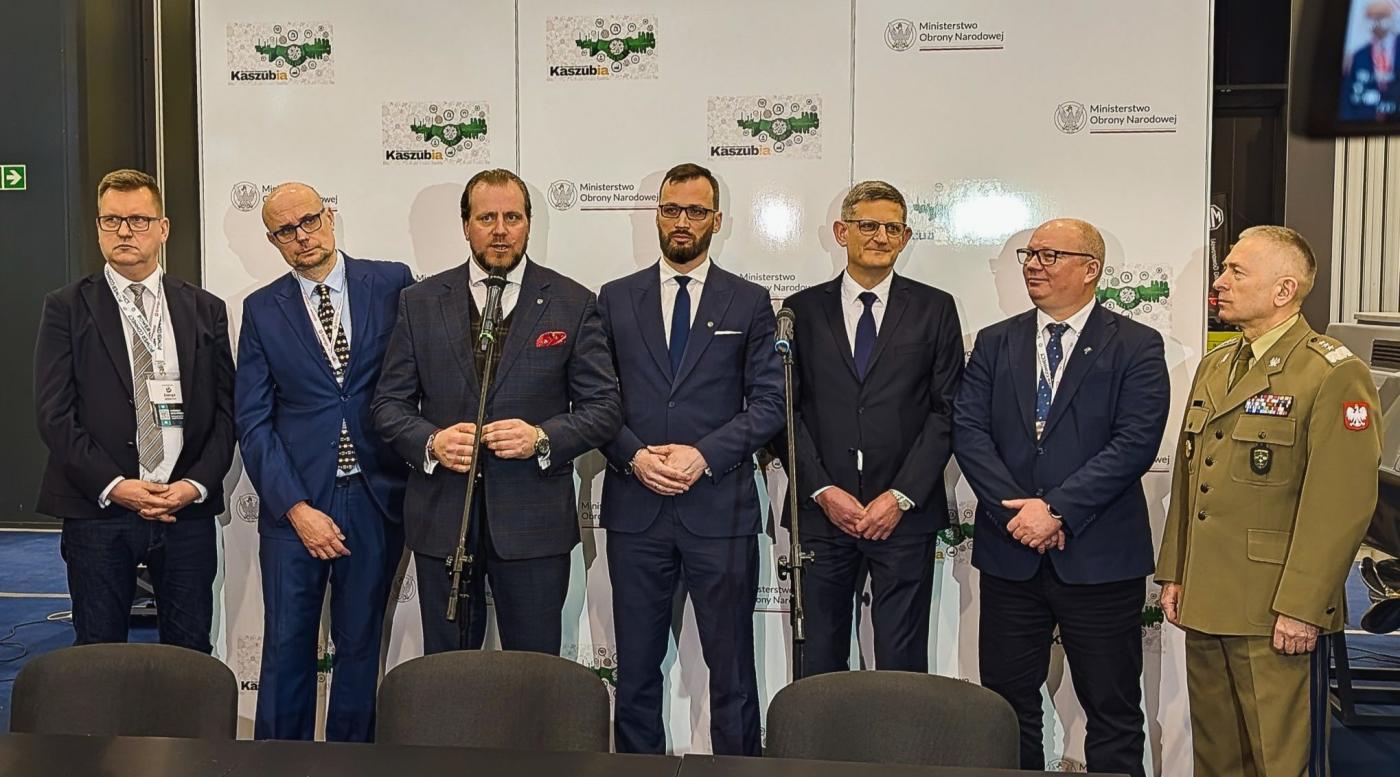
fot. PGZ Stocznia Wojenna
The agreement was signed during the PowerConnect Energy Fair and Conference at AMBEREXPO in Gdańsk, one of Poland’s key platforms for discussing energy transition, advanced technologies, and science–industry cooperation.
The ceremony was attended by Maciej Samsonowicz, advisor to the Polish Minister of National Defence, and Lieutenant General Krzysztof Król from the General Staff of the Polish Armed Forces. The signatories included Prof. Krzysztof Wilde, Rector of Gdańsk University of Technology; Prof. Wojciech Chmiel, representative of AGH University; and Marcin Ryngwelski, President of the Management Board of PGZ Naval Shipyard.
Technology as a strategic security driver
The initiative reflects a broader shift in modern defense thinking, where technological capability increasingly outweighs traditional metrics such as troop numbers.
– “I am very pleased that cooperation between universities within the Green Industrial Districts of Kaszubia and Galicia is now materializing in the form of this letter of intent,” said Maciej Samsonowicz. “For the Ministry of National Defence, it is crucial not only to pursue procurement and business activities, but also to develop research and development initiatives within Poland.”
Lt. Gen. Krzysztof Król emphasized the evolving nature of threats:
- We clearly see that threats around us are no longer determined solely by the number of soldiers or the size of a potential adversary’s army. Technology is playing an increasingly important role.
Swarm-capable underwater systems
The core objective of the partnership is the development of autonomous underwater platforms capable of operating in coordinated swarms — a capability seen as a key technological frontier in maritime security and subsea operations.
- Polish universities have a great deal to offer in the design, development, and production of autonomous vehicles, including underwater and surface platforms. Our ambition is to ensure that as much technological expertise as possible originates domestically, with supply chains remaining close to home, said Prof. Krzysztof Wilde.
He also highlighted the university’s long-standing expertise:
- At Gdańsk University of Technology, we have been working on underwater vehicles for over 40 years. We specialize, among other things, in threat detection and neutralization. However, there is still much to be done in maritime security, especially in the subsea domain. This initiative aims to expand our offering in underwater drones and their cooperative operation.
AI and data fusion at the core
Artificial intelligence and sensor data integration will play a central role in enabling autonomy and swarm coordination.
- What we bring to the table can effectively compete with solutions delivered by partners with significantly more experience, particularly in the military domain. Systems capable of autonomous operation in underwater environments and coordinated swarm behavior are a challenge worth undertaking. This could become an important specialization for Poland, noted Prof. Wojciech Chmiel of AGH University.
Industry–academia synergy
PGZ Naval Shipyard will contribute its industrial capabilities, including production infrastructure and real-world testing in maritime environments.
- In our current projects, we cooperate closely with universities, including Gdańsk University of Technology, for which we are grateful. We already have joint experience, for example with the Głuptak vehicle used on Kormoran II mine countermeasure vessels […] That is why I was very pleased that the Naval Shipyard was invited to participate in this initiative, said Marcin Ryngwelski.
He also pointed to a growing workforce challenge:
- There is a clear shortage of engineers today. That is why it is essential that projects like this help develop young talent for whom modern technologies are second nature. As industry, we need such specialists.
Division of responsibilities
The partners have outlined a clear distribution of roles:
- Gdańsk University of Technology – development of sensor and detection systems, underwater navigation without GPS, communication systems, and onboard systems integration
- AGH University of Science and Technology – AI algorithms for sensor data analysis, object detection, data fusion, and swarm autonomy
- PGZ Naval Shipyard – production infrastructure, testing, and technology demonstrations in real maritime conditions
The resulting systems are expected to be deployed in both military and civilian scenarios, including seabed monitoring, object detection, and protection of critical subsea infrastructure such as pipelines, power cables, and offshore installations.
PowerConnect 2026: platform for innovation
PowerConnect continues to strengthen its role as a key meeting point for the energy, technology, and industrial sectors in Poland.
Gdańsk University of Technology presented its projects at stand no. 20 in Hall B, providing an opportunity for direct engagement with researchers, students, and industry partners.
The 2026 edition of the event is held under the media patronage of Gazeta Morska, Daily Mare, and pracujnamorzu.pl, supporting the promotion of innovation across the maritime and offshore sectors.
Building a national competence in maritime technologies
The agreement marks another step toward strengthening Poland’s domestic capabilities in maritime and defense technologies. The development of autonomous underwater drone swarms may become a cornerstone of a new industrial specialization at the intersection of security, offshore infrastructure, and advanced engineering.
In an era of increasing reliance on subsea infrastructure and rising hybrid threats, such capabilities are no longer optional - they are becoming strategically essential.
Buy us a coffee, and we’ll invest in great maritime journalism! Support Gazeta Morska and help us sail forward – click here!
Kamil Kusier
redaktor naczelny
comments
Add the first comment
see also
Port Haller a strategic maritime investment for Poland and the Baltic region
Polish tactical communications breakthrough: COMP@N-Z enters NATO catalogue
Baltica 2 HDD landfall completed. Offshore wind farm cable route ready for grid connection
CRIST Offshore launches production of BC-Wind offshore power station
Poland advances satellite radar capabilities with new Eycore-MoD initiative in Kashubia
PGZ Naval Shipyard and OSI Maritime Systems: towards a new model of naval industry cooperation
Naftoport expansion in Gdańsk enters execution phase. Strategic boost to Poland’s energy security
Remontowa Shipbuilding delivers hybrid ferry Bjarkøy to Norwegian operator
Baltic Towers and Siemens Gamesa launch strategic cooperation for Baltica 2 offshore wind project
PERN expands fuel logistics backbone as maritime capacity grows
ADVERTISEMENT
ADVERTISEMENT