PGZ Naval Shipyard and OSI Maritime Systems: towards a new model of naval industry cooperation
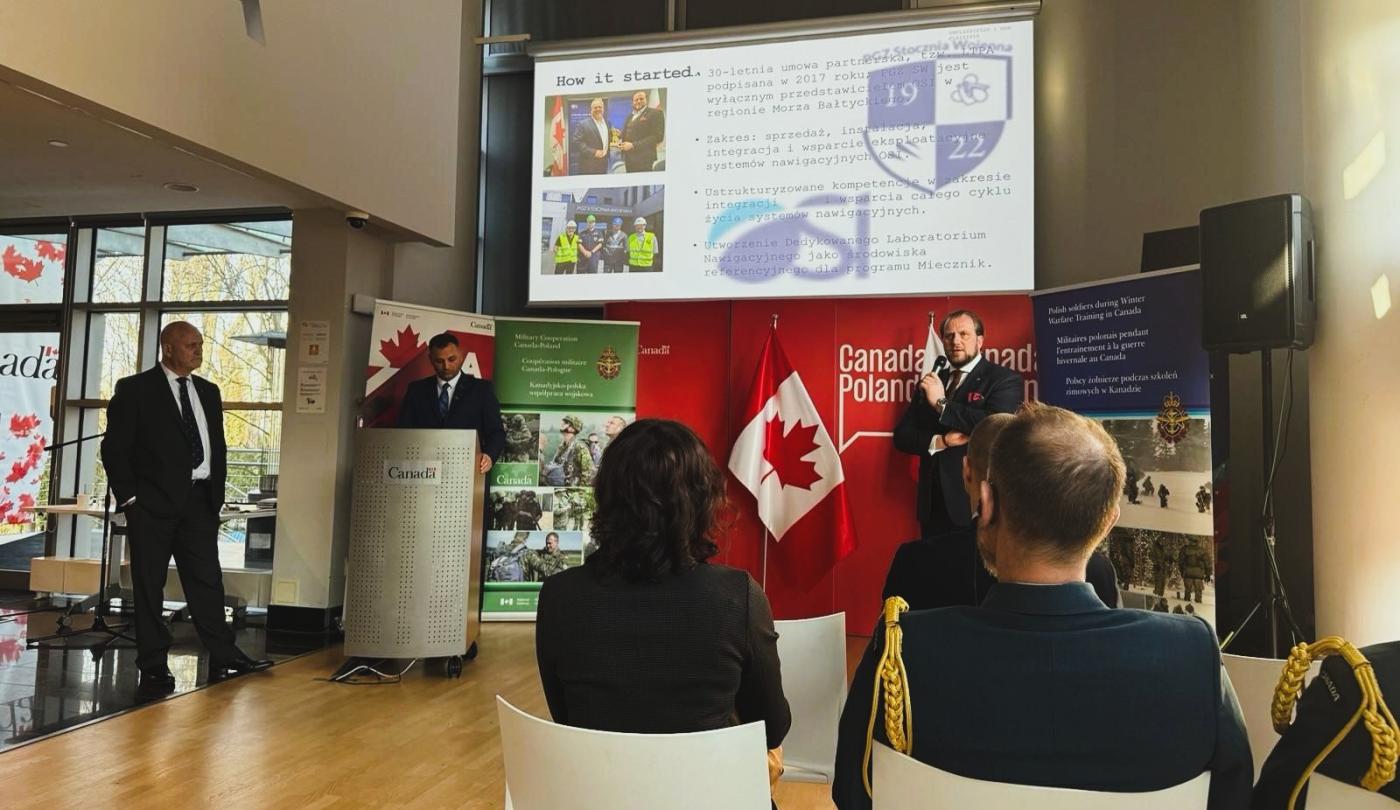
The Embassy of Canada in Poland recently hosted Canada–Poland Industry Day, an event held במסגרת the strategic partnership announced in August 2025 by the prime ministers of both countries. Among the participants, PGZ Naval Shipyard and its Canadian partner OSI Maritime Systems presented a cooperation model that goes beyond the traditional supplier–integrator relationship.
business maritime economy shipbuilding industry defense industry equipment and technology news22 march 2026 | 10:28 | Source: Gazeta Morska | Prepared by: Kamil Kusier | Print
fot. PGZ Stocznia Wojenna
According to company representatives, the partnership is designed not as a one-off procurement arrangement, but as a long-term framework focused on capability building within Poland’s defence industrial base. OSI Maritime Systems is currently supplying Integrated Bridge and Navigation Systems (IBNS) for several key Polish Navy programmes, including the Miecznik-class frigates, the Kormoran II mine countermeasure vessels, and the Ratownik rescue ship.
PGZ Naval Shipyard acts as OSI’s exclusive representative in Poland and is actively involved in establishing a domestic support ecosystem. This includes the development of a dedicated Navigation Laboratory, intended to provide in-country servicing, testing, and lifecycle support for advanced navigation systems.
- This cooperation demonstrates what long-term industrial partnership should look like: joint projects, knowledge transfer, and the development of competencies on the Polish side. It is not a transactional relationship, but a foundation we have been building for years, said Marcin Ryngwelski, President of the Management Board at PGZ Naval Shipyard.
From an industry perspective, this approach reflects a broader shift in naval modernization programmes—towards the gradual localization of technical and support capabilities within the end-user country. Traditionally, advanced onboard systems, particularly in navigation and command domains, have been delivered and maintained by foreign suppliers. In this case, Polish engineers and shipyard personnel are directly involved in integration, testing, and long-term system support, increasing national technological autonomy.
In practical terms, PGZ Naval Shipyard’s role extends beyond installation. It includes:
- training of naval operators and technical staff,
- in-country testing and certification,
- development of diagnostic and maintenance capabilities within the Navigation Laboratory.
From an industrial and sustainment perspective, a key aspect of this model is that competencies are developed within active operational programmes rather than standalone or demonstrative projects. This increases their long-term applicability and reduces reliance on external suppliers for maintenance and lifecycle support.
In this context, Canada–Poland Industry Day illustrates a form of bilateral cooperation that moves beyond policy-level declarations and translates into tangible industrial outcomes, including the development of infrastructure, in-country support capabilities, and technical expertise in advanced naval navigation systems.
see also
Buy us a coffee, and we’ll invest in great maritime journalism! Support Gazeta Morska and help us sail forward – click here!
Kamil Kusier
redaktor naczelny
comments
Add the first comment
see also
Port Haller a strategic maritime investment for Poland and the Baltic region
Polish tactical communications breakthrough: COMP@N-Z enters NATO catalogue
Baltica 2 HDD landfall completed. Offshore wind farm cable route ready for grid connection
CRIST Offshore launches production of BC-Wind offshore power station
Poland advances satellite radar capabilities with new Eycore-MoD initiative in Kashubia
Naftoport expansion in Gdańsk enters execution phase. Strategic boost to Poland’s energy security
Remontowa Shipbuilding delivers hybrid ferry Bjarkøy to Norwegian operator
Baltic Towers and Siemens Gamesa launch strategic cooperation for Baltica 2 offshore wind project
Polish universities and industry join forces to develop dual-use autonomous underwater drone swarms
PERN expands fuel logistics backbone as maritime capacity grows
ADVERTISEMENT
ADVERTISEMENT