









Navantia and the Spanish Navy advance BHC programme, completing key preliminary design review
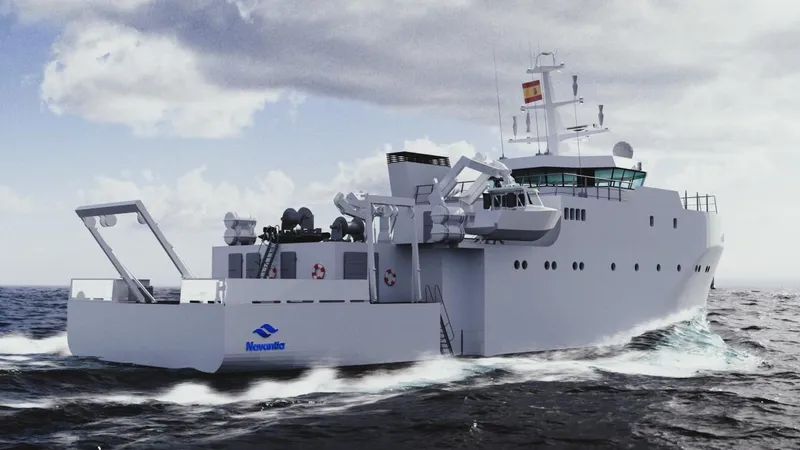
Navantia and the Spanish Navy are moving forward with the construction of two new coastal hydrographic vessels (BHC), following the execution order signed in December 2023. The programme has now passed a major milestone with the completion of the preliminary design review (PDR) — a crucial phase that validates whether the vessel design meets all operational, technical and budgetary requirements.
In brief
Navantia and the Spanish Armada completed the preliminary design review (PDR) in the programme to build two Buques Hidrográficos Costeros hydrographic vessels, following the signing of the Execution Agreement in December 2023. The vessels will be 50 metres long, with a displacement of about 1,000 tonnes, a crew limited to 30 people and a range of 3,000 nautical miles allowing surveys for up to 15 days. The units are designed to run on biofuels and will be operated by the Instituto Hidrográfico de la Marina. The programme at the Navantia San Fernando shipyard will last 51 months and is expected to provide about 700 jobs and more than 870,000 working hours.
During the PDR, Navantia — working closely with the Hydrographic Flotilla Programme Office of DGAM and the Construction Inspection Office of the Cádiz Arsenal — conducted an extensive technical evaluation of the design documentation. The review confirmed the robustness of the main ship systems and outlined the actions required to progress into the next stages of development.
Next-generation hydrographic capabilities
The new BHC vessels will measure 50 metres in length, displace around 1,000 tonnes, and operate with a reduced crew of 30, enabled by a high degree of automation. They will offer an endurance of 3,000 nautical miles and up to 15 days of continuous operations in shallow waters. The design also incorporates the ability to operate on biofuels, aligning with broader decarbonisation goals across European fleets.
Key mission profiles will include:
- hydrographic surveying to support the production of Spain’s official nautical charts,
- providing environmental, geographic and meteorological data to the fleet,
- supporting the protection of underwater archaeological heritage,
- strengthening the operational capabilities of the Spanish Naval Hydrographic Institute, the future operator of the vessels.
A boost for the Cádiz shipbuilding cluster
The programme is being executed at Navantia’s San Fernando shipyard (Bay of Cádiz). With a duration of 51 months, the contract is expected to generate approximately 700 jobs and over 870,000 working hours, reinforcing the industrial and economic impact of naval shipbuilding in the region.
Once completed, the BHC units will significantly enhance Spain’s national hydrographic capability, improving navigational safety, maritime situational awareness and the country’s presence in scientific and environmental data collection.
Source: Gazeta Morska · Compiled by: Kamil Kusier
Related articles
 Navy and defence ORP Mewa marks four months with SNMCMG1. Poland's first Kormoran II deployment runs to year-end
 Shipbuilding industry Ex-Enterprise towed to Mobile under $418.5m contract. Test case for Nimitz-class disposal begins
 Navy and defence Norwegian submarine Utstein completes NATO patrol guarding offshore oil and undersea infrastructure
 History Polish Naval Museum in Gdynia opens its doors on Independence Day, 11 November
 Equipment and technology Saab unveils Sea Giraffe AMB D naval radar with 250 km air surveillance range
 Navy and defence Polish minehunters and NATO group search Gulf of Gdańsk port approaches
Comments (0)
The discussion is moderated by the editors: a comment appears after review. Your e-mail address is not published.
Nobody has commented on this article yet.