









Japan conducts world’s first successful electromagnetic railgun test at sea
In a breakthrough for naval weapons technology, the Japan Maritime Self-Defense Force (JMSDF) has announced the world’s first successful at-sea test of an electromagnetic railgun. The live-fire demonstration took place on Wednesday in Tokyo Bay, with the weapon mounted on the bow of the experimental vessel JS Asuka.
In brief
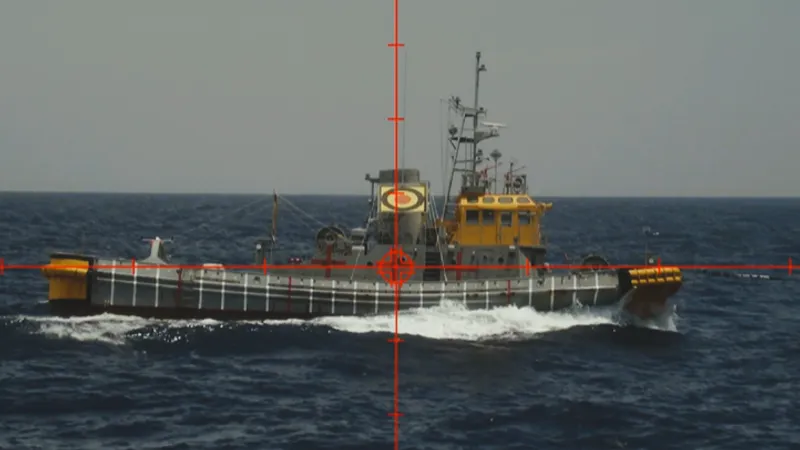
The Japanese Navy conducted on Wednesday in the waters of Tokyo Bay the world's first successful test of an electromagnetic gun that destroyed a target vessel. The shot was fired from the experimental ship JS Asuka from a railgun weighing more than eight tonnes, and the projectile reached a muzzle velocity of about 2,230 m/s, roughly Mach 6.5, hitting a small vessel moored at the base in Yokosuka. The Acquisition, Technology and Logistics Agency and Japan Steel Works are responsible for the system. The US Navy halted its own railgun project in 2021 after spending more than 500 million USD.
The railgun, weighing more than eight tons, fired a projectile at a muzzle velocity of approximately 2,230 m/s (around Mach 6.5), striking and destroying a moored target vessel off the coast of Yokosuka. The JMSDF released photographic evidence of the test on social media, confirming the strike.
The program is jointly developed by Japan’s Acquisition, Technology & Logistics Agency (ATLA) and Japan Steel Works, a major domestic defense manufacturer.
Unlike conventional naval guns, the electromagnetic railgun uses pure kinetic energy to launch inert projectiles at hypersonic speeds. This makes the ammunition significantly cheaper, lighter, and inherently safer, as it contains no explosive filler and therefore cannot detonate in storage or during enemy attack. Defense analysts at Shephard Media estimate the projectiles used in the test to be 40 mm rounds weighing roughly 320 grams.
Beyond cost and safety benefits, the system offers substantial operational advantages. It can function in all weather conditions and has the potential to engage targets beyond the visual horizon, a capability highly sought after for maritime operations. Japanese planners also expect the railgun to be effective against a range of modern threats — including hostile surface vessels, drones, and even hypersonic missiles — once it reaches full operational capability.
The United States Navy previously invested more than $500 million into a similar railgun program but officially halted development in 2021. Japan’s continued progress positions it as a frontrunner in the global race to field practical electromagnetic weapon systems, potentially shaping the future of naval firepower for decades to come.
Source: Gazeta Morska / PAP · Compiled by: Kamil Kusier
Related articles
 Navy and defence ORP Mewa marks four months with SNMCMG1. Poland's first Kormoran II deployment runs to year-end
 Shipbuilding industry Ex-Enterprise towed to Mobile under $418.5m contract. Test case for Nimitz-class disposal begins
 Navy and defence Norwegian submarine Utstein completes NATO patrol guarding offshore oil and undersea infrastructure
 History Polish Naval Museum in Gdynia opens its doors on Independence Day, 11 November
 Equipment and technology Saab unveils Sea Giraffe AMB D naval radar with 250 km air surveillance range
 Navy and defence Polish minehunters and NATO group search Gulf of Gdańsk port approaches
Comments (0)
The discussion is moderated by the editors: a comment appears after review. Your e-mail address is not published.
Nobody has commented on this article yet.