









Fujian crosses Taiwan Strait. China’s most advanced carrier nears operational status
China’s third and most advanced aircraft carrier, Fujian, has sailed through the Taiwan Strait en route to the South China Sea to conduct “research trials and training missions,” the People’s Liberation Army Navy (PLAN) confirmed on Friday. The deployment underscores Beijing’s ongoing naval modernization efforts and has drawn close scrutiny from regional maritime observers.
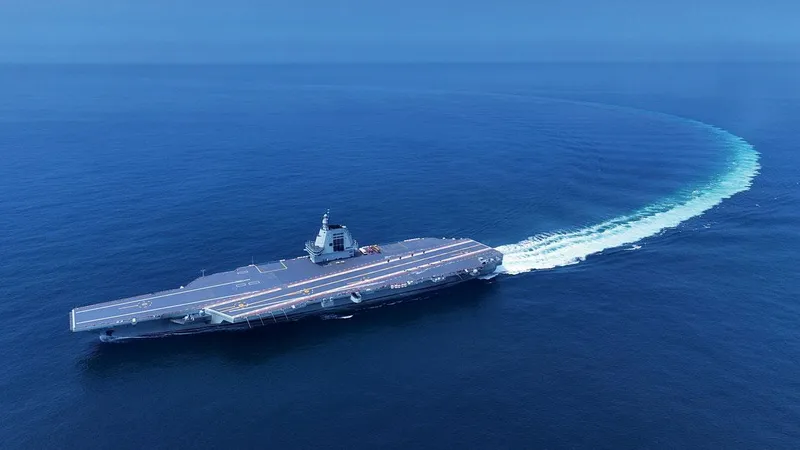
In brief
The Chinese aircraft carrier Fujian sailed through the Taiwan Strait and headed for the South China Sea, where according to the People's Liberation Army Navy it is carrying out research trials and training missions. The Japanese Ministry of Defense reported that during the transit through the East China Sea the aircraft carrier Fujian was accompanied by two guided-missile destroyers. Fujian, unlike the carriers Liaoning from 2012 and Shandong from 2019, has electromagnetic catapults, and the range of the defensive zone it provides exceeds 600 km according to experts. The Chinese navy numbers more than 370 surface ships and submarines.
In an official statement, the PLAN stressed that the carrier’s activities are “routine” and “not directed against any particular target.” Nevertheless, the transit comes amid heightened regional military activity: the U.S. and Japan are holding joint exercises near Okinawa, while Taiwan’s Ministry of National Defense confirmed the carrier’s presence and stated that its movements are being closely monitored.
Japan’s Ministry of Defense reported that two guided-missile destroyers accompanied Fujian as it crossed the East China Sea, suggesting the operation was a carefully coordinated trial rather than a simple transit.
A leap in Chinese carrier capability
Fujian represents a major technological step forward for China’s blue-water navy. Unlike its predecessors – Liaoning (commissioned in 2012) and Shandong (2019) – the new carrier is equipped with electromagnetic catapults, allowing heavier aircraft to launch with full fuel and weapons loads. This capability significantly expands the PLAN’s operational envelope, enabling the deployment of airborne early warning aircraft and fifth-generation stealth fighters from the carrier’s deck.
Analysts estimate Fujian’s defensive and strike reach extends beyond 600 km, giving China a powerful tool for power projection. The timing of this mission is noteworthy: Shandong undertook a similar cruise roughly a month before its own commissioning, suggesting Fujian may soon enter active service.
Regional security implications
Chinese naval activity in the East and South China Seas, combined with regular coast guard patrols near disputed islands, continues to raise concerns in Tokyo, Taipei, and Manila. Regional powers are responding by strengthening their own maritime capabilities and deepening security cooperation under the U.S.-led alliance network.
China now fields over 370 surface ships and submarines, making the PLAN the world’s largest navy by fleet size. With Fujian nearing operational readiness, Beijing will gain enhanced capacity for sustained operations beyond its near seas — a development that could further complicate the strategic balance in the Indo-Pacific and intensify concerns over a potential attempt to forcibly reunify Taiwan.
Source: Gazeta Morska / PAP · Compiled by: Krzysztof Pawliszak
Related articles
 Navy and defence ORP Gopło will not be preserved intact. Prototype laminate minesweeper passes to Poland's Military Property Agency
 Navy and defence HMS Prince of Wales takes on ammunition in Norway. First resupply outside the UK
 Navy and defence ORP Mewa marks four months with SNMCMG1. Poland's first Kormoran II deployment runs to year-end
 Shipbuilding industry Ex-Enterprise towed to Mobile under $418.5m contract. Test case for Nimitz-class disposal begins
 Navy and defence Norwegian submarine Utstein completes NATO patrol guarding offshore oil and undersea infrastructure
 History Polish Naval Museum in Gdynia opens its doors on Independence Day, 11 November
Comments (0)
The discussion is moderated by the editors: a comment appears after review. Your e-mail address is not published.
Nobody has commented on this article yet.