









French navy seizes record-breaking cocaine shipment off African coast
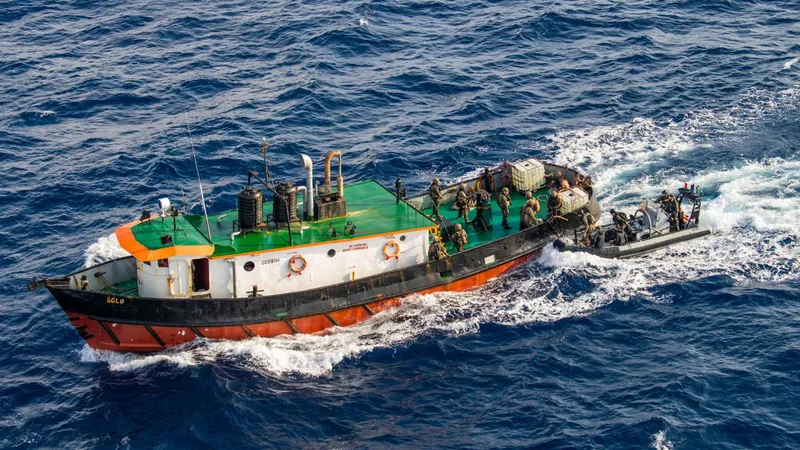
On Saturday, March 15, 2025, acting on orders from the Atlantic maritime prefect and the public prosecutor in Brest, a French navy vessel intercepted a staggering 6,386 kg of cocaine from a fishing vessel operating off the coast of Africa. This operation, a result of extensive international maritime and intelligence collaboration, underscores the effectiveness of joint efforts in combating drug trafficking.
In brief
A French Navy warship seized 6,386 kilograms of cocaine with a market value of nearly 371 million euros from a roughly 20-metre fishing boat registered in Guyana, off the coast of Africa. The operation was carried out on the orders of the maritime prefect for the Atlantic and the Brest prosecutor, from a helicopter carrier, with support from Dauphin and Cougar helicopters and a drone. The decision to intervene was taken by the anti-narcotics office OFAST based on information from MAOC-N, the British NCA and the American DEA. The drugs were destroyed by decision of the Brest prosecutor's office.
Scale of the operation and global coordination
The French anti-narcotics office (OFAST) initiated the intervention based on intelligence provided by the Maritime Analysis and Operations Centre – Narcotics (MAOC-N), the UK's National Crime Agency (NCA), and the US Drug Enforcement Administration (DEA). The French navy, operating from a helicopter carrier, executed the operation with support from two helicopters — Dauphin and Cougar — and a drone. The intercepted fishing vessel, approximately 20 meters long and registered in Guyana, was boarded with the flag state’s consent under article 17 of the United Nations Convention Against Illicit Traffic in Narcotic Drugs and Psychotropic Substances.
Results: seizure and destruction of the cargo
The French team secured 6,386 kg of cocaine onboard, with an estimated street value of nearly €371 million. The drugs were transferred to the French naval vessel and subsequently destroyed under the directive of the Brest public prosecutor. This operation highlights the strength of international cooperation, delivering a significant blow to organized crime networks.
France’s naval presence in the region
The French navy maintains a consistent presence in West and Central African waters, safeguarding vital trade and maritime routes. One or two French naval vessels, supported by a maritime patrol aircraft, are almost permanently deployed in the Gulf of Guinea under operation Corymbe. This mission contributes to the broader strategy of maritime security architecture developed through the Yaoundé process and supports the European Union’s coordinated maritime presence initiative.
Key takeaways for the maritime sector
The success of this operation reinforces the importance of international collaboration in protecting maritime routes. The maritime sector — including European ports and shipowners — must remain vigilant and adaptable to evolving security threats like smuggling. France’s operation serves as a powerful reminder that robust, intelligence-driven alliances are pivotal in reducing illegal activities at sea.
Daily Mare will continue to monitor developments in global maritime security, focusing on efforts to ensure safer, more stable sea transport routes.
Source: Gazeta Morska · Compiled by: Kamil Kusier
Related articles
 Navy and defence HMS Prince of Wales takes on ammunition in Norway. First resupply outside the UK
 Navy and defence ORP Mewa marks four months with SNMCMG1. Poland's first Kormoran II deployment runs to year-end
 Shipbuilding industry Ex-Enterprise towed to Mobile under $418.5m contract. Test case for Nimitz-class disposal begins
 Navy and defence Norwegian submarine Utstein completes NATO patrol guarding offshore oil and undersea infrastructure
 History Polish Naval Museum in Gdynia opens its doors on Independence Day, 11 November
 Equipment and technology Saab unveils Sea Giraffe AMB D naval radar with 250 km air surveillance range
Comments (0)
The discussion is moderated by the editors: a comment appears after review. Your e-mail address is not published.
Nobody has commented on this article yet.