Aurora borealis over the Baltic Sea: a space weather signal for the maritime industry
An intense aurora borealis was observed overnight across Northern Europe, including the Baltic Sea region. While the phenomenon captured public attention for its striking visuals, it also signalled heightened geomagnetic activity with potential implications for maritime operations, navigation and port infrastructure.
marine lifestyle weather pomerania west pomerania tricity news20 january 2026 | 10:15 | Source: Gazeta Morska | Prepared by: Kamil Kusier | Print
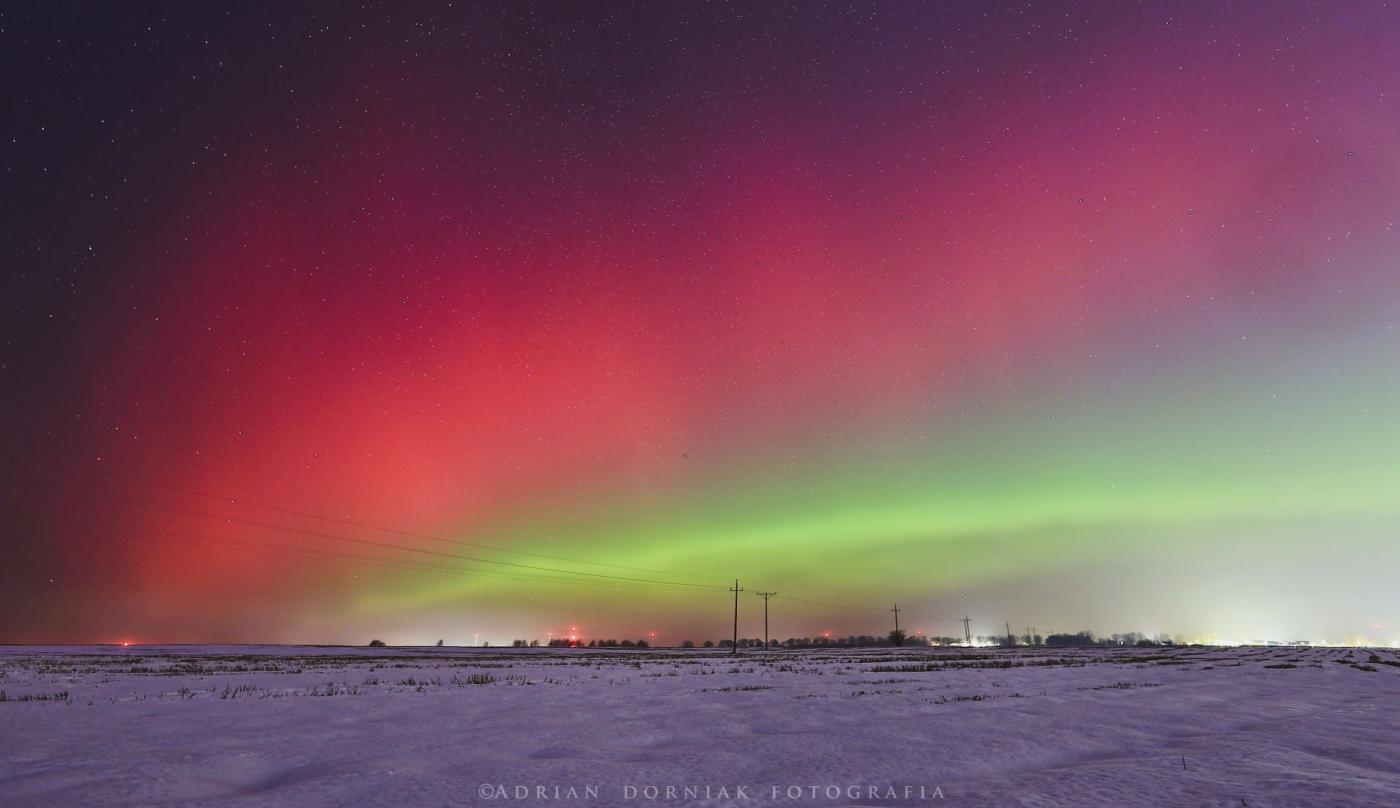
fot. Adrian Dorniak
Why auroras matter to shipping
Auroras occur when charged solar particles interact with Earth’s magnetosphere. When visible at lower latitudes than usual, they are commonly associated with moderate to strong geomagnetic storms.
For the maritime sector, such conditions may affect:
- GNSS positioning systems, including GPS and Galileo,
- the accuracy of magnetic compasses,
- the reliability of integrated bridge and navigation systems.
Operational considerations for vessels and ports
Although modern ships are generally resilient to short-term disturbances, periods of elevated space weather activity require increased situational awareness, particularly in congested and shallow waters such as the Baltic Sea.
Operators may need to:
- verify navigation data consistency,
- ensure redundancy between satellite-based and traditional navigation methods,
- assess the robustness of power supply and communications in port environments.
Space weather as an emerging maritime risk factor
The recent auroral display coincides with the current solar maximum phase, during which geomagnetic disturbances are expected to occur more frequently. As maritime operations become increasingly digital and automated, space weather is emerging as a non-traditional but relevant operational risk.
Beyond operations: a rare and inspiring sight
Despite its technical implications, the aurora borealis remains one of nature’s most visually compelling phenomena. For seafarers, port workers and maritime observers, witnessing auroral lights above the sea is often described as a once-in-a-lifetime experience.
Soft green, red and violet bands reflecting off open water and port infrastructure offer a perspective rarely seen outside high-latitude regions. Many professionals take advantage of such moments to experiment with night photography, capturing images that merge maritime landscapes with cosmic processes. In this way, the aurora is not only a space weather indicator, but also a reminder of the sense of awe that still accompanies life and work at sea.
A visual phenomenon with strategic implications
Beyond its aesthetic value, the aurora borealis underscores the fact that maritime safety is influenced not only by weather and sea state, but also by solar activity far beyond Earth’s atmosphere. Integrating space weather awareness into operational planning is becoming an increasingly important element of modern maritime risk management.
Buy us a coffee, and we’ll invest in great maritime journalism! Support Gazeta Morska and help us sail forward – click here!
Kamil Kusier
redaktor naczelny
comments
Add the first comment
see also
Galeon Yachts and Meyer Shank Racing: merging luxury yachts with motorsport expertise
Winter periscope mode and sandbanks instead of ice: how seals rest in the southern Baltic
Baltic Sea water levels at a record low: a meteorological-oceanographic anomaly with major implications
106 years ago Poland “turned to the sea”. Split celebrations, one goal: a strong maritime Poland
Red Rose trapped in ice on the Bay of Puck. Sequence of events and structural risks
Crystal Sails Awards presented. Pomeranian sailing officially concludes the 2025 season
The Famous Project: first all-female crew sails non-stop around the world
Robert Lewandowski becomes Sunreef Yachts ambassador, orders 80-foot power catamaran built in Poland
Polish ice sailors claim a haul of medals as “Hollywood ice” delivers top-level competition
World Sailing sets a new benchmark for sustainability with life-cycle assessments of Olympic sailing equipment
ADVERTISEMENT
ADVERTISEMENT