









Triple interdiction off Colombia highlights U.S. Coast Guard’s multi-target maritime capability
The U.S. Coast Guard cutter Tahoma has demonstrated advanced multi-domain interdiction capability after simultaneously intercepting three suspected narcotics smuggling vessels in the Caribbean, underscoring the growing operational complexity of counter-trafficking missions in the Western Hemisphere.
In brief
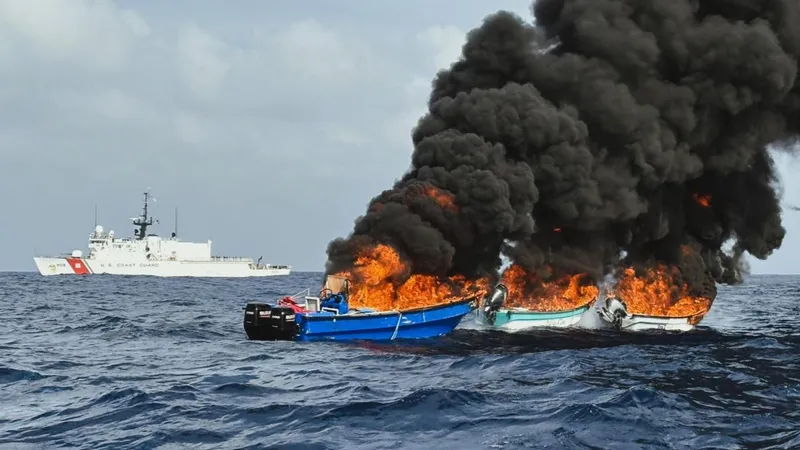
The crew of the cutter USCGC Tahoma simultaneously intercepted three vessels suspected of smuggling cocaine around 90 nautical miles from Cartagena, Colombia. The operation used shipboard fast response boat teams and an air component of the Helicopter Interdiction Tactical Squadron. According to a US Coast Guard statement, an aerial use of force procedure was applied against one of the vessels, which failed to comply with orders to stop. After completing the patrol, USCGC Tahoma offloaded the seized substances at Port Everglades in Florida.
Coordinated three-target interdiction
Operating under U.S. Coast Guard Atlantic Area Command, USCGC Tahoma, a 270-foot medium endurance cutter, conducted a coordinated interdiction approximately 90 nautical miles off Cartagena, Colombia.
The operation involved the simultaneous disruption of three suspected smuggling craft, requiring the deployment of embarked small boat teams alongside an aviation detachment from the Helicopter Interdiction Tactical Squadron (HITRON).
According to operational details released by the Coast Guard, one vessel failed to comply with stop commands, triggering an aerial use of force protocol to disable the craft.
HITRON as a force multiplier
HITRON remains one of the most distinctive force elements in U.S. maritime counter-narcotics operations. Equipped with armed helicopter crews trained to disable high-speed “go-fast” vessels, the unit provides a decisive tactical advantage in intercept scenarios where surface pursuit alone may be insufficient.
The use of airborne engine-disabling tactics significantly reduces pursuit duration while increasing interdiction success rates and evidence preservation.
Simultaneously engaging three separate targets highlights a high degree of command-and-control maturity between cutter command, aviation assets, and interdiction boarding teams.
Strategic importance of maritime interdiction
The Caribbean basin continues to serve as a major maritime transit corridor for narcotics shipments moving from South America toward North American markets.
As a result, maritime interdiction remains a cornerstone of U.S. regional security strategy, involving coordination between the Coast Guard, interagency partners, and allied regional forces.
Interdicting narcotics at sea offers operational advantages over land-based enforcement by disrupting trafficking networks earlier in the supply chain and limiting downstream distribution.
Cutter platforms and maritime security role
Following completion of patrol activities, Tahoma offloaded seized contraband at Port Everglades, Florida.
From an industry perspective, the operation reinforces the enduring relevance of medium endurance cutters as multi-mission platforms capable of combining maritime law enforcement, patrol presence, counter-smuggling operations, and regional security projection.
The mission also illustrates how legacy patrol assets, when integrated with aviation and rapid interdiction capabilities, continue to provide strong operational value in high-threat maritime environments.
Operational significance for the sector
Beyond its enforcement outcome, the Tahoma case offers a practical example of evolving maritime security doctrine: layered interception, air-surface integration, and high-speed interdiction are increasingly central to law enforcement missions in contested trafficking corridors.
For commercial maritime stakeholders and port security operators, such operations underline the continued militarization and technological sophistication of anti-trafficking efforts across the Caribbean theater.
Source: Gazeta Morska · Compiled by: Kamil Kusier
Related articles
 Safety and rescue Polish SAR’s new rescue vessel Mistral launched at Kewatec in Finland
 Safety and rescue Icelandic Coast Guard and police delegation visits Polish Border Guard’s Maritime Division
 Safety and rescue Polish Navy helicopter evacuates man from Baltic platform 100 km off Władysławowo
 Navy and defence SNMG2 joins Allied warships in PASSEX as Italy's Mare Aperto 2026 gets under way
 Safety and rescue From lightships to solar power: 160 years of the Grundkallen light station
 Education 254 people, manikins and life rafts: Maritime University of Szczecin joins national CPR record attempt
Comments (0)
The discussion is moderated by the editors: a comment appears after review. Your e-mail address is not published.
Nobody has commented on this article yet.