









Training for shipowners. Entry/Exit system in practice
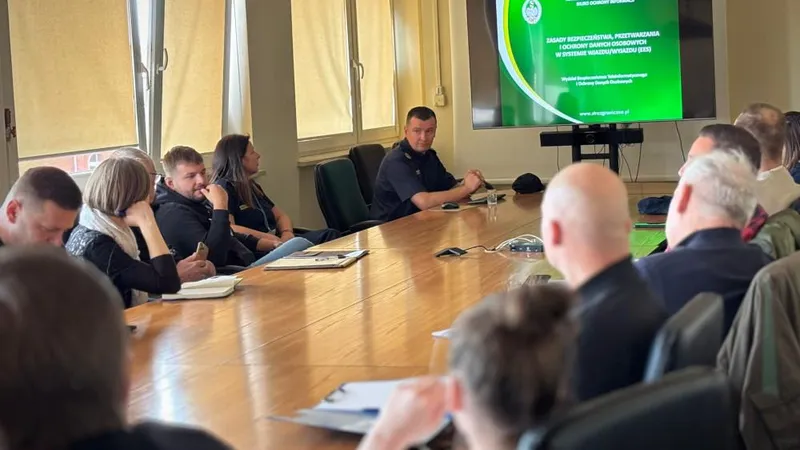
A dedicated training session for representatives of the commercial fleet was recently held at the Headquarters of the Maritime Border Guard Unit, focusing on the implementation of the Entry/Exit System (EES) – the EU’s new electronic system for registering the entry and exit of third-country nationals crossing the Union’s external borders.
In brief
The Headquarters of the Maritime Border Guard Unit organised training for representatives of merchant fleet shipowners on the implementation of the Entry/Exit System, the European Union's system for electronic registration of entries and exits of third-country nationals at the external borders of the European Union. The classes were led by an officer of the Border Department of the Maritime Border Guard Unit, who discussed the system's operating principles and the new obligations of shipowners. The training was organised at the request of the shipowning community, and participants discussed cases concerning clearance of ship crews and passengers in Polish ports.
The session was conducted by an experienced officer from the MOSG Border Division, who outlined the key changes and obligations introduced by EES. These updates are particularly relevant for shipowners and seafarers serving on vessels calling at Polish ports, where border control procedures will undergo significant adjustments.
The training was organized in response to growing interest within the maritime community. Shipowners, seeking to ensure full compliance with upcoming regulations, expressed the need for practical and expert guidance on EES implementation. Participants had the opportunity to discuss real operational scenarios and clarify specific issues related to crew and passenger processing.
Such meetings serve not only an informational role but also a practical one – helping maritime stakeholders to better understand the new system, clear up uncertainties, and prepare for its rollout.
Close cooperation between maritime authorities and the shipping sector remains essential to ensuring the smooth, safe, and compliant operation of Poland’s ports and maritime transport system.
Source: Gazeta Morska · Compiled by: Kamil Kusier
Related articles
 Safety and rescue Polish SAR’s new rescue vessel Mistral launched at Kewatec in Finland
 Safety and rescue Icelandic Coast Guard and police delegation visits Polish Border Guard’s Maritime Division
 Safety and rescue Polish Navy helicopter evacuates man from Baltic platform 100 km off Władysławowo
 Navy and defence SNMG2 joins Allied warships in PASSEX as Italy's Mare Aperto 2026 gets under way
 Safety and rescue From lightships to solar power: 160 years of the Grundkallen light station
 Education 254 people, manikins and life rafts: Maritime University of Szczecin joins national CPR record attempt
Comments (0)
The discussion is moderated by the editors: a comment appears after review. Your e-mail address is not published.
Nobody has commented on this article yet.