









Three salvos for Poland: The Bismarck, ORP Piorun, and a lesson worth remembering
On 27 May 1941, after a days-long chase across the storm-lashed Atlantic, a British pursuit force sent the battleship Bismarck to the bottom, the pride of the Kriegsmarine and one of the most powerful surface warships then afloat. Eighty-five years on, the anniversary is a fitting moment to recall the part played by a Polish destroyer, ORP Piorun, and to draw a few lessons for our own time.
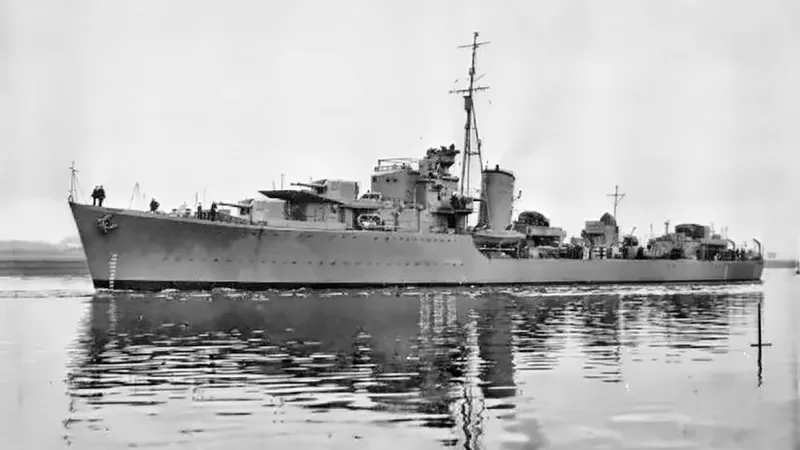
In brief
The destroyer ORP Piorun was the first ship of the pursuit group to detect the German battleship Bismarck late in the evening of 26 May, and British forces sank the Bismarck on 27 May 1941. Captain (Navy) Eugeniusz Pławski gave the order: three salvos in honour of Poland, and ORP Piorun fought a duel for nearly an hour while transmitting homing signals for the main British forces. Torpedo aircraft from the carrier Ark Royal and the battleships HMS King George V and HMS Rodney sank the Bismarck. ORP Grom sank off Narvik, and 59 of the 213 crew members were killed.
Late on 26 May, sailing with Captain Philip Vian's 4th Destroyer Flotilla, Piorun was the first ship of the pursuit group to make contact with the German battleship. Cmdr Eugeniusz Pławski did not flinch. The order rang out: "Three salvos for Poland!" For close to an hour the Polish destroyer fought an uneven duel, weaving through Bismarck's secondary-battery fire under cover of smoke and hard turns. The decisive work, though, was done on the airwaves: Piorun held contact and transmitted the homing signals that allowed the main British force to move into position. By dawn, her fuel almost gone, she was ordered away — and never saw the kill. That came the following day, after Swordfish torpedo bombers from HMS Ark Royal crippled Bismarck's rudder and the battleships HMS King George V and HMS Rodney pounded her into a wreck.
None of this diminishes the Polish contribution. If anything, it sharpens it. The value of the story lies not in the blow struck, but in the posture: a small ship with a largely green crew stood toe to toe with the most powerful battleship in the world and refused to give way.
The heroism of Polish warships in the Second World War
Piorun was not the exception. She was the rule.
In September 1939 the Polish fleet — the fourth-strongest in the Baltic, yet far weaker than the Kriegsmarine, did not lay down its arms. Three destroyers, Błyskawica, Grom and Burza, sailed for Britain under Operation Peking even before the war began, to fight alongside the Allies from the first day of the European war to the last. ORP Orzeł passed into legend with her daring escape from Tallinn, stripped of her charts and signal books. Crews that could no longer fight scuttled their own ships or accepted internment in neutral Sweden, but did not strike their colours to the enemy.
The price was steep. Off Narvik, ORP Grom was sunk by German bombs; 59 of her 213 crew were lost. Across the war, Polish sailors buried hundreds of their own. And yet the Polish Navy, operating with the Allies, grew to several dozen vessels, steamed well over a million nautical miles, and earned its place in the Battle of the Atlantic. The finest witness to that era still floats: ORP Błyskawica, widely regarded as the oldest preserved destroyer in the world, moored at Gdynia as a museum ship to this day.
This is the bedrock of Poland's maritime tradition — the conviction that a flag is defended or goes down with the ship, but is never handed over.
The Baltic is not "NATO's internal sea"
Since Finland and Sweden joined the Alliance, commentary has filled with a comfortable phrase: the Baltic is now "NATO's internal sea," almost a "NATO lake." The expression lulls the reader into complacency — which is precisely why it is dangerous.
The map allows no such shortcut. Russia still holds the Kaliningrad exclave, with its base at Baltiysk; still commands the eastern reaches around St Petersburg and Kronstadt; still maintains its Baltic Fleet. A sea ringed by several states with competing interests, and crossed by power cables, gas pipelines and fibre-optic links, is nobody's "internal lake." It is one of the busiest and most sensitive bodies of water on earth.
To call the Baltic the Alliance's internal sea is to outsource responsibility, to assume that someone else will defend our interests. But security at sea begins with one's own ability to act.
Russia in the Baltic what must not be overlooked
Threats in the Baltic long ago ceased to wear a purely "naval" uniform. Damage to undersea cables and pipelines, the suspicious manoeuvres of "shadow fleet" tankers, GPS jamming, airspace violations and deliberate provocations are now routine on a sea that is calm only in appearance.
Watching the growth of Russian capability in the Baltic is neither russophobia nor fear-mongering. It is elementary prudence. A state that does not understand what is happening on its sea - and beneath its surface - will sooner or later pay for that ignorance, economically if not militarily. Poland, whose foreign trade passes overwhelmingly through maritime ports and routes, cannot afford indifference.
Only a strong state deserves its sea
Hence the central lesson of this 85th anniversary: Polish power at sea must be rebuilt and developed, steadily, not ceremonially.
That means completing the modernisation of the Navy, with the Miecznik-class frigate programme at its head, and taking seriously the long-standing gap in underwater capability. It means investment in the domestic shipbuilding industry, in ports, in hydrography, and in the people without whom even the most modern warship is merely steel. And it means thinking of the sea not as a border but as the space in which a nation's security and prosperity are decided.
The story of Piorun is a reminder that standing at sea is not measured by tonnage alone. It is measured by will, preparation and consistency. But will without tools is only a gesture. Remembrance of that courage therefore obliges us to more than anniversary wreaths.
The sea rewards those who respect it and is merciless to those who forget it. Only a state that is strong, aware of its interests and ready to defend them truly deserves its sea. Poland, with centuries on the Baltic and a flag it never surrendered, has every right to it. The question is whether it will choose to claim it.
Three salvos for Poland still make sense, provided there is someone left to fire them.
Source: Gazeta Morska · Compiled by: Kamil Kusier
Related articles
 History Gdańsk conservator moves to expropriate the port workers’ Maritime Culture House in Nowy Port
 History Polish Naval Museum in Gdynia opens its doors on Independence Day, 11 November
 History Two Lancaster wrecks, one operation. The bombers fell over the Baltic laying mines still disarmed today
 History Seven dead in war, seven in peacetime. Błyskawica turns 90 and still flies the ensign
 Shipbuilding industry Batavia goes ashore. The Dutch show what to do with a ship no longer worth keeping afloat
 History 17 September 1939. The Soviets invaded Poland. Aggression, deportations and Katyn
Comments (0)
The discussion is moderated by the editors: a comment appears after review. Your e-mail address is not published.
Nobody has commented on this article yet.