The Polish flag: twenty years of drift and a belated change of course. More than just the white-and-red
There is hardly a more telling symbol of failure in Poland’s maritime policy than the near absence of the Polish flag on ships owned by Polish operators. This is not a new, incidental, or marginal issue. It is a systemic problem that has been building for years until it became the norm—so common, in fact, that for a long time it ceased to attract attention at all.
business maritime economy politics pomerania west pomerania commentary news19 january 2026 | 09:29 | Source: Gazeta Morska | Prepared by: Kamil Kusier | Print
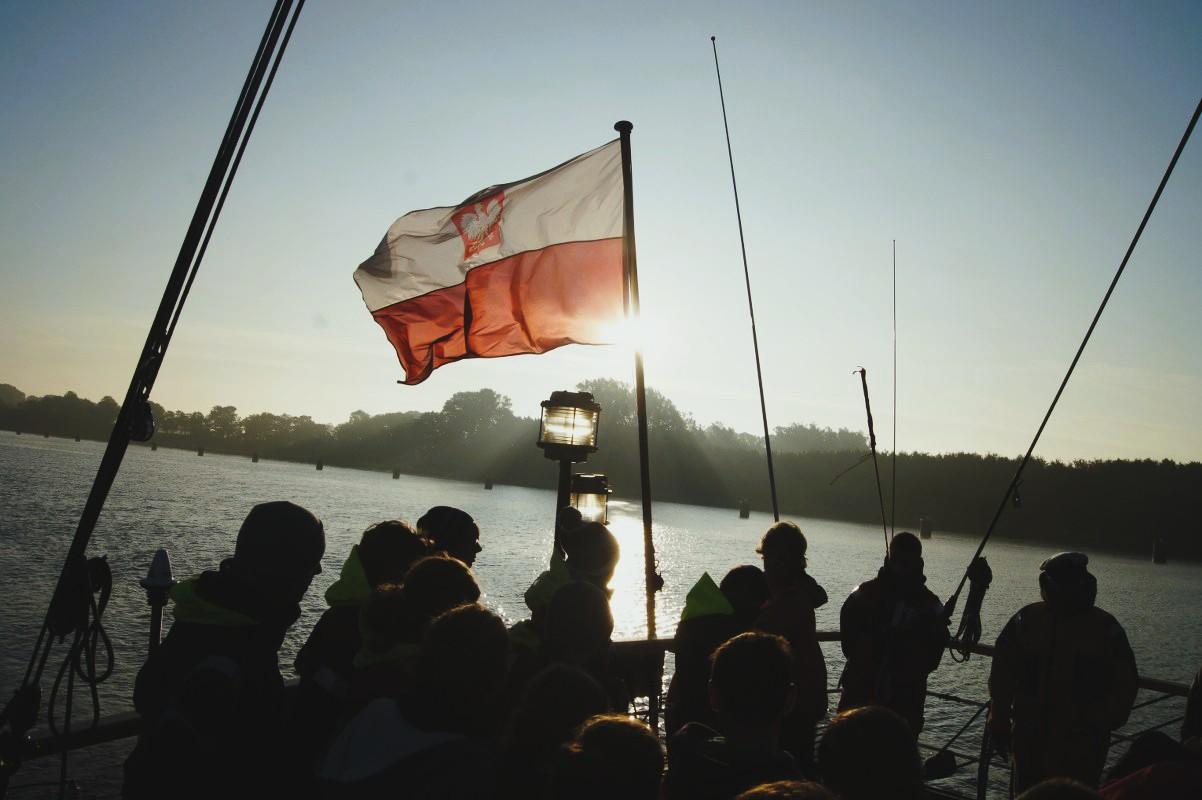
fot. Zbigniew Bosek / Wikimedia
Only successive “Polish” ships sailing under foreign flags—most recently the new ferry Jantar Unity—have reignited a debate whose essence has remained unchanged for more than two decades: why does a maritime state no longer have a meaningful merchant fleet under its own flag?
What the Polish flag problem really is
The problem of the Polish flag is not a lack of ships, nor a lack of shipowners. Polish shipping companies do operate vessels. Polish seafarers work at sea. Polish ports handle growing volumes of cargo. Yet most of this activity takes place outside the Polish legal, tax, and social security system.
Ships are owned by Polish companies, often crewed by Polish seafarers, trading to and from Polish ports, but formally registered under foreign jurisdictions. The reason has been clear for years: operating under the Polish flag has been more expensive, more complex, and less predictable than under many other flags.
High labour costs, rigid employment rules, outdated social insurance regulations unsuited to maritime work, and lengthy, bureaucratic registration procedures turned the Polish flag from an asset into a liability. In a global industry where margins are tight and mobility is key, the outcome was inevitable.
2004 as the moment Poland lost its fleet under national jurisdiction
The year 2004 occupies a special place in Poland’s modern history. It marked the country’s accession to the European Union—a return to Europe, a civilisational milestone, and the promise of economic modernisation. Poland opened itself to the continent politically, economically, and infrastructurally.
But that same year has another, less celebrated meaning. Almost unnoticed, Poland gave up the sea.
In 2004, the last vessel of Poland’s largest shipowner, Polska Żegluga Morska (PŻM), was reflagged. From that moment on, the largest Polish-controlled merchant fleet ceased to operate under Polish jurisdiction. Not because the European Union required it, but because the Polish state failed—or refused—to adapt its regulatory framework to the realities of European and global shipping.
The symbolism is striking. On the one hand, Poland entered Europe. On the other, it handed its sea over to Europe—abandoning its own flag, its own legal authority, and its own instruments of influence in an area that for decades had been a pillar of Poland’s international economic presence.
Since then, the sea has been treated in Polish policy mainly as infrastructure: ports, fairways, terminals, throughput. What is missing is sovereignty at sea. And a state that cannot connect land and sea into a coherent system of interests ultimately limits itself.
The sea does not tolerate indifference. Reaching it is not enough—you must also understand and respect it. Those who do not respect the sea do not truly deserve it, even if they have access to it.
The scale of the problem: numbers that leave no doubt
Today, only a handful of larger merchant vessels operate under the Polish flag, while fleets controlled by Polish shipowners are many times larger. The vast majority of these ships are registered under foreign flags—both non-EU flags of convenience and EU flags offering more competitive conditions.
The consequences are measurable. Billions of złoty each year in taxes, fees, social contributions, and maritime services flow into foreign budgets. Poland loses revenue—but also something far harder to rebuild: competence, influence, and strategic agency at sea.
Jantar Unity: a new ship, the same old problem
The entry into service of the modern ferry Jantar Unity once again sparked public debate about the Polish flag. Built for a Polish operator and intended to serve routes from Polish ports, the vessel was nevertheless registered under a foreign flag.
This was not a precedent. But it became a symbol.
If even today—despite full awareness of the problem and amid official declarations of reform—a brand-new vessel ends up in a foreign register, the message is clear: the system still does not give shipowners sufficient reasons to choose the Polish flag. The controversy surrounding Jantar Unity is not about one ship; it is about decades of ineffective policy.
Why this is more than a matter of prestige
The absence of a merchant fleet under the national flag is not a branding issue. It is a matter of state security, supply-chain resilience, and crisis-response capability. A state without a fleet under its own jurisdiction becomes dependent on decisions taken by foreign administrations in times of geopolitical tension.
There is also a social dimension. Polish seafarers work largely outside the national system of taxation and social security. Maritime education loses its natural backbone in the form of a national fleet. Without it, maintaining long-term maritime competencies becomes increasingly difficult.
A belated course correction: will this time be different?
The announced legislation aimed at supporting shipping companies and creating conditions for operating under the Polish flag (the so-called UD79 bill) represents the first serious attempt in many years to address the issue systemically. Lower taxes, reduced labour costs, and simplified ship registration directly target the barriers that have driven vessels away from the Polish register.
Deputy infrastructure minister Arkadiusz Marchewka has stated openly that, after more than twenty years, the government wants to bring the white-and-red flag back to Polish ships. It is an important declaration. But the market will believe it only when it sees actual vessels returning to the Polish flag—and remaining there.
The Polish flag as a test of a maritime state
The return of the Polish flag to the sea will be a test of the state’s maturity. A test of whether maritime policy is treated strategically rather than merely as infrastructure policy. A test of whether Poland understands that a merchant fleet is not a relic of the past, but a component of modern economic sovereignty.
After twenty years of drift, a chance to change course has finally appeared. The sea grants second chances only to those who truly know where they are heading.
see also
Buy us a coffee, and we’ll invest in great maritime journalism! Support Gazeta Morska and help us sail forward – click here!
Kamil Kusier
redaktor naczelny
comments
Add the first comment
see also
Austal partners with Damen for local construction of LST 100 for Australian Army
The submarine contract of the decade? Canada weighs South Korea against Germany
Bechtel signs contract with Doraco for Poland’s first nuclear power plant
When two powers clash, Poland must be ready to act. Military security must be the priority
MON, Arka Gdynia and AMW sign letter of intent supporting "Green Industrial District - Kashubia" project
Mine countermeasure vessel Jaskółka begins sea acceptance trials
PEJ relocates headquarters to Pomerania. A strategic step in Poland’s nuclear power development
Radmor hosts delegation from the Republic of Turkey. Advancing maritime security cooperation
3D-printed catamaran: robotic manufacturing sets course for the future of small craft
Navantia and Fincantieri deepen cooperation on the european patrol corvette programme
ADVERTISEMENT
ADVERTISEMENT