









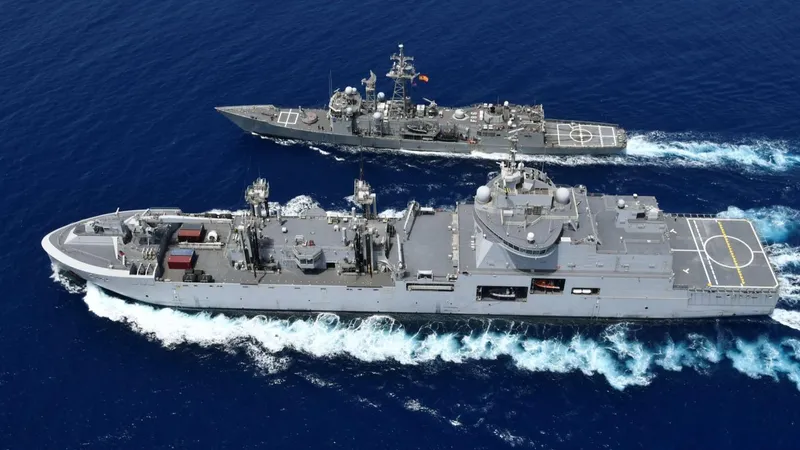
Spanish and French naval units conduct RAS operation during Operation Atalanta mission
Naval assets deployed under Operation Atalanta continue to operate in the Indian Ocean, maintaining a persistent presence in piracy-prone waters. At-sea replenishment (RAS) procedures remain a key enabler of sustained maritime operations, allowing vessels to remain on station for extended periods without returning to port.
In brief
The Spanish frigate ESPS Canarias carried out a replenishment at sea manoeuvre in the Indian Ocean region with the French logistics support ship Jacques Chevallier. The operation covered fuel replenishment and a check of interoperability procedures between allied vessels. Operation Atalanta, conducted by the European Union since 2008, protects merchant shipping and escorts humanitarian shipments of the UN World Food Programme. Replenishment at sea capability allows Operation Atalanta ships to remain in the area without calling at ports.
Logistics supporting operational endurance
During a recent replenishment-at-sea manoeuvre, the Spanish Navy frigate ESPS Canarias conducted a refuelling operation with the French Navy logistics support ship Jacques Chevallier. The evolution included fuel transfer and the validation of interoperability procedures between EU naval units.
Officials involved in the mission underline that at-sea replenishment remains a critical capability for sustaining long-duration deployments in high-risk maritime environments.
Sustained presence in a strategic maritime region
Launched in 2008, Operation Atalanta is the European Union’s counter-piracy mission tasked with protecting commercial shipping and safeguarding humanitarian aid deliveries by the World Food Programme.
Although incidents of piracy have decreased compared to peak levels, the Horn of Africa and adjacent sea lanes continue to require constant maritime surveillance and deterrence operations.
European naval interoperability
The coordinated activity between Spanish and French naval forces highlights the growing interoperability of European maritime assets. RAS operations are among the most complex naval logistics procedures, requiring precise navigation, speed stability and close coordination between bridge teams and deck crews of both vessels.
Source: Gazeta Morska · Compiled by: Kamil Kusier
Related articles
 Safety and rescue Polish SAR’s new rescue vessel Mistral launched at Kewatec in Finland
 Safety and rescue Icelandic Coast Guard and police delegation visits Polish Border Guard’s Maritime Division
 Safety and rescue Polish Navy helicopter evacuates man from Baltic platform 100 km off Władysławowo
 Navy and defence SNMG2 joins Allied warships in PASSEX as Italy's Mare Aperto 2026 gets under way
 Safety and rescue From lightships to solar power: 160 years of the Grundkallen light station
 Education 254 people, manikins and life rafts: Maritime University of Szczecin joins national CPR record attempt
Comments (0)
The discussion is moderated by the editors: a comment appears after review. Your e-mail address is not published.
Nobody has commented on this article yet.