Shipbuilding industry is awesome. Marcin Ryngwelski on active and passive stabilizers
Roll motion cannot be eliminated, because it results directly from how the hull interacts with wind and waves. However, it can be significantly reduced. Properly integrated stabilizers allow a vessel to maintain operational capability and comfort in a seaway. Marcin Ryngwelski, CEO of PGZ Naval Shipyard, explains how stabilizers work and why their installation is structurally and technologically demanding.
business education maritime economy work at mare shipbuilding industry shipbuilding industry is awesome equipment and technology news10 november 2025 | 09:18 | Source: Gazeta Morska | Prepared by: Kamil Kusier | Print
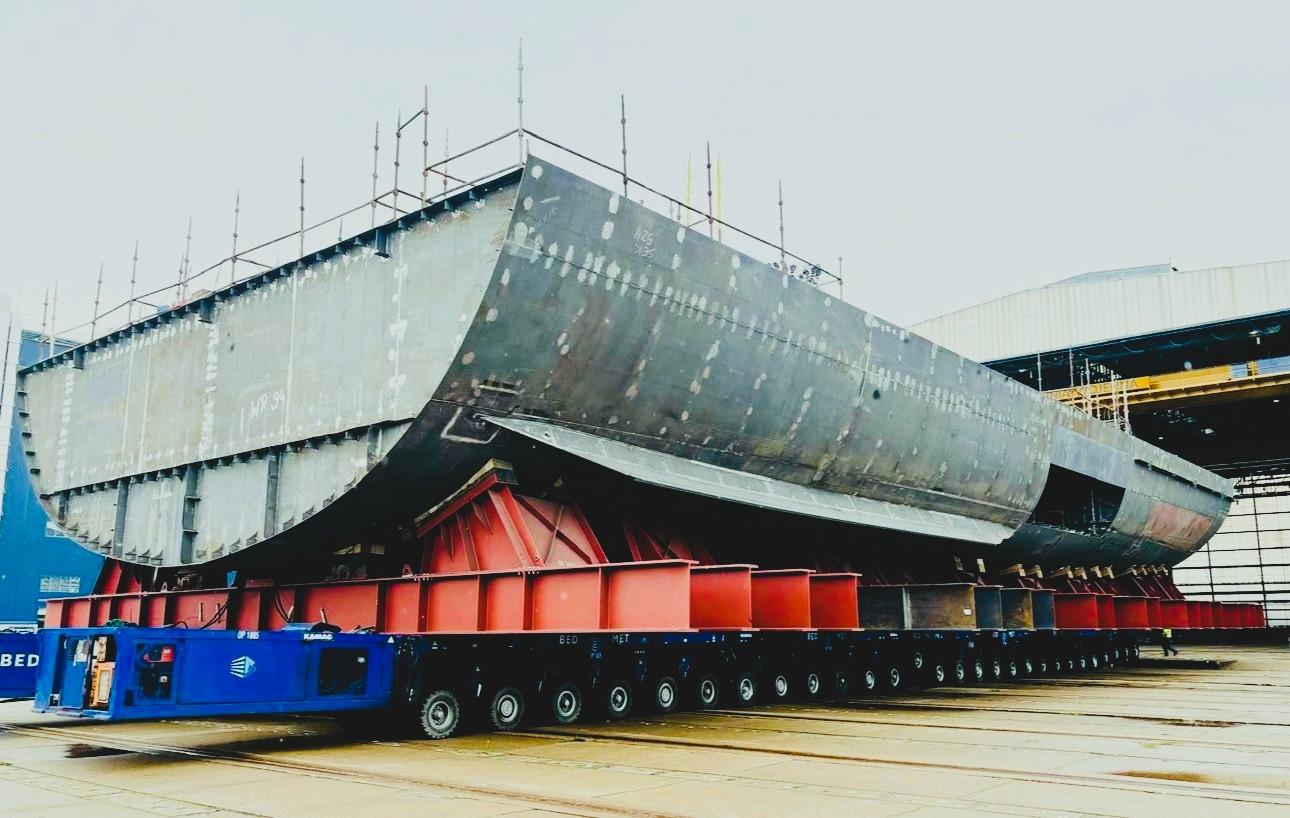
fot. Marcin Ryngwelski / PGZ Stocznia Wojenna
Roll motion as a design consideration
- Every vessel will roll. This is a natural hydrodynamic response, says Ryngwelski.
Roll is the rotation of the hull around its longitudinal axis and depends on hull form, weight distribution and metacentric height. The engineering goal is not to remove roll entirely but to limit its amplitude and rate.
Why stabilizers must be planned early
Stabilizers influence hull geometry, internal layout and system routing.
- A stabilizer has to be included already in the design phase. The intended operating waters and mission decide which solution is suitable. A frigate operating in the North Atlantic and a passenger vessel in the Mediterranean will have different requirements, notes Ryngwelski.
Passive vs. active systems
| System | Key features |
|---|---|
| Passive stabilizers | Use hydrodynamic resistance or fluid movement; examples include bilge keels and anti-roll tanks. No active control required. |
| Active stabilizers | Use powered actuation to counter roll in real time. The most common are fin stabilizers, positioned below the waterline and controlled automatically. |
Fin stabilizers — precision work below the waterline
Fin stabilizers are usually placed amidships. Their installation requires hull cutouts, structural reinforcement and watertight integration.
-The tolerances are in millimeters. Welding below the waterline must meet the highest strength and watertightness standards. It requires specialized teams who perform this type of work regularly, Ryngwelski explains.
Integration includes:
- hydraulic or electromechanical actuation,
- electrical power and control connections,
- gyro-based control logic and calibration.
Every step is documented and verified by the classification society.
Performance verification
Expected roll behavior is often tested before ship construction, including model basin tests at the Ship Design and Research Centre in Gdańsk.
After installation, stabilizers undergo:
- harbour acceptance tests (HAT),
- sea acceptance trials (SAT).
- Sea trials confirm that stabilizers deliver the expected performance in real sea conditions.
Stabilizers do not eliminate roll but manage it effectively. Their performance results from coordinated naval architecture, precision hull fabrication and controlled testing.
see also
Buy us a coffee, and we’ll invest in great maritime journalism! Support Gazeta Morska and help us sail forward – click here!
Kamil Kusier
redaktor naczelny
comments
Add the first comment
see also
Austal partners with Damen for local construction of LST 100 for Australian Army
The submarine contract of the decade? Canada weighs South Korea against Germany
Bechtel signs contract with Doraco for Poland’s first nuclear power plant
When two powers clash, Poland must be ready to act. Military security must be the priority
MON, Arka Gdynia and AMW sign letter of intent supporting "Green Industrial District - Kashubia" project
Mine countermeasure vessel Jaskółka begins sea acceptance trials
PEJ relocates headquarters to Pomerania. A strategic step in Poland’s nuclear power development
Radmor hosts delegation from the Republic of Turkey. Advancing maritime security cooperation
3D-printed catamaran: robotic manufacturing sets course for the future of small craft
Navantia and Fincantieri deepen cooperation on the european patrol corvette programme
ADVERTISEMENT
ADVERTISEMENT