









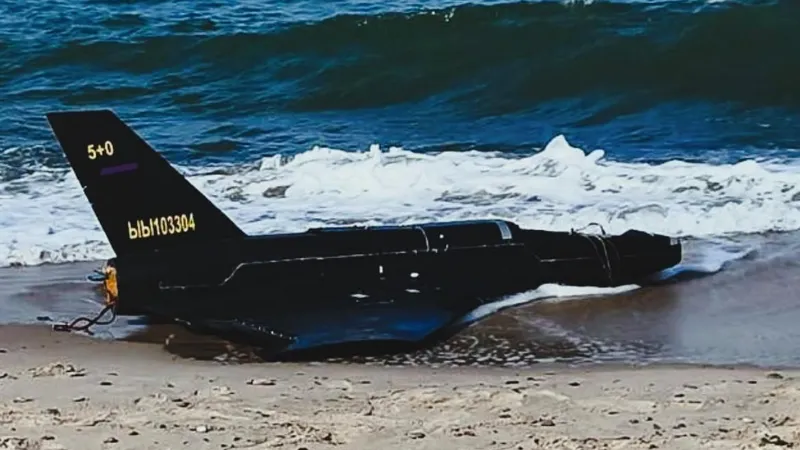
Russian drone on a beach near Jarosławiec. Gerbera recovered from the Baltic by a naval survey boat
The Polish military has recovered from the Baltic an unmanned aircraft found on Monday on the beach at Rusinowo near Jarosławiec, in West Pomerania. According to initial inspection it is a Russian-made military drone, most likely a Gerbera. The object was lying at the waterline and was pulled from the sea by a military hydrographic boat. The site is secured by the Military Police and the drone is to be examined by bomb disposal specialists.
In brief
A military hydrographic boat retrieved from the Baltic Sea a Russian drone, most likely of the Gerbera type, found on Monday on the beach in Rusinowo near Jarosławiec in West Pomeranian province. A walker reported the find, and an initial 100-metre safety zone was set up around the object, which the police wanted to extend to 300 metres. Military Police are securing the site and sappers are to examine the drone, Operational Command spokesman Lieutenant Colonel Jacek Goryszewski said. Deputy defence minister Cezary Tomczyk told the Sejm that everything points to the drone's Russian origin.
The incident was announced on X by Władysław Kosiniak-Kamysz, Deputy Prime Minister and Minister of National Defence. He wrote that the military had located and recovered a drone from the Baltic near the beach at Rusinowo, that initial inspection pointed to a military unmanned aircraft originating from Russia, and that services were securing the scene and the recovered equipment.
Reported by a walker, 100-metre cordon
The find was reported by a person walking along the beach. An initial 100-metre safety zone was set up around the drone, which police wanted to extend to 300 metres, because nobody on the spot knew whether it was a training aircraft or a combat drone carrying a warhead. Alongside the police, the Border Guard, the Military Police and representatives of the Maritime Office in Słupsk arrived at the beach.
Lieutenant Colonel Jacek Goryszewski, spokesman for the Operational Command of the Polish Armed Forces, said the drone had been lifted from the water by a military hydrographic boat and that once the Military Police had secured the area, bomb disposal specialists would take over. Lieutenant Colonel Dariusz Rozkosz, spokesman for the Commander of the Military Police, stressed that all relevant services were on site and that the first task was to establish how safe the object was.
Gerbera, a cheap decoy of plywood and foam
The Operational Command indicated that the aircraft is most likely a Gerbera, one of the most widely used Russian drones in the war against Ukraine. It resembles the Iranian Shahed-136 in appearance but is far cheaper: the airframe is made partly of foam and plywood, allowing fast mass production. Most Gerberas are decoys intended to confuse and overload air defences, but some can carry a warhead or reconnaissance equipment. That is why every such object is treated as potentially dangerous until cleared by specialists.
Deputy Defence Minister Cezary Tomczyk, asked in the Sejm, said everything pointed to Russian origin and that the drone would be handed over to the services for examination in line with procedures. Cezary Tomczyk added that in terms of hybrid and surveillance activity, Poland is today in many respects target number one.
Between the Ustka range and the Darłowo air base
From a military point of view the location is not random. Jarosławiec lies between the Central Air Force Training Range at Ustka and the naval air base at Darłowo, on a stretch of coast where exercises involving missiles and aircraft are held regularly. That is why the first reports from the beach said it was unclear whether the drone was a training or a combat aircraft.
Polish media note that this is the first time a Russian drone has been found so deep inside Polish territory, on the central coast, far from the borders with Belarus and the Kaliningrad exclave. It is not yet known when or from where the drone flew, nor whether it came down in the sea near Rusinowo or was washed ashore after a longer drift. The Morze.org portal points out that until the examination is complete there is no absolute certainty about the object's origin and that in conditions of hybrid warfare it is worth sticking to the facts.
Similar finds have been reported in recent weeks on Black Sea beaches in Romania and Bulgaria. An object washed up on a beach in Liepāja, Latvia, turned out to be an air defence training target rather than a Russian drone, a reminder of how carefully initial reports need to be treated.
Source: Gazeta Morska · Compiled by: Kamil Kusier
Related articles
 Safety and rescue Polish SAR’s new rescue vessel Mistral launched at Kewatec in Finland
 Safety and rescue Icelandic Coast Guard and police delegation visits Polish Border Guard’s Maritime Division
 Safety and rescue Polish Navy helicopter evacuates man from Baltic platform 100 km off Władysławowo
 Navy and defence SNMG2 joins Allied warships in PASSEX as Italy's Mare Aperto 2026 gets under way
 Safety and rescue From lightships to solar power: 160 years of the Grundkallen light station
 Education 254 people, manikins and life rafts: Maritime University of Szczecin joins national CPR record attempt
Comments (0)
The discussion is moderated by the editors: a comment appears after review. Your e-mail address is not published.
Nobody has commented on this article yet.