









Russia's navy heads out of the Mediterranean again. Tartus remains uncertain
After a spring attempt to rebuild a permanent presence at the Syrian port of Tartus, the Russian Navy once again appears to be heading out of the Mediterranean. Since the fall of the Assad regime, Moscow has lost reliable access to its only naval base outside the former USSR, and now holds on there mainly through port calls, deception and fragile logistics, while Ukrainian strikes reach ever further. The picture rests largely on open-source analysis.
In brief
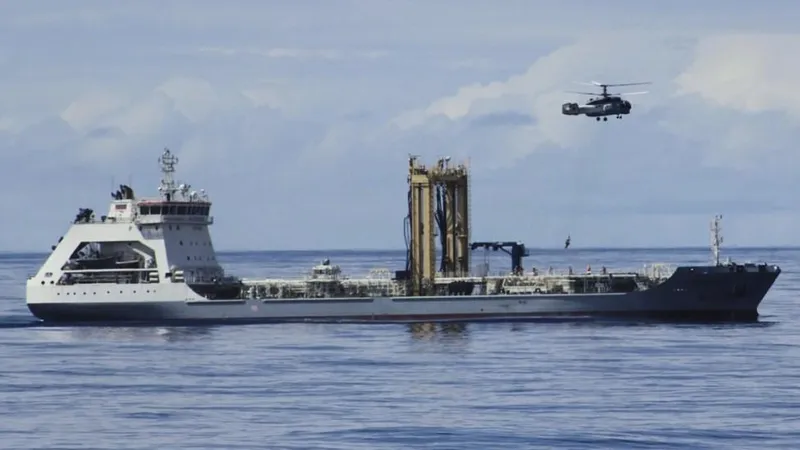
The Russian Navy is again withdrawing from the Mediterranean after a spring attempt to rebuild its presence in Tartus, Syria. A convoy with the frigate Admiral Kasatonov and the vessels General Skobelev, Sparta and Akademik Pashin passed through the English Channel on 18 April and the Strait of Gibraltar on 29 April, while the tanker General Skobelev spoofed its AIS signal, feigning presence in the Baltic. In images from 4 June the ships lay in Tartus behind a barrier against surface drones. The 2017 agreement gave Russia a 49-year free lease and the right to keep up to 11 warships, but after the fall of Assad in December 2024 the status of the base remains undecided.
A convoy to Tartus
This spring Russia sent a resupply convoy towards Syria, escorted by the Gorshkov-class frigate Admiral Kasatonov. It comprised three sanctioned vessels regularly used to move weapons and supplies: the product tanker General Skobelev, the ro-ro carrier Sparta and the oiler Akademik Pashin. The convoy passed through the English Channel on 18 April and the Strait of Gibraltar on 29 April, and although it declared Port Said as its destination, it was bound for Tartus. The General Skobelev meanwhile spoofed its AIS signal, pretending it was still in the Baltic. The cargo suggested that a permanent presence at Tartus was being restocked.
Tartus under a Ukrainian shadow
In imagery from 4 June, the Admiral Kasatonov and Akademik Pashin lay at Tartus behind an anti-sea-drone barrier that was not needed a year earlier. Analysts also spotted Raptor boats and a Project 21980 Grachonok anti-saboteur craft nearby. That shows how seriously the threat from Ukraine's long-range strike programme is taken, but it also lends weight to reports of an attempt to re-establish a permanent presence. At the same time, both warships now appear to be heading back west. If they make for Gibraltar and then Admiral Kasatonov's home port of Severomorsk, the Akademik Pashin may refuel the frigate Admiral Grigorovich along the way, which is loitering in the English Channel, apparently running low on fuel.
From a base to port calls
Tartus was Russia's only naval base outside the former USSR. Under a 2017 agreement Russia held a 49-year, rent-free lease there and the right to keep up to 11 ships, including nuclear-armed ones. The fall of Assad in December 2024 changed everything: the Russian Navy withdrew from the base by early 2025, and the new authorities in Damascus remain ambivalent. Although after an October meeting with Putin the Syrian side said it respected earlier agreements, the status of the base is still unresolved. For months the only Russian warship in the Mediterranean was the corvette Stoykiy, which, after an odd voyage around Africa and exercises off Cape Town, stayed off the Syrian coast rather than heading home. Russian arrivals at Tartus now look more like port calls than the exercise of basing rights. Moscow also leans on Algeria, though Algiers is unlikely to grant a permanent base. For Syria, Russia remains the main oil supplier: deliveries rose 75% in 2026, to around 60,000 barrels a day.
Why it matters in the Baltic
Tartus is a warm-water port from which Russia can project power onto NATO's southern flank, into Africa and the Middle East, including Libya. Its loss, or uncertain status, weakens Russia's reach across the Mediterranean. The Baltic dimension, however, is tangible: the weapons-carrying convoys and Baltic Fleet amphibious ships set out from the Baltic and pass NATO's northern flank on their way to Syria, while tankers spoofing their AIS, like the General Skobelev feigning a presence in the Baltic, draw on the same playbook of deception as Russia's shadow fleet. For Poland and NATO, that means Russia's Mediterranean retreat does not reduce the risk in the Baltic, but shifts where the effort is concentrated, and the same methods turn up right on our doorstep.
Source: Gazeta Morska · Compiled by: Kamil Kusier
Related articles
 Safety and rescue Polish SAR’s new rescue vessel Mistral launched at Kewatec in Finland
 Safety and rescue Icelandic Coast Guard and police delegation visits Polish Border Guard’s Maritime Division
 Safety and rescue Polish Navy helicopter evacuates man from Baltic platform 100 km off Władysławowo
 Navy and defence SNMG2 joins Allied warships in PASSEX as Italy's Mare Aperto 2026 gets under way
 Safety and rescue From lightships to solar power: 160 years of the Grundkallen light station
 Education 254 people, manikins and life rafts: Maritime University of Szczecin joins national CPR record attempt
Comments (0)
The discussion is moderated by the editors: a comment appears after review. Your e-mail address is not published.
Nobody has commented on this article yet.