









Ramspol inflatable storm surge barrier proves its efficiency - a blueprint for future flood protection systems
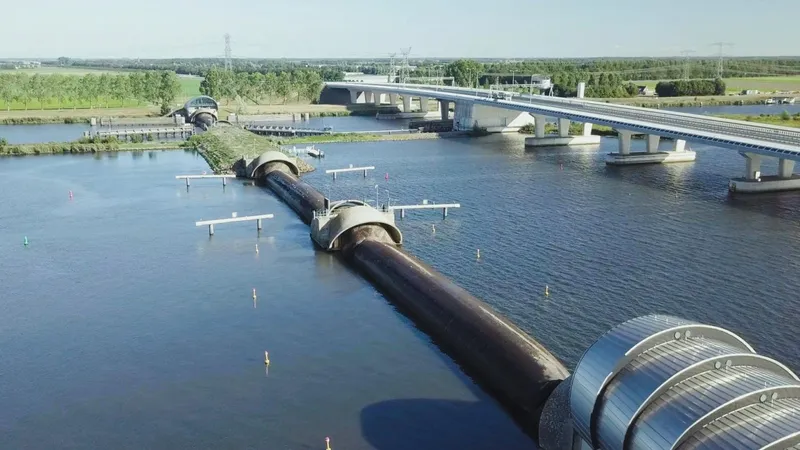
The recent functional test of the Ramspol inflatable storm surge barrier in the Netherlands has once again confirmed the reliability of this unique flood defence system. Unlike conventional static structures, Ramspolkering activates only when water levels pose a real threat, offering protection without permanently altering the hydraulic landscape.
In brief
The Dutch Ramspol barrier has successfully passed a periodic test of its inflatable balgstuw system, regarded as unique worldwide. The Ramspol structure consists of three rubber bladders into which 3.5 million litres of air and 3.5 million litres of water are pumped, forming a barrier about 10 metres high and 240 metres long. Once the threat subsides, the bladders sink into a concrete trough below the water surface, restoring navigation. Possible locations in Poland include the lower Vistula from Tczew to the river mouth, the Szczecin Lagoon area, the lower Oder and the Żerański Canal.
This balgstuw-type barrier, the only one of its kind in operational use worldwide, demonstrates a shift in modern water management philosophy: flexibility over rigidity, adaptability over permanent intervention.
Engineering that stays invisible – until it’s needed
The Ramspol system consists of three reinforced rubber membranes that remain submerged in a concrete chamber under normal conditions. When triggered by rising water levels:
- 3.5 million litres of air and 3.5 million litres of water are injected into the membranes,
- A flood barrier of approximately 10 metres in height and 240 metres in length emerges across the channel,
- The surge flow is temporarily halted, buying critical time for coastal defence systems and emergency coordination.
Once the danger subsides, the membranes deflate and retract below the waterline, leaving the waterway fully navigable and visually unobstructed.
A solution that avoids land-use conflicts
Across Europe – and increasingly in Poland – traditional flood control infrastructure such as dikes, retention reservoirs or dry polders often face public resistance and environmental scrutiny. Communities object to land expropriation, permanent visual barriers or ecological disturbance.
Inflatable storm barriers offer a third way:
- no permanent occupation of agricultural or recreational land,
- no need for large-scale landscape transformation,
- deployment limited to actual flood events, not year-round infrastructure presence.
In flood-sensitive regions where negotiations over land use stall hydrotechnical projects, systems like Ramspol could provide an accepted compromise between safety and territorial continuity.
Opportunity areas beyond the Netherlands
The potential for implementing similar inflatable flood barriers is significant in several high-risk, high-conflict water zones in Central and Eastern Europe. In Poland, potential application sites could include:
- lower Vistula Delta (Żuławy region) – where Baltic storm surges regularly threaten low-lying agricultural lands,
- Szczecin Lagoon and Oder estuary approaches – prone to backflow from wind-driven surges,
- urban waterways of Warsaw – including the Żerański Canal corridors, facing rapid water level spikes during flood waves,
- Warta and Noteć floodplains – where space for permanent retention infrastructure is limited and socially contested.
Here, a deployable barrier system could protect infrastructure and farmland without imposing irreversible changes on the local environment.
Engineering compromise: temporary strength, permanent security
Ramspolkering illustrates a forward-looking model in coastal and inland flood defence – one that separates hydraulic performance from physical permanence.
Strategic advantages include:
- full navigational clearance outside activation periods,
- reduced environmental footprint and visual impact,
- compatibility with automated water level monitoring systems, allowing autonomous deployment,
- increased public acceptance, particularly in areas where classic hydraulic infrastructure faces social resistance.
From heavy infrastructure to smart intervention
The success of the Ramspol test raises an important strategic question for European water management agencies:
Are we ready to transition from massive, static flood defence systems to intelligent, on-demand water management technologies?
With climate volatility amplifying the frequency of sudden surge events, elastic infrastructure models – deployable, reversible and sensor-driven – may soon become standard in flood-prone territories. Ramspolkering is more than a barrier. It is a proof of concept for adaptive flood defence, where engineering precision meets territorial neutrality.
Source: Gazeta Morska · Compiled by: Kamil Kusier
Related articles
 Safety and rescue Polish SAR’s new rescue vessel Mistral launched at Kewatec in Finland
 Safety and rescue Icelandic Coast Guard and police delegation visits Polish Border Guard’s Maritime Division
 Safety and rescue Polish Navy helicopter evacuates man from Baltic platform 100 km off Władysławowo
 Navy and defence SNMG2 joins Allied warships in PASSEX as Italy's Mare Aperto 2026 gets under way
 Safety and rescue From lightships to solar power: 160 years of the Grundkallen light station
 Education 254 people, manikins and life rafts: Maritime University of Szczecin joins national CPR record attempt
Comments (0)
The discussion is moderated by the editors: a comment appears after review. Your e-mail address is not published.
Nobody has commented on this article yet.